Archive for February, 2010

h1

South Asian Smart Power – Aman ki Asha

February 26, 2010
Futility of Military/Economically Motivated relations Minus Democratic Input

Futility of Military Motivated relations Minus Democratic Input

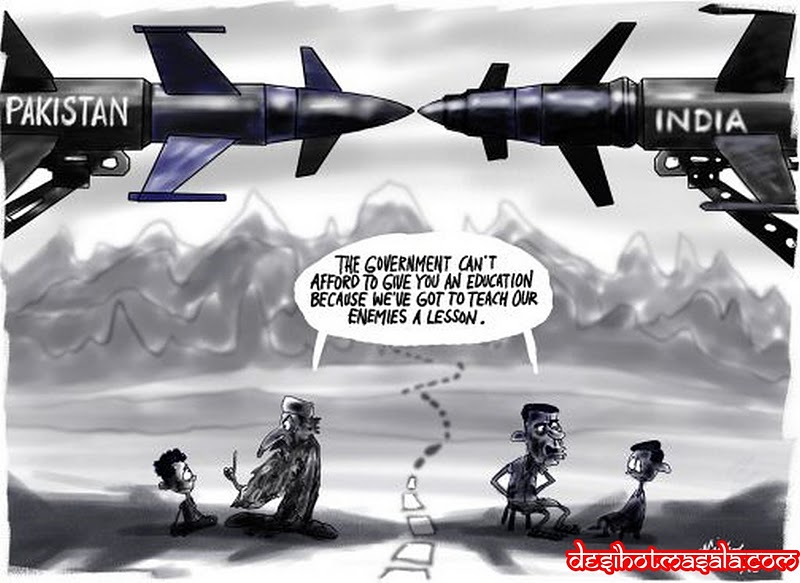
While working in D.C. some years back almost every Congress person, Think Tank and academic I came across was certain on one thing on nuclear proliferation: if an atomic bomb ever goes off again, it’s going to happen in South Asia. It was a dismal but resounding notion that I have even heard expressed amongst South Asians. Profound mistrust, three wars, land disputes, all spurred by a gory colonial partition 60 odd years ago has left Pakistan and India scarred in a way that makes cynics of even the best of us.

A realist might tell you that nuclear armed neighbors by way of deterrence have allowed India and Pakistan to refrain from war since testing their atom bombs, but even they would conclude war is inevitable. Liberals would make a case for enhanced trade to gradually spur economic interdependence to help avoid conflict, which is perhaps the most palatable idea, but statistics show that deepening trade between India and Pakistan has not yet improved relations:

“trade between India and Pakistan was at its highest ever in the year following Kargil. 

Even the Mumbai attacks have not significantly dented India-Pakistan trade relations. Pakistan trades with 100’s of countries, India being the 9th largest trading partner”

So if deepening trade and deterrence haven’t yielded what confidently could be considered lasting peace, what will it take? I’m of the opinion that realist and liberalist policies must be accompanied by ground level, macro scale diplomacy.  Because while deterrence satisfies the all mighty military institutions, and trade satisfies highly influential business elites there’s little attention given to the masses; and by masses I mean billions of South Asians who have yet to even fathom peace as a possibility.

Call it ground level diplomacy, soft power or good ol’ winning hearts and minds: it’s  the missing ingredient in bilateral relations. Resident Indian’s and Pakistani’s have a perceived animosity for one another that verges on the irrational. Catapulting cricket matches between both countries as akin to war, hate crimes against Muslims in India to cross border terrorism is absurd for states divided by man made, post colonial borders.

So the problem is not one of trade, or military might: it’s epistemic. Both countries must engage one another from the ground up. Shashi Tharoor, the decorated Indian Parliamentarian described the effectiveness of Indian soft power best at a TED conference last year:

“India’s soft power, its true of music, dance of arts, yoga, aryuveda, even cuisine. With these examples come the sense that in todays world its not the side of the bigger army that wins, it’s the one that tells a better story. And india is the land of a better story. Stereotypes are changing.  Today people in Silicon valley people talk of IIT’s with same reverence of MIT”

Why not apply that soft power in Pakistan? And vice versa. I laud the Aman ki Asha initiative for doing exactly this. Launched by Pakistani media conglomerate Geo T.V. and on the Indian side, the Times of India, both companies have taken up the task of engaging both countries using soft power. As media houses, through television, print and web placements, they engage masses directly, finally sidestepping politically or economically motivated discourse both countries are used to. THeir mission statement reads:

Public opinion is far too potent a force to be left in the hands of narrow vested interests. The people of today must find its voice and force the rulers to listen. The awaam must write its own placards and fashion its own slogans. The leaders must learn to be led and not blindly followed. Skepticism about the given is often the genesis of faith. This skepticism has been brewing. It can be unleashed to forge a new social compact between the people of this region. A social compact based on a simple yet powerful impulse – Aman ki Asha. A desire for peace.

Aman ki Asha taps the widespread but underrepresented sentiments of commonality shared by South Asians. By engaging the masses directly with soft power it’s is a brilliant first step at mitigating the most potent problem in bilateral relations: mistrust. And what is most brilliant about the initiative is that could have teeth. Unlike countless other proposals for peace, Aman ki Asha uses mass media to speak to masses directly with a specifically outlined agenda:

“Issues of trade and commerce, of investments, of financial infrastructure, of cultural exchanges, of religious and medical tourism, of free movement of ideas, of visa regimes, of sporting ties, of connectivity, of reviving existing routes, of market access, of separated families, of the plight of prisoners, will be part of our initial agenda. Through debates, discussions and the telling of stories we will find commonalities and space, for compromise and adjustment, on matters that have bedevilled relations for over 60 years”

It sounds promising, because although I do not anticipate this dissemination of smart power to yield results immediately, if it’s done consistently it might have a capacity to democratize the push for peace. It ought not to be the military, or economic institutions setting the agenda, rather, policies should reflect the will of the people. Aman ki Asha is a hugely cooperative step in bilateral ties. More peaceful relations in South Asia can begin by reminding the masses of what my Pakistani born and raised mother said when she came back from a trip to India in 2005 they (Indians) eat the same food, sound the same, act and even look the same as us”. With such strong commonality felt amongst everyday people, one questions the legitimacy of policymaking that has historically divided, rather than united South Asians. And if that sentiment disseminates, albeit gradually, there’s much to hope for in the future.

ORIGINALLY PUBLISHED @

h1

Joe Biden’s Biggest “Concern”

February 13, 2010
Joe Biden Says Pakistan is a BIgger Concern than Afghanistan

Joe Biden Says Pakistan is a BIgger Concern than Afghanistan

Vice President Biden was on Larry King this week slating Pakistan as America’s larger concern than Afghanistan. He explained “Pakistan is a big country…has nuclear weapons that are able to be deployed and has a real significant minority of radicalized population and a not complete functional democracy in the sense we think about it” . Which sounds tremendously pressing and makes for catchy prime time television, but let’s delve into his rationale one by one, and assess his concerns.

Pakistan is certainly “a big country” with a “real significant minority of radicalized population” and the Vice President is dead on with this issue. Among the top ten largest countries in the world, Pakistan is still developing in a relatively underdeveloped region, and houses one of the largest refugee problems on earth. So even a minority of radicalized militants is enough to wreck havok on Pakistan, as it has been. And likewise, that minority population single handedly deters our fight in fighting the war on Terror.

And this truly defines the Pakistan quagmire: dealing with extremist militants in an underdeveloped, politically volatile war zone.

Biden also said Pakistan “is not a completely functional democracy in the sense we think about it”, which is a statement of fact. However it’s a misplaced concern because it’s not necessarily a hindrance to our interests at this time. In our alliance with Pakistan Democrats have historically sided with civilian governments, while Republicans have preferred to deal with military regimes in Islamabad. So Biden’s issue with Pakistan’s brand democracy is an inherent tension that has existed in this alliance for decades.

It’s a cause of tension over the years because we’ve effectively dealt with Military regimes in the past, and other international players such as China, and India have also found it effective to deal with military led Pakistan. So Democrats like Vice President Biden insisting on American style democracy is not always necessary.

In a perfect world, our allies would have fully functioning democracies akin to ours, but the reality is our brand of governance is not easily applied in places like Pakistan.

Plus there’s a perceived arrogance that comes along with our leaders being critical of governments that function differently than ours. I think the Vice Presidents suggestion makes for a nice talking point on democracy for tv viewers, but offers no practical insight let alone a solution to Pakistan as our foremost concern.

Finally, the Vice President cited “vulnerabilities” regarding the safety of Pakistan’s nuclear weapons. Nuclear non proliferation is a bipartisan, and to a large extent, global cause of anxiety that few will argue against. But how realistic is a notion of Pakistan’s nuclear arsenal being vulnerable to non military or non state actors? It’s a nightmarish scenario that catapults Pakistan atop our immediate Foreign Policy agenda because the mere sliver of possibility proliferation could happen entails catastrophically high risks that no one is willing to take. But such alarming rhetoric doesn’t inform us of the likelihood of this happening. It just frieghtens us, deters diplomacy and ultimately undermines the U.S. Pakistani alliance. Such rhetoric, minus substantial evidence should be shared amongst policymakers and government officials pertinent to the situation. Otherwise, the rhetoric can be counter-productive in engaging allies like Pakistan.

Overall, the Vice President’s comments were consistent with the Obama Administration’s promises of an increasingly narrow focus on our Foreign Policy to Pakistan.

ORIGINALLY PUBLISHED @

h1

Welcoming the War – Drones in Pakistan — Part 3

February 11, 2010
Are the Drones Worth the Cost of Compromising Cooperation ?

Are the Drones Worth the Cost of Cooperation ?

Read Part 1 – Reconciling CIA Drones In Pakistan

Read Part 2  – Concessions & Collateral Damage

The most provocative piece I’ve seen on drones in Pakistan was published last week. Not the most detailed, well researched article (the New Yorker takes the cake so far) but certainly the most confrontational. Farhat Taj writes in the Daily Times that International media, including American and Pakistani reports critical of drone use are totally unfounded. Vehemently, Taj writes:

The people of Waziristan are suffering a brutal kind of occupation under the Taliban and al Qaeda. It is in this context that they would welcome anyone, Americans, Israelis, Indians or even the devil, to rid them of the Taliban and al Qaeda”

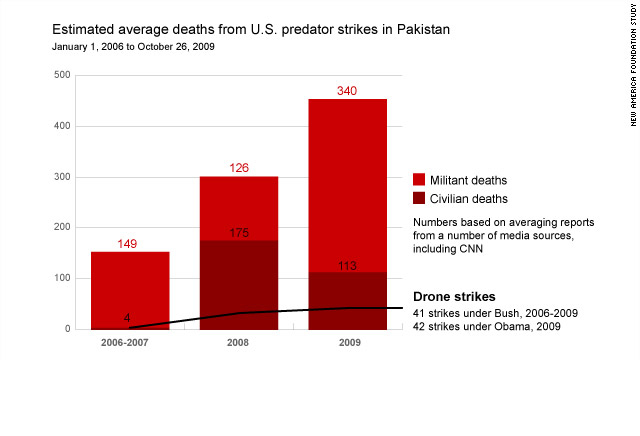
It’s a grand, almost inconceivable statement given that Anti Americanism is on a rapid rise and India / Pakistan are widely considered notorious Arch Nemesis in international relations today.  Taj says inhabitants of Waziristan actually “welcome” drone attacks and dismisses all accusations of civilian casualties as Taliban propaganda. Basing this on the idea that almost no media are allowed in the area, she concludes there is no verifiable evidence, and therefore no reason for concern of civilian casualties. But mere logic would indicate otherwise. Although surgical, drones are not so precise to as to obliterate one individual at a time. When they strike, the range of damage inflicted by any drone is bound to cause peripheral damage, destroying more than just a singular terrorist.

Taj also too vehemently dismisses the concern that drones infringe on Pakistan’s sovereignty. She says greater Pakistan is oblivious to the more pressing priority of wiping out Taliban. And while I agree the Taliban is inflicting profound, perpetual and grave damage on Waziristan, greater Pakistan’s perceptions are important and not to be overlooked so easily.

Waziristan is but a fraction of Pakistan. If the majority of Pakistani’s see drones as an infringement of sovereignty, future cooperation with strategically poised Pakistan can become difficult. The alliance is already waning and one of politics’ golden rules is: perceptions matter. Whether or not there are exact numbers of civilian casualties, Pakistani’s are strongly against unmanned aircraft dropping bombs in their territory. Regardless of circumstances, the perception of an alliance with America, and our War on Terror is endangered by the drones. Hence arguments that drones are counter productive.

At what cost are we using drones to wipe out a few key leaders from militant and extremist groups? Might we accomplish the same success in hunting down terrorists by employing Pakistani forces to take these guys out themeslves using close cooperation with our counter terrorism, intelligence and military operations?

Some already argue that Islamabad tacitly works with the United States on drones in the north, however, the official and public stance of the Pakistani government is of staunch disapproval of drones. It’s a fair argument because without Islamabad’s approval, the United States would be in violation of international law, and protocol in using drones in Waziristan minus Pakistsan’s approval. So I buy the argument that Islamabad works closely in using drones in the north. But the fact that the government goes to the extent of constantly assuring its public that they disapprove of drones on record, is testimony to how offensive the use of unmanned aircrafts are in Pakistan.

So while our heightened use of drones might be effective in obliterating key leaders from the Taliban ranks for success in the immediate term, the consequences of drones entail potentially riling further anti Americanism which could compromise our interests in the future.

Cooperation is key, and I’m not convinced increased use of drones will help us engage Pakistan in the future.

ORIGINALLY PUBLISHED @