Archive for May, 2010

h1

Unfair & Unlovely

May 28, 2010

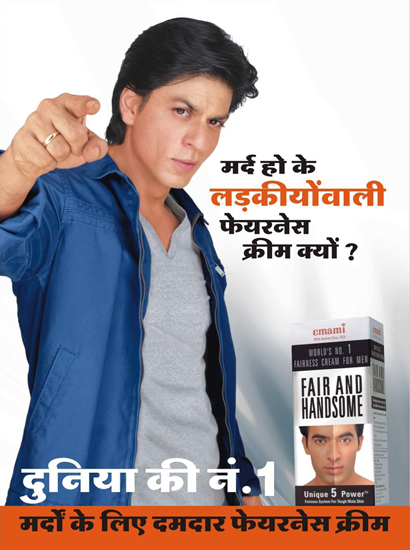
OMG Shahrukh Khan "Fair & Handsome" -  Seriously?

OMG Shahrukh Khan "Fair & Handsome" - Seriously?!

I’ve very intentionally avoided this subject despite its relevancy to South Asia, but it’s close to summertime and now that Shah Rukh Khan is involved it’s borderline political, so it’s within my jurisdiction.

“Fair and Lovely” face cream is so pervasive in “desi” culture that it’s a household name amongst both Resident and non Resident Pakistani’s. International diplomats, the United Nations, countless non profits have all failed to get India and Pakistan to agree on nukes, trade, cricket, religion (the list goes on) but when it comes to the primal issues of attraction, both have consistently been on the same page. Visit the Fair and Lovely website and you’re confronted with images of a woman’s face growing progressively lighter and the slogan: “Gorepan se kahin ziyada SAAF GORAPAN”  Translation: “Even more Whiteness than Whiteness”. I kid you not, that is an accurate translation literally and contextually speaking, and yes despite this, we are still in the 21’st Century.

So this week Shahrukh Khan’s face is seen promoting the creams male counterpart, “Fair and Handsome”. The Telegraph reports “despite doubts of the effectiveness, the sight of Khan’s chiseled features endorsing the cream has angered campaigners, who say it’s “racist” to promote lighter skin as superior”
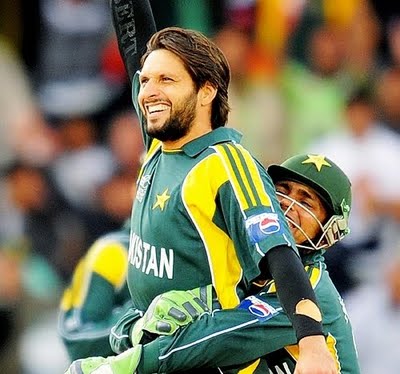
Shahid Afridi's Pretty Chiseled

Shahid Afridi's Pretty Chiseled

Alright, first off Shah Rukh Khan doesn’t from any angle I can see have “chiseled” features. Shahid Afridi is more chiseled than him. But, that’s besides the point and doesn’t invalidate the fact that billions of men and women around the world idolize Khan and find him very attractive, hence the lakhs of rupees I’m sure he’s receiving for this endorsement. But with such immense fame, comes responsibility and his endorsement of Fair & Handsome cream is justifiably being labeled “racist” by angry campaigners.

I grew up in California where girls lay out in the sunshine all summer to quite frankly, try and get skin like mine. When sunshine isn’t an option, they confine themselves into what are nothing shortof human frying pans, lids closed in tanning beds as they do their best to maintain my shade of golden brown all year long. So it’s no surprise that I love my mocha skin. Always have. I wouldn’t change it for anything. Tan skin is part and parcel of being a Californian. Just listen to Katy Perry or the Beach Boys. In this part of the world, tan has always been undeniably sexy.

Maria & Zainab - Perfect Beach tans ;)

Zainab & Maria - Perfect Beach tans

Which is why the angered campaigners in India are correct in denouncing the Shah Rukh Khan endorsement; it perpetuates an unhealthy, yes racist fascination with fair skin. The reason it’s racist while the the girls in California wallowing in tanning beds isn’t is because “Fair & Lovely” occurs in a post-colonial context. You’d think that as oppressed subjects having suffered and struggled to fight of massive injustices of colonialism until Partition wherein India severed itself into two as a result (the birth of Pakistan) looking like the oppressor would be unpopular. But instead fair skin is the ultimate desire in desi land, and it’s mind boggling because European skin tones are not naturally attainable in South Asia.

Sure evolutionary biology will tell you that humans are innately attracted to beautiful people. According to biologists, we’re attracted to relatively youthful characteristics because they’re indicative of heightened fertility (i.e. lustrous hair, hourglass figures, large eyes and clear skin) but a preference for skin color really is only skin deep. South Asians naturally have darker skin and there’s no reason it should be touted as inferior.

Out of chance I happened to have grown up in a particular part of the West that values darker skin, but had I lived in Pakistan I might not have been so lucky. It’s a sad realization, because skin color is not in our control, which is why it’s problematic when corporations like Fair and Lovely seize control in attempt to create preferences where none should exist. They’re preying on insecurities to peddle their products which is done by all advertisers, but this one goes too far because it’s racist.

Shame on Shah Rukh Khan for endorsing Fair & Handsome cream; it’s not a “fair” or “handsome” move on his part.  It’s Unfair and Ugly.

h1

Two Pakistans

May 20, 2010
Facbeook Banned in Pakistan - May 2010

Facbeook Banned in Pakistan - May 2010

There’s a notion of two distinct America’s; one that is conservative, mostly Republican Red and the other a more liberal Democratic Blue, and in a similar way I’ve seen two Pakistan’s.

Case in point : the Pakistan Telecommunications Authority severed access to the worlds largest social networking site this week when a Lawyers Association won a court injunction officially banning Facebook because of a page entitled “Post Drawings of Prophet Mohammad Day”.  As of now, the Pakistan government has added YouTube, and certain pages on Flickr and Wikipedia to the ban list which is either fueling vehement support of the ban (a conservative, we’ll say Red thing to do) and protests against Facebook or a eliciting a total opposite response “God save this country, lunatics are running it” (a more liberal, response we’ll label Blue).

The polarized views are reminiscent of our own democratic deliberations; strong demonstrations for (Red) and against (Blue) the legality of the Iraq invasion beginning in 2004, or protests against the passage of Proposition 8 (Blue) in California which outlawed same sex marriage in 2008 (Red).

So do such polar views necessarily indicate a distinctly Blue and Red America? I’ve never thought so, because overallAmerican’s tend to be far more centrist than our elected officials make us out to be in a two party system. Generally, Americans from California to New York and everywhere in between share basic social and cultural values; we watch the same shows, dress similarly, and ultimately ascribe to the values outlined in our Constitution (albeit interpretations differ).

But Pakistan is very different. There is far less social homogeneousness and more indications of a vastly distinct populace, a Red and Blue Pakistan if you will. Citizens from the remote, more rural northern areas bordering Afghanistan, or Red places will likely dress, consume, and believe differently than people in the more cosmopolitan hustle and bustle of large cities like Karachi, or Blue Pakistan.

Pakistani’s are educated on vastly different scales. While one child might be raised in a feudal system from a village in Sindh with no education, another might be educated per the Cambridge system in a large city, while another might have only had formal training in religious studies at a Madrassah! In terms of dress; it’s not uncommon to find females covered in burqa’s from head to toe, no face, hands or even eyes showing (Red), while you’ll find other’s in the skimpiest of attire partying until daybreak (Blue), at which point some Pakistani’s may rise to pray at a local Mosque while others are just getting home from a night of drinking and dancing. It’s Red and Blue if i’ve ever seen it, if not as stark as the contrast of Black on White.

So there’s an enormous diversity in belief systems that is more immediately recognized in the Pakistani landscape than in ours. I recall living there while in High School and being shocked at the level of ignorance toward America by some and whole hearted embrace of western culture by others. But polar lifestyles and belief systems amongst Pakistani’s doesn’t indicate there isn’t a grey area of people who fall in between two extremes, nor does it mean the group perceived as more “western” is necessarily against the ban on Facebook. In fact, notorious party animal and international rock star Ali Azmat didn’t denounce the censorship:

“Musician Ali Azmat said the issue should be dealt with sternly so that no such thing takes place in the future. “Every Muslim condemns this act, but it should be handled responsibly because we have to maintain our image. I have registered my condemnation of the relevant Facebook page.”

And that’s when I start to worry. If so called “liberal” personalities in Pakistan can be overworked over the Facebook page and fail to renounce such short sighted legislation, I shudder to think of how widespread acceptance of unnecessary censorship still is in Pakistan.

I’ll be the first to say the Facebook page is in poor taste, it’s a sorry excuse for a cause and the fact that it does not have even  a 20k following yet is testimony to how silly it is. Thus the futility of the inane effort makes the Pakistani ban a disproportionate, counter productive response.

The page does not incite hate or violence and I would go so far as to say it posed an opportunity for the Pakistani government to lead its citizens to moderation in this instance. After violent protests against the Danish cartoons which forever mar the image of Muslims today, Pakistan missed a chance to demonstrate Islamic sensibility.

By banning Facebook over a trivial issue the government makes a mockery of it’s people, Red and Blue alike. Officially designated as The Islamic Republic of Pakistan, the government carries a profound responsibility to simultaneously uphold freedom and religious consciousness. Not an easy task, but the last thing Pakistan needs right now are further riled extremists and increased Anti-Americanism.

ORIGINALLY PUBLISHED @

h1

What About “Moderation” Nietzsche?

May 13, 2010
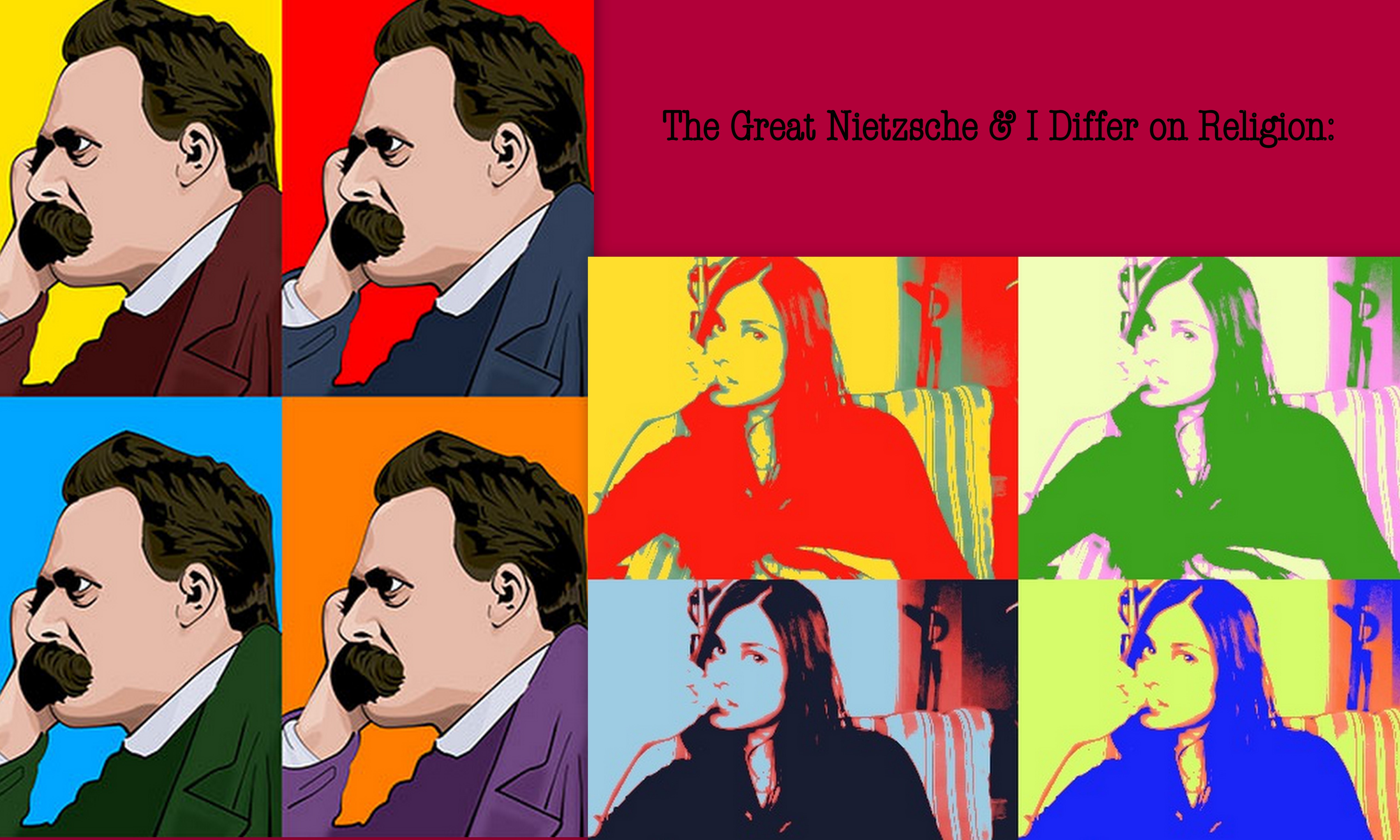
Zainab Jeewanjee differs with Friedric Nietzsche when it comes to Religion

Friedric Nietzsche & Zainab Jeewanjee : Can't agree on Religion

There’s an amazing article this week at TruthDig.com by Mr. Chris Hedges entitled “After Religion Fizzles, We’re Stuck with Nietzsche”. Hedges’ gist is that the core teachings of Abrahamic faiths (Islam, Christianity and Judaism) “are now lost in the muck of church dogma, hollow creeds and the banal bureaucracy of institutional religion”

Not a new argument; criticism of organized religion for being dogmatic is as ubiquitous as my generations disdain for Michael Jackson (God Rest his Soul).

And Hedges’ does a fairly sound job of supporting a censure of religious institutions by the notion of their failure to “unequivocally denounce unfettered capitalism, globalization and pre-emptive war” concluding that “empowerment of the individual conscience which was the starting point of great ethical systems of civilization” from Confucius to Kant have been traded for adherence to poorly outlined ideologies touted by dogmatic religious institutions. He prescribes we revert to an introspective, individual questioning of authority to guide our moral sense. And I like it; I want to expand on that notion, especially since Nietzsche, although super duper fascinating always irked me with his too sweeping condemnation of religion.

To pick up where Hedges article leaves off; what does happen when we’re “stuck” with the emptiness of Nietzsche’s notion that there is no morality? Like Hedges Nietzsche criticizes religion as inherently dogmatic, but to a far greater extent. Nietzsche says organized religion is riddled with the voids created by an incorrect contention that fixed perspectives exist. I read his work Beyond Good and Evil last year wherein with Christianity in particular,

Nietzsche finds religion prescribes actions, if not an entire way of life based on faulty contentions; faulty in that they are rooted on a morality that is inherently relative; he might even say contrived.

Specifically contrived is morality rooted in asceticism that accompanies organized religious expectations such as those calling for chastity (think Catholic priests) or abstinence from both food and sexual pleasure in the form of fasting (think the Muslim Holy month of Ramadaan). Such boundaries according to Nietzsche give rise to a society of undiscerning masses who wallow, yet make every effort in their struggle to achieve nothing more than a kind of denial, suffering and ultimately, mediocrity.

On top of that, prescriptions of asceticism being rooted in religious truths assumed to be absolute, constant and certain come into question and eventual conflict in light of more modern rationality which is less rooted in faith and instead in science, as Hedges would agree. Thus atheism becomes more readily accepted as the concept of God in and of itself is less able to be reconciled with advances in science that defy so called truths upon which religious prescriptions for a faithful life are based.

So to accept that time and space are relative, denying that absolute truth can ever be experienced and that religious asceticism in specific is nothing more than a pacifying consolation for an individual, Nietzsche’s philosophy condemns Abrahamic faith for their prescription’s of ultimately, a lifetime of mediocrity.

Thus his subsequent explanation for increasing atheism is understandable, however makes religion out to be a dismal experience in utter ignorance. And the bleak realization of such an argument can immediately prompt a kind of defensiveness wherein such radical challenges are immediately contested.

Although I consider myself moderately religious with a most certain faith in a monotheistic God, without intentionally being defensive in response to Nietzsche’s criticism of religion, I find his assertions contradictory to a notion of faith. Because if his premise is that there are no absolutes, and the problem with religion is that it cannot easily be reconciled with science, which is often considered to be in and of itself a kind of certainty, then it is perhaps difficult to reconcile the very notion that absolute truths do not exist and perspectives are relative to time and space.

By arguing that something mostly accepted as absolute, certain and “true” as science is a reasonable explanation against the spread of theism, Nietzsche himself lends credibility to the notion that certain truths might actually exist.

To clarify: if institutionalized religion is embedded in dogmatism founded on untruths as proved by its inability to reconcile with the realities of science, then would science then not be, in its strong opposition to religion, a body of at least some truths? Especially given that science is today generally regarded as irrefutable given its own roots in empirical procedures and products.

Furthermore, this raises the inevitable question that, in the absence of religion or philosophy then, what is morality, or the “right thing to do”? Nietzsche may argue that there is no certain definition of what is moral since it would be relative to time and space. However, again, accepting that a certain epistemic confinement is a plausible result of the dogmatism of religion, then is faith not then a credible means to achieving morality since it is rooted not in any tangible, scientific or absolute truth?

Faith is then relative as it requires no truth. Given the absence of absolute truths, faith then becomes quite conducive to my understanding of Nietzsche in that it seamlessly accepts the possibility of not knowing for certain.

Of course, this can itself become dogmatic and therefore problematic when individuals reach an extreme wherein reason and scientific and other rationale are abandoned for fanatical faith and harmful ends. But bracketing the extreme and assuming moderation as the norm for most individuals of “faith”, religious spirituality, especially a sincere belief in an intangible God who Nietzsche himself describes as “incapable of making himself clearly understood”, then can be a strong, and perhaps ironically, “spiritual” acceptance in the notion of a relative existence.

***sigh*** So guess I’m gonna have to just beg to differ with the late, great Nietzsche on this one and send my props to Mr. Hedges for a very insightful piece  😉