Captain. Keeper. Fielder. Batsman. Sangakkara does it all. He’s been one of my favorite players in the world since he emerged as one of the few wicketkeepers whose also consistent at bat, and the only wicketkeeper/batsman effective anywhere from opener, to 6th man down.
He’s just a sheer joy to watch. Sangakkara can make runs off any ball bowled his way, because his strikes are consistently clean, and always middled. He’ll never play a ball swinging toward the off side, to the leg side. And that kind of foresight is valuable wisdom in cricket.
Day 3, second test match vs India, Sri Lanka’s down 0 for 1, attempting to chase the monstrous 642 Indian total. Sangakkara steps in. Once opener Paranavithana fell to Sreesanth’s off side out swinger to the left handed batsman who nicked it straight into Dhoni’s hands, I guarantee Sangakkara was thinking: “shoot. I gotta hold my wicket, and be a pillar so my team doesn’t feel pressure to make an astronomical run rate”. He’s thinking like Dravid right now. But the beauty of Sangakkara is, he thinks that without having as much experience as a batsman like Dravid or Gilchrist. Sangakkara’s maturity as a batsman, captain, and keeper lie in the mere fact that if the team requires ten runs an over, he’ll do it, if they need him to hold his wicket for 100 balls, he’ll do it: he does what it takes to win. He’s dependable, consistent and although he’s out early on today, it’s not his norm.
Sri Lanka’s down 216 for 8 with impressive bowling by Sreesanth, and India’s opening lineup unleashed a batting onslaught giving them tremendous pace early on.
Sehwag’s seemingly constant ODI mindset was a blessing and Gambhir played magnificent innings, collectively chalking up 297, which eased pressure on following batsman to play their regular game. The openers did their job, and in any match, be it ODI, 20Twenty or Test, that’s key. I suppose this is just the flip side of the first test match. Sri Lanka dominated leaving India with the option to draw if not face an innings defeat, and it looks like we may see Sri Lanka in that position today.
Zee Tv’s been advertising the Sri Lanka India series with the tag line: “the two great Asian teams face off” and just into game 1, it’s lived up to hype.
Batting’s the name of the game so far with India winning the toss and electing to bat on a track prime for the likes of Tendulkar and Sehwag. But they lost 4 quick wickets beginning with Gautam Gambhir who opened with just 1 run off 10 balls. Very disappointing, because having elected to bat, it’s the openers responsibility to take initiative of controlling the game early on, and with Sehwag at the other end, things looked positive in the first two overs. But an amateur mistake cost Gambhir when he played a shot leaving his bat seemingly miles away form his pad. First rule of defensive batting in a supporting role: keep your bat close to your pads! Gambhir was supposed to be Sehwag’s support and when left handed Welegedara pitched a fair in-swinger (out-swinger to lefty Gambhir) he should have known better than keep his bat so far away. (In Gambhir’s defense though, Walegadara’s left handed bowling to his left handed batting is difficult to face so early in the attack).
No excuses for Sehwag though. It was clear from the onset he was in ODI mode. Generating 16 runs off 11 balls was a treat in the first 3 overs, but did little good for the team. Sehwag failed to read Walegadara’s in-swing keeping his bat prepared for a straight ball, making him plum for the LBW picking. With both openers out, the match was set for Tendulkar as the Master batsman and Dravid as the “Wall” to take center stage. But the partnership fell short of expectations when Sachin, like Sehwag seemed to be in ODI form, smashing a boundary on the first ball, but getting out 2 balls later when Walegadara struck again. Laxman fell for a duck thereafter but Dravid, in classic form was a God send coming in with India at 4 for 32.
Rahul Dravid came in & did what he does best: be the “Wall”. I realized in this match, he’s the most composed batsman in the world. And like any great form of art, be it music, theatre, painting or another sport, Dravid slows down time with his work. He bats like there’s an eternity at hand and as if wickets simply haven’t fallen. He operates beyond circumstances with a precise composure to demonstrate a maturity that a lot of batsman just lack. And that value is realized in test matches where time is secondary to holding ones wicket. Dravid didn’t once hold his bat in an aggressive position, it was mostly downward, playing each ball safely with much needed control. He didn’t go out of his way to smash any ball, but beautifully directed the pace of key balls into gaps, or nudged them just enough to get multiple runs when it was safe to do so. I think Dravid is the most conservatively effective batsman in the game today. Inzamam ul-Haq’s early days come to mind as someone comparable. You can never go wrong with a text book batsmen in test cricket: Dravid’s footwork is consistently flawless, his bat is always close to the pads and his eyes are never off the ball. It’s no wonder he led the team to a record breaking comeback making 177 off 261 bringing India to the very respectable total of 476.
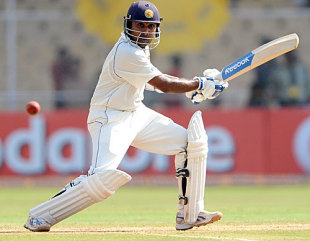
Day two: knowing that to win the match Sri Lanka would need a high run rate, opener Dilshan stepped up to bat a beautiful 112 off 133, (wonderful batting acceptable for even an ODI). His contribution was key in the same way Dravid’s was to ensuring Sri Lanka maintain wickets, while keeping the run rate up. Also, Dhoni made some basic mistakes that enhanced Sri Lanka’s game. Dhoni brought in spinner Harbhajan much too early into the attack. In about the 6th over, Dhoni broke the rhythm of his fast bowlers by unorthodoxly having Harbhajan bowl. Strike bowlers play at least 10-15+ overs and spinners normally aren’t used to or are effective with newer balls because they don’t get spin. So bringing in a spinner was an unnecessary, and costly move that allowed Sri Lanka to open up their batting which settled into a good rhythm to chalk up a very nice run rate. Jaywardene in particular is playing one of the most beautiful centuries i’ve seen in awhile.
So to continue on and win this, Sri Lanka should play the entire day and chalk up a strong total of roughly 500+ runs, then declare and try to clean out India in day 4. If India wants to win from hre on out, they should focus squarely on better wicket taking. Harbhajan should be used later in the overs and Zaheer’s aggressiveness should continue to take more wickets. India should have bowled Sri Lanka for a maximum of 475, but Sri Lanka isn’t falling before that, they’re already at a magnificent 435-5. So India should be looking for solid opening in their next innings, and a total of at least 400+ again, while still leaving themselves enough time to get Sri Lanka all out. Whichever way this goes though, i think we’re in for some classy innings 🙂
Shahid Afridi is the most exciting cricketer in ODI’s. He’ll either smash the fastest century in history, or maintain a strike rate of 300 off just a couple balls before being caught out. So for Pakistan his presence could mean massive game winning runs, or for the opposition, a quick, key wicket early on. Either way, it’s extremely suspenseful excitement for both teams and all fans watching that no other player offers.
What’s even more exciting is that Afiridi’s no longer a novice. He’s been around 10+ years but hasn’t received the kind of acclaim his potential commands. He’s overlooked as merely an inexperienced slogger because no one really expects him to last more than a couple overs. But in this years 20/20 World Cup and today’s ODI, Afridi asserted himself as the quintessential all rounder.
One shouldn’t underestimate tight fielding, very effective bowling, and competitive spirit Afridi harnessed over the years . Because even when he’s inconsistent at bat, his wealth of periphery contributions have led to victory, proving he’s so much more than just a slogger.
In today’s match versus New Zeland he demonstrated maturity by chalking up roughly just 50% percent of runs off boundaries when Pakistan was 70 for 4, and taking key wickets, almost getting a hat trick. Doubters take note: Afridi is entirely capable of playing a solid, consistent, and well rounded game.
His volatile career can partially be attributed to laughable PCB selection processes and mediocre coaching. Because the past decade of Pakistani cricket has been defined by arbitrary player selections and coaches irrationally shuffling the lineup.
Counter productive, yo-yo operations assigned Afridi everywhere from opener, middle order and tail end batsman without giving him sufficient time to play where he is most effective. His natural game is aggressive and valuable at the mid to lower end for two reasons. Firstly, although he’s had trouble with spinners, he’s deadly when attacking a worn down ball from a medium paced bowler. Secondly, Afridi’s style isn’t conducive to requirements of an opener. Opening bat imposes a pressure for a deep concentration and patience.
Because Pakistan is often inconsistent and has yet to decide on solid openers, this leaves middle and lower end batsman required to chalk up significant runs when openers don’t hack it. And that kind of pressure requires rapid, hard hitting runs on a grand scale from severely limited balls that only Afridi can produce. He thrives on such conditions, rising to the occasion and leading Pakistan to victories like today’s.
Not to mention his consistent bowling. He always maintains a good economy and although he’s not a strike bowler, he quite often strikes wickets. In today’s match he patiently maintained line and length despite going without a wicket for a few overs, eventually taking out Daniel Vettori who looked dangerous with a 90+ strike rate.
Key to such effective bowling is Afridi’s deadly variation in speed. He has the unique ability to throw batsmen off their game by changing up bowling pace buttressed by an equally menacing competitive spirit. He’ll bowl 3 slow balls, and the next one faster than even Razzaq’s fastest. Some fast bowlers change up’s aren’t even as fast as his.
Plus he disguises the changeup very well: batsmen don’t know if he’s going to throw a googly, leg spin, or just throw a fast one with no turn at all. Afridi doesn’t allow batsmen liberty to anticipate a ball, hence his consistently good economy. Side note: Tendulkar is also good at this.
There’s no doubt Afridi’s a talented cricketer. But the past year we’ve seen a mature Afridi harness his game and emerge as a strong leader against world class teams. With the Pakistan team in what seems like a constant transitional phase, Afridi has risen to all occasions maintaing a powerful game and vivid energy that is key to supporting youngsters like Umar Gul and Kamran Akmal as we saw in today’s match.
So kudos to Ramiz Raja for finally addressing skipper Younus Khan about his lacking performance after today’s match. It’s high time Pakistan found a new captain, and i think Afridi has earned a shot at the position.
During yesterday’s Australia Pakistan match, my brothers and I got into a discussion on ODI bowling. I said:
what Pakistan could use now aside from openers are solid strike bowlers. The kind who authoritatively combine sheer pace with deadly accuracy to leave batting lineups trembling in defensive mode. Wasim Akram, Waqar Younus, Imran Khan and Shoaib Akhtar come to mind, who within just a few overs, could command a reversal of the course of entire matches allowing their team to defend even modest totals. These were the guys who made Hat Tricks look easy. As a kid I recall my wide eyed expectation that Akram or Younus would simply take multiple wickets to salvage any match where Pakistan was slipping. And they rarely let me down.
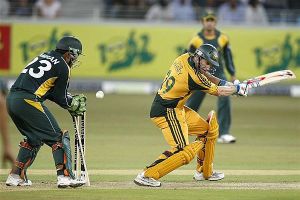
While the current lineup isn’t quite at that caliber yet, yesterday was still a nice taste of some electrifying Pakistani bowling. But first came batting. Though I initially recommended Akmal play it safe allowing more experienced batsmen to assume leadership, he did well to take big shots during opening innings. I didn’t anticipate Younis Khan and Shoaib Malik’s subdued batting or Afridi opening, so Akmal’s 44 off of 63 deliveries proved supportive. Still, conjuring just a 206 total shouldn’t have been difficult to chase, but the Pakistani squad made it a tough earned victory for the Aussies. Skipper Ponting described it best,
“I was chewing my finger nails up there for the last little bit. That ended up being closer than I thought was possible. We snuck across the line.”
I was nervous at the onset of the second innings when the Aussie run rate averaged around 6 after 10 overs compared to the Pakistani average that was just under 4. Watson opened well managing a strike rate of 109 with his partner Paine at around 72. But, just as the Aussies were:
“coasting at 140” a loss of “six wickets for 47 in a dizzying 12-over sequence that temporarily opened the door for India to leap-frog them into the next round of the tournament.”
Pakistani hopes skyrocketed as the Aussies scrambled to maintain wickets. Hussey and Ponting supported their openers with fair enough runs so that despite the fall of wickets, the run rate was maintained to sufficiency almost throughout. Almost throughout. Shoaib Malik took out the Aussie pillar Rikcy Ponting and at the 36th over Saeed Ajmal bowled Ferguson. Promptly thereafter, Naved-ul-Hassan took out Hussey who was looking more and more threatening leaving the Aussies 157 for 4.
Then came my second most missed Pakistani player, Mohammad Asif (second only to Abdur Razzaq), who made a very cool comeback bowling full outside off to Hopes. Hopes drove it upward straight to Younis and then Asif clean bowled batsman number 6 in the same over. That’s likely when skipper Ponting started chewing his finger nails. With just a couple tail enders left to chase roughly a half century and an electrified bowling to face, the last 9 overs were gripping. It wound up going to the very last ball where the Aussies managed to win it. And any game that winds up decisive based on the last ball is fine by me.
So it looks like Australia is in through the Semi’s with Dhoni and company’s tremendous thrashing of the West Indies not enough to take them forward. In any case, bring on New Zealand!
Even if peace talks are stalled between India and Pakistan, warming relations are on the cards for South Asian’s this week. With India’s chances of surviving the ICC Champions Trophy contingent to a Pakistan win on Wednesday against Australia, Dhoni and company will be watching closely in hopes for a victory for the men in green. So what’s it going to take:
Strong Opening:
Imran Nazir can’t be hasty. He has a tendency to get carried away after an early four, or six. Overconfidence can be a hinderance. And he can’t rely on hopes of weak fielding as he might have done in previous matches. He should play his natural game, hit a few boundaries overt time, but keep on guard.
Kamran Akmal has fair potential, even if he’s not my top choice for opener because of a lacking consistency. Key for him is simply: “don’t get out”. Allow Nazir to handle hiking up a solid run rate and understand that if his partner does get out, skilled batsman such as Malik and Afridi are behind him. Plus it’s well known that Pakistan can generate 100+ runs with middle/tail end batsman if need be. So Akmal should refrain from taking leadership, hold his wicket and play big shots if given safe opportunities to do so.
Discipline:
Umar Gul must be more careful. With a 9.16 economy in the India match, and zero wickets, he needs to step it up. Gul has to take charge as Pakistan’s most experienced opening bowler with this squad. There’s no such thing as negligible extras when playing against the Aussies, it’s just too costly.
Wicket Taking:
When Australia loses a wicket, they face opposition with equal or even greater confidence than before. Their batting doesn’t falter, it goes up a notch. So what Pakistan needs to do is ensure a constant aggressiveness in bowling. Keeping an Aussie run rate down in the first five overs is critical. If you give the Aussies a chance to consistently gain confidence from the onset, they’ll run with it and it’ll be hard to chase/contain from there.
Fielding:
Shahid Afirdi & Shoaib Malik are the top fieldsmen. But it’s going to take aconcerted effort on the entire Pakistan side to avoid weak fielding that can wind up expensive in the end. The Australian concept seems to be that when a fielder drops a catch off their hit, they punish bowlers by hitting one out of the park, as if to consider the misfielding an opportunity for a bonus hit, or a free wicket of sorts. It’s an aggressive strategy underscoring the importance of fielding against this team.
The game plan for Pakistan ultimately is: Cautious Intensity. No extras, keep the Aussie run rate down, maintain wickets and the runs will come. Besides, Pakistan’s already secured their seat in the Semi Finals. A safe victory is really all we ask for. Well, in the case of the Indian squad, given that their survival is reliant on both a Pakistan win and an astronomical run rate against the West Indies in their next match, they might be hoping Pakistan get a little more than just a “safe” victory 😉
Excited about Pakistan’s victory in todays ODI vs. India at the ICC Champions Trophy, i looked for YouTube highlights of previous India Pakistan matches hoping to relive thrilling performances of batsmen trembling at Akram/Younis yorkers or some record breaking Tendulkar/Sehwag innings. But I was unable to find a consolidated reel of South Asian highlights as such. It seems all content pertaining to Indian and Pakistani Cricket are elaborately produced showcases of either country triumphing over the other, or amusing clips revealing serious sledging between both teams over the years. And that’s understandable, it’s a competitive sport and fans create videos for the teams they support.
But something is changing. I don’t think fans are looking at these videos the same way as years past. Sambit Bal wrote a nice precursor to today’s match describing the epic India Pakistan rivalry as something far more profound than just another sporting competition. He says cricket in South Asia “has always been close to the national identity”. Quite astutely, he describes how it’s then used: “sometimes as a salve, sometimes a weapon; it has enabled bonding and it has divide; at times it has been a bridge, at others a vehicle for ugly chauvinism; and governments have used it as both a handshake as well as a show of fists”. And therein lies the dilemma.
India Pakistan matches are tremendously exciting, wrought with raw enthusiasm and incredible anticipation, but wind up raising stakes far higher than are normal or necessary. Bal says cricket is close to South Asian “national identity”, and in conversations I’ve heard matches described as akin to “war” or “religion”. That’s just going too far.
To inextricably tie these matches to one’s identity or religious affiliation let alone actual combat is absurd, but fortunately, a phenomenon that’s shrinking. Less and less are India Pakistan matches carrying the same weight for masses and even players. Bal explains that because matches between the countries have increased since 2004, an
“overkill took away the anticipation and intensity. But from a larger perspective, it also took away the heat and emotional charge, and that was not a bad thing at all. Since they were always playing, wins and losses no longer felt like life and death. It felt somewhat dull, but it also felt sane.”
Ahhhh, it felt sane. Now that’s a great way to put it. Cricket shouldn’t be a tool or driving force of nationality, politics let alone international relations. That’s a recipe for perpetual division, which is the last thing South Asia, or the world for that matter needs right now. So even if India Pakistan matches are seeing diminished anticipation, at least it shifts our focus toward the game itself rather than political, social and religious issues which ought to be unrelated. Because a heightened concentration on the game of cricket can finally allow us to debate what’s truly interesting. Like how Pakistan is the only team capable of winning a match in the last ten over’s by scoring 100+ runs while India is the only team who can do that in the first ten 😉




 Zainab B. Jeewanjee
 Zainab Jeewanjee