During yesterday’s Australia Pakistan match, my brothers and I got into a discussion on ODI bowling. I said:
what Pakistan could use now aside from openers are solid strike bowlers. The kind who authoritatively combine sheer pace with deadly accuracy to leave batting lineups trembling in defensive mode. Wasim Akram, Waqar Younus, Imran Khan and Shoaib Akhtar come to mind, who within just a few overs, could command a reversal of the course of entire matches allowing their team to defend even modest totals. These were the guys who made Hat Tricks look easy. As a kid I recall my wide eyed expectation that Akram or Younus would simply take multiple wickets to salvage any match where Pakistan was slipping. And they rarely let me down.
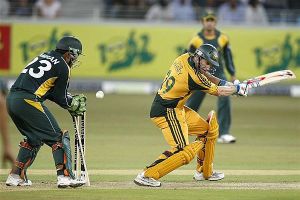
While the current lineup isn’t quite at that caliber yet, yesterday was still a nice taste of some electrifying Pakistani bowling. But first came batting. Though I initially recommended Akmal play it safe allowing more experienced batsmen to assume leadership, he did well to take big shots during opening innings. I didn’t anticipate Younis Khan and Shoaib Malik’s subdued batting or Afridi opening, so Akmal’s 44 off of 63 deliveries proved supportive. Still, conjuring just a 206 total shouldn’t have been difficult to chase, but the Pakistani squad made it a tough earned victory for the Aussies. Skipper Ponting described it best,
“I was chewing my finger nails up there for the last little bit. That ended up being closer than I thought was possible. We snuck across the line.”
I was nervous at the onset of the second innings when the Aussie run rate averaged around 6 after 10 overs compared to the Pakistani average that was just under 4. Watson opened well managing a strike rate of 109 with his partner Paine at around 72. But, just as the Aussies were:
“coasting at 140” a loss of “six wickets for 47 in a dizzying 12-over sequence that temporarily opened the door for India to leap-frog them into the next round of the tournament.”
Pakistani hopes skyrocketed as the Aussies scrambled to maintain wickets. Hussey and Ponting supported their openers with fair enough runs so that despite the fall of wickets, the run rate was maintained to sufficiency almost throughout. Almost throughout. Shoaib Malik took out the Aussie pillar Rikcy Ponting and at the 36th over Saeed Ajmal bowled Ferguson. Promptly thereafter, Naved-ul-Hassan took out Hussey who was looking more and more threatening leaving the Aussies 157 for 4.
Then came my second most missed Pakistani player, Mohammad Asif (second only to Abdur Razzaq), who made a very cool comeback bowling full outside off to Hopes. Hopes drove it upward straight to Younis and then Asif clean bowled batsman number 6 in the same over. That’s likely when skipper Ponting started chewing his finger nails. With just a couple tail enders left to chase roughly a half century and an electrified bowling to face, the last 9 overs were gripping. It wound up going to the very last ball where the Aussies managed to win it. And any game that winds up decisive based on the last ball is fine by me.
So it looks like Australia is in through the Semi’s with Dhoni and company’s tremendous thrashing of the West Indies not enough to take them forward. In any case, bring on New Zealand!
Even if peace talks are stalled between India and Pakistan, warming relations are on the cards for South Asian’s this week. With India’s chances of surviving the ICC Champions Trophy contingent to a Pakistan win on Wednesday against Australia, Dhoni and company will be watching closely in hopes for a victory for the men in green. So what’s it going to take:
Strong Opening:
Imran Nazir can’t be hasty. He has a tendency to get carried away after an early four, or six. Overconfidence can be a hinderance. And he can’t rely on hopes of weak fielding as he might have done in previous matches. He should play his natural game, hit a few boundaries overt time, but keep on guard.
Kamran Akmal has fair potential, even if he’s not my top choice for opener because of a lacking consistency. Key for him is simply: “don’t get out”. Allow Nazir to handle hiking up a solid run rate and understand that if his partner does get out, skilled batsman such as Malik and Afridi are behind him. Plus it’s well known that Pakistan can generate 100+ runs with middle/tail end batsman if need be. So Akmal should refrain from taking leadership, hold his wicket and play big shots if given safe opportunities to do so.
Discipline:
Umar Gul must be more careful. With a 9.16 economy in the India match, and zero wickets, he needs to step it up. Gul has to take charge as Pakistan’s most experienced opening bowler with this squad. There’s no such thing as negligible extras when playing against the Aussies, it’s just too costly.
Wicket Taking:
When Australia loses a wicket, they face opposition with equal or even greater confidence than before. Their batting doesn’t falter, it goes up a notch. So what Pakistan needs to do is ensure a constant aggressiveness in bowling. Keeping an Aussie run rate down in the first five overs is critical. If you give the Aussies a chance to consistently gain confidence from the onset, they’ll run with it and it’ll be hard to chase/contain from there.
Fielding:
Shahid Afirdi & Shoaib Malik are the top fieldsmen. But it’s going to take aconcerted effort on the entire Pakistan side to avoid weak fielding that can wind up expensive in the end. The Australian concept seems to be that when a fielder drops a catch off their hit, they punish bowlers by hitting one out of the park, as if to consider the misfielding an opportunity for a bonus hit, or a free wicket of sorts. It’s an aggressive strategy underscoring the importance of fielding against this team.
The game plan for Pakistan ultimately is: Cautious Intensity. No extras, keep the Aussie run rate down, maintain wickets and the runs will come. Besides, Pakistan’s already secured their seat in the Semi Finals. A safe victory is really all we ask for. Well, in the case of the Indian squad, given that their survival is reliant on both a Pakistan win and an astronomical run rate against the West Indies in their next match, they might be hoping Pakistan get a little more than just a “safe” victory 😉
Excited about Pakistan’s victory in todays ODI vs. India at the ICC Champions Trophy, i looked for YouTube highlights of previous India Pakistan matches hoping to relive thrilling performances of batsmen trembling at Akram/Younis yorkers or some record breaking Tendulkar/Sehwag innings. But I was unable to find a consolidated reel of South Asian highlights as such. It seems all content pertaining to Indian and Pakistani Cricket are elaborately produced showcases of either country triumphing over the other, or amusing clips revealing serious sledging between both teams over the years. And that’s understandable, it’s a competitive sport and fans create videos for the teams they support.
But something is changing. I don’t think fans are looking at these videos the same way as years past. Sambit Bal wrote a nice precursor to today’s match describing the epic India Pakistan rivalry as something far more profound than just another sporting competition. He says cricket in South Asia “has always been close to the national identity”. Quite astutely, he describes how it’s then used: “sometimes as a salve, sometimes a weapon; it has enabled bonding and it has divide; at times it has been a bridge, at others a vehicle for ugly chauvinism; and governments have used it as both a handshake as well as a show of fists”. And therein lies the dilemma.
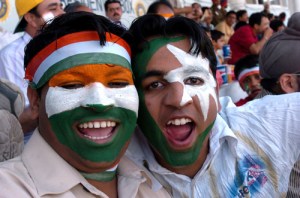
India Pakistan matches are tremendously exciting, wrought with raw enthusiasm and incredible anticipation, but wind up raising stakes far higher than are normal or necessary. Bal says cricket is close to South Asian “national identity”, and in conversations I’ve heard matches described as akin to “war” or “religion”. That’s just going too far.
To inextricably tie these matches to one’s identity or religious affiliation let alone actual combat is absurd, but fortunately, a phenomenon that’s shrinking. Less and less are India Pakistan matches carrying the same weight for masses and even players. Bal explains that because matches between the countries have increased since 2004, an
“overkill took away the anticipation and intensity. But from a larger perspective, it also took away the heat and emotional charge, and that was not a bad thing at all. Since they were always playing, wins and losses no longer felt like life and death. It felt somewhat dull, but it also felt sane.”
Ahhhh, it felt sane. Now that’s a great way to put it. Cricket shouldn’t be a tool or driving force of nationality, politics let alone international relations. That’s a recipe for perpetual division, which is the last thing South Asia, or the world for that matter needs right now. So even if India Pakistan matches are seeing diminished anticipation, at least it shifts our focus toward the game itself rather than political, social and religious issues which ought to be unrelated. Because a heightened concentration on the game of cricket can finally allow us to debate what’s truly interesting. Like how Pakistan is the only team capable of winning a match in the last ten over’s by scoring 100+ runs while India is the only team who can do that in the first ten 😉
Riaz Mohammad Khan is being considered for the position of Pakistan’s Special Envoy to India says Foreign Minister Shah Mahmood Qureshi. Attempting to resume talks that are stalled since the Mumbai atrocities, Minister Qureshi suggests using “backchannel diplomacy” through informal talks and in parallel with a formal peace process to achieve a warming of relations and overall progress in relations. In a recent statement to Indian TV networks, Qureshi clearly states he is “instructed by the President to move on. We want to normalize with India”. Such top level recommendations reflect Islamabad’s growing desire for more progressive relations with their neighbor, as consistently pursued by the Zardari administration.
Attributing initial moves toward back channel diplomacy to Musharraf era policies in resolving the Kashmir issue with India, Qureshi stresses that progress can only be made if both “front and back channel (diplomacy) move in tandem”. It’s a reasonable assessment given relations have been held up despite three high level meetings between leaders at the sidelines of international summits since June. Back Channel diplomacy, being secret and inherently less formal can eliminate domestic political concerns policymakers face that might stifle open, progressive discussion.
With a climate of mistrust exacerbated by the Mumbai atrocities and on the Pakistan side, claims that India is constantly funding militant separatists in Baluchistan, back channel diplomacy can mitigate both states political need to formally construct ever toughening stances against one another.
The Baluchistan and Mumbai issues are highly sensitive to citizens in both countries and assuaging those concerns is rightfully a priority for politicians on all ends. As a result, official talks between India and Pakistan wind up inherently staunch as they are subject to international media portrayals and reactionary sensitivities of masses in either country. This has done little to advance peace talks in any tangible way. And because the United States has a stake in ensuring stability in Pakistan given increased investment in the form of the Kerry Lugar bill and additional troops to Afghanistan, perhaps special envoy Holbrooke, or another appointed official on behalf of Washington might serve to mediate initial attempts at back channel diplomacy.
This summers meeting between Pakistani Prime Minister Gilani and Indian counterpart Manmohan Singh at the Non-Aligned Summit (NAM) resumed cooperative talks since they had stalled after the Mumbai atrocities. The summit marked a breakthrough in Indian-Pakistani relations when both sides decided to bracket issues of terrorism from future peace talks, by signing an agreement that identifies terrorism as the tantamount, mutual interest at this time. But the meeting has proven costly for Prime Minister Singh who some speculate, in attempt to leave behind a legacy of progressive cooperation with Pakistan, might have gone too far. Members of the opposition BJP party, and even some in his own Congress party say the NAM declaration does little else but soften India’s position in foreign policy to Pakistan.
Singh addressed criticism in Parliament during debate with a BJP member who accused him of “surrendering” and “walking into the Pakistani camp”. The prime minister countered that unless tensions and possible war are desired, such engagement is necessary and by in large, did not retract his statements. Although, he did try and recover some political base by later clarifying: “ talks between the two countries on broader issues like trade and travel cannot continue unless Pakistan pursues strong action against terror”. The clarification however, maintains his stance that peace talks can take place bracketing concerns on terrorism but would still allow leeway for trade and travel issues to be used as leverage later. Delinking peace talks thus leaves open the possibility of including Kashmir in future discussions with Pakistan, (although there is no specific mention of Kashmir in the agreement), and could mark a beginning of more progressive dialogue. Singh specifically cited Prime Minister Gilani’s providing an additional dossier on the Mumbai atrocities at the NAM summit had convinced him of Pakistan’s commitment to uprooting terrorist groups given that:
“this is the first time that Pakistan has ever formally briefed us on the results of an investigation into a terrorist attack in India. It is also the first time that they have admitted that their nationals and a terrorist organization based in Pakistan carried out a ghastly terrorist act in India.”
Under current leadership it seems relations are moving with some positive direction, with emphasis on the word “some”. Because such instances for optimism are not entirely rare in South Asian history. A recent article in Dawn reminds us that while positive dialogue takes place,
“India-Pakistan relations do not move in a straight line. They zigzag from crisis to crisis. In the interregnum the two countries either engage in negotiations or struggle to revive an interrupted dialogue”
That’s a very perceptive notion. The agreement at NAM is hopefully indicative of future cooperation, but history has shown us a reality that the arms race in South Asia tends to impede diplomatic progress. Ultimately, the message conveyed with development of arms, is immediate, tangible, and potentially hostile. On the other hand, diplomacy is gradual, inherently more subtle and less concrete.
So earlier this week on the anniversary celebrating India’s retaking of military posts in Kargil when Delhi symbolically launched its nuclear submarine, the INS Arihant (Destroyer of the Enemies) realpolitik dictates a clear message to Pakistan that is explained by their Foreign Office spokesman Abdul Basit:
‘continued induction of new lethal weapon systems by India’ is ‘detrimental to regional peace and stability’. The obvious concern in Pakistan then is whether this capability is a potential “platform to launch nuclear missiles”
Thus when either neighbor develops such armaments, basics of power politics teaches that the risk of not responding with deterrent armaments could be akin to state suicide. Whether or not one assumes conflict to be inevitable , an arms race is almost certain in situations like this. So, even though Pakistan is unlikely to announce nuclear submarine capability soon, in some capacity armaments of defense will be sought to counter India’s recent development. This will be considered necessary even though the Indian launch is directed at China’s rapid military modernization and not limited to a focus on Pakistan. Realpolitik will still drive Islamabad to invest in counter armaments despite the fact that Pakistan is heavily invested in the costly War on Terror, and more than ever in need of funding for social developments and aid for the largest refugee problem in the world.
International summits such as the Non Aligned Movement or even SAARC meetings which yield progressive diplomacy then work secondary to an expensive, and expansive arms race which in turn, perpetuates a now notorious and mutual mistrust that plagues South Asia. So, Prime Minister Singh’s alleged “softening” with Pakistan might be conciliatory in a diplomatic way, but continued development of armaments eclipses that rhetoric. Progressive relations will ultimately require more tangible approaches that enhance a meaningful trust rather than perpetuate an arms race.
Muhammad Ali Jinnah, better known as the founder of Pakistan when India was divided in 1947 is making headlines today with controversy surrounding ex-Indian Parliamentarian Jaswant Singh’s recent book: India – Partition – Independence. Immediately following the books release, Singh was expelled from his position in the Bhartiya Janata (BJP) party, protests wherein the book was burned and a prompt ban on the work in Gujarat ensued. But why the uproar?
In a recent interview, Singh reveals the following views on Jinnah that are now apparently too controversial in India, but receiving mostly praise across Pakistan:
Jinnah was an Indian nationalist
He joined the Indian Congress party before the Muslim League implying an original loyalty to a United India and eventual shift to non secularism as a result of Congress party politics later
Jinnah fought the British for an Independent India, in tandem with fighting “resolutely and relentlessly” for Muslim rights in India
Jinnah is admirable for being a self made man, having created a position in politics for himself without the luxury of prior wealth or status
Jinnah was not anti-Hindu
Jinnah failed insofar as he received a “moth eaten” piece of divided India in the form of Pakistan and left Muslims who stayed back in India without sufficient guidance
Gandhi himself referred to Jinnah as a great Indian, so there should be no controversy in recognizing him as such today
Muslims in India today are downtrodden, live in pain and are “robbed of the essence of psychological security”
Both Indian Muslims and Pakistani’s have paid a price for Partition since both would have been stronger under a united India
To those who have not grown up or spent much time in South Asia, it may be difficult to understand why such ideas can be controversial and strike such polar chords in the hearts and minds of people divided by a man made border only 60 years ago. But the division of India, into two states resulting in an independent Pakistan saw extreme violence, mass refugee migration and that carnage left a lasting scar on South Asian mindsets. Put in a most blunt form: India suffered the bitter taste of a fractured state that is rooted among the great civilizations in history. And Pakistan suffered the bitter reality of as Singh put it, “a moth eaten”, post colonial state with perhaps an inevitably fractured and frail territory from inception. From the bizarre geopolitical landscape of Bangladesh not contingent to, yet officially part of Pakistan to the conflict over Kashmir at the very onset of partition, Singh makes a fair point in explaining partition caused profound suffering on both ends. The subsequent bitterness is manifest in perpetual hostility between both states in the form of conflicts, and in India, even on a communal level where according to Singh, Muslims are still downtrodden.
So praising Jinnah as a “great man” in India may be akin to condoning the very fracturing of India. In Pakistan, it’s lauded as an admission that their founder heroically created a homeland where Muslims would no longer be downtrodden. Singh’s work also might acknowledge that partition dealt an unfair hand to Pakistani’s, an idea that can come across as unpalatable on the Indian side. But relying on interviews from Jaswant Singh on the book so far, I think the controversy is a tired insinuation of hostility from the state. Banning the book on the grounds that:
only fuels a hostile polarization of India and Pakistan. Mind you, India and Pakistan as states are increasingly polarized, which in turn results in a division of peoples. Because my guess is that had government kept its hands out of censoring Singh’s book it might have spoken to the hearts and minds of South Asian’s disseminating novel ideas that are not divisive. Noam Chomsky once said that “states are violent institutions”, in South Asia, at the very least they are bitter, but people inherently are not. Singh’s work might have tapped into that sentiment and in the banning of it, states tighten their grip on citizens by perpetuating division and hostility in South Asia. Against a backdrop of a desire for economic growth, stability and globalization, that kind of bitterness is stale 60 odd years later. So I’m looking forward to reading the book and am lucky that my copy was reserved before the ban, in safe hands far from from protests and government intervention.



 Zainab B. Jeewanjee
 Zainab Jeewanjee