It’s my first week in Denver where I’ll be attending graduate school for the next two years and I’m soaking in how kind this city is. It is the most laid back, genuine U.S. City I’ve experienced. The sincerity with which people prod “No, where are you really from?” when I initially respond “California”, is priceless. I feel like a novelty here. At an Eid Celebration last night, even a local of Pakistani descent pointed out “Wow, the guys are going to flip over you. There are no ethnic girls in Denver”.
“Ethnic”? I’ll take it; I realize I’m getting a pass for being a Californian female. Because in light of increasingly disheartening news from Pakistan, be it about floods, match fixing in cricket, and mostly terrorism plaguing the country since 9/11, Pakistani’s have captured the American state of mind in a less than appealing way. Once indecipherable on a world map for most Americans, Pakistan emerged as our stalwart ally in victory after 40+ years of Cold War. Yet as we turn to Islamabad again to fight a War on Terror, we possess a deep skepticism of Pakistani intentions.
Since September 11, every time I come to the States or western countries I feel people have the wrong impression about Pakistan as a terrorist nation. I just wanted to declare that we are very friendly, loving and caring people, and we want peace in this world as much as Americans and the rest of the world wants.
There are extremists in every religion, but just because of them you cannot judge the whole country as a terrorist nation. I just wanted to get this message across as a Pakistani
In plain terms Qureshi clarified that his country is a mostly moderate nation where people expect the same peace and security desired by all people. He reminded us of Pakistan’s humanity, directly countering the “transactional” ties that progressively complicate our understanding of Pakistan. Fareed Zakaria might agree. In a recent piece, he eloquently concurred:
Across the Muslim world, militant Islam’s appeal has plunged. In the half of the Muslim world that holds elections, parties that are in any way associated with Islamic jihad tend to fare miserably, even in Pakistan.
In his article “We’re Safer Than We Think” Zakaria points out that Muslims in Pakistan and beyond are if anything, less safe from terrorism than we are as they suffer the brunt of radical Islam’s consequences.
Over the last few years, imams and Muslim leaders across the world have been denouncing suicide bombings, terrorism, and Al Qaeda with regularity….The fatal problem with these kinds of attacks is that they kill ordinary civilians—not U.S. soldiers or diplomats—and turn the local population against Islamic radicals.
With more thorough detail, Zakaria’s is saying exactly what Qureshi did; Pakistan is not a country of terrorists. So next time I get asked where I am “really” from, I might just say “I’m from Asiam Qureshi.’s country”.
There’s a notion of two distinct America’s; one that is conservative, mostly Republican Red and the other a more liberal Democratic Blue, and in a similar way I’ve seen two Pakistan’s.
The polarized views are reminiscent of our own democratic deliberations; strong demonstrations for (Red) and against (Blue) the legality of the Iraq invasion beginning in 2004, or protests against the passage of Proposition 8 (Blue) in California which outlawed same sex marriage in 2008 (Red).
So do such polar views necessarily indicate a distinctly Blue and Red America? I’ve never thought so, because overallAmerican’s tend to be far more centrist than our elected officials make us out to be in a two party system. Generally, Americans from California to New York and everywhere in between share basic social and cultural values; we watch the same shows, dress similarly, and ultimately ascribe to the values outlined in our Constitution (albeit interpretations differ).
But Pakistan is very different. There is far less social homogeneousness and more indications of a vastly distinct populace, a Red and Blue Pakistan if you will. Citizens from the remote, more rural northern areas bordering Afghanistan, or Red places will likely dress, consume, and believe differently than people in the more cosmopolitan hustle and bustle of large cities like Karachi, or Blue Pakistan.
Pakistani’s are educated on vastly different scales. While one child might be raised in a feudal system from a village in Sindh with no education, another might be educated per the Cambridge system in a large city, while another might have only had formal training in religious studies at a Madrassah! In terms of dress; it’s not uncommon to find females covered in burqa’s from head to toe, no face, hands or even eyes showing (Red), while you’ll find other’s in the skimpiest of attire partying until daybreak (Blue), at which point some Pakistani’s may rise to pray at a local Mosque while others are just getting home from a night of drinking and dancing. It’s Red and Blue if i’ve ever seen it, if not as stark as the contrast of Black on White.
So there’s an enormous diversity in belief systems that is more immediately recognized in the Pakistani landscape than in ours. I recall living there while in High School and being shocked at the level of ignorance toward America by some and whole hearted embrace of western culture by others. But polar lifestyles and belief systems amongst Pakistani’s doesn’t indicate there isn’t a grey area of people who fall in between two extremes, nor does it mean the group perceived as more “western” is necessarily against the ban on Facebook. In fact, notorious party animal and international rock star Ali Azmat didn’t denounce the censorship:
“Musician Ali Azmat said the issue should be dealt with sternly so that no such thing takes place in the future. “Every Muslim condemns this act, but it should be handled responsibly because we have to maintain our image. I have registered my condemnation of the relevant Facebook page.”
And that’s when I start to worry. If so called “liberal” personalities in Pakistan can be overworked over the Facebook page and fail to renounce such short sighted legislation, I shudder to think of how widespread acceptance of unnecessary censorship still is in Pakistan.
I’ll be the first to say the Facebook page is in poor taste, it’s a sorry excuse for a cause and the fact that it does not have even a 20k following yet is testimony to how silly it is. Thus the futility of the inane effort makes the Pakistani ban a disproportionate, counter productive response.
The page does not incite hate or violence and I would go so far as to say it posed an opportunity for the Pakistani government to lead its citizens to moderation in this instance. After violent protests against the Danish cartoons which forever mar the image of Muslims today, Pakistan missed a chance to demonstrate Islamic sensibility.
By banning Facebook over a trivial issue the government makes a mockery of it’s people, Red and Blue alike. Officially designated as The Islamic Republic of Pakistan, the government carries a profound responsibility to simultaneously uphold freedom and religious consciousness. Not an easy task, but the last thing Pakistan needs right now are further riled extremists and increased Anti-Americanism.
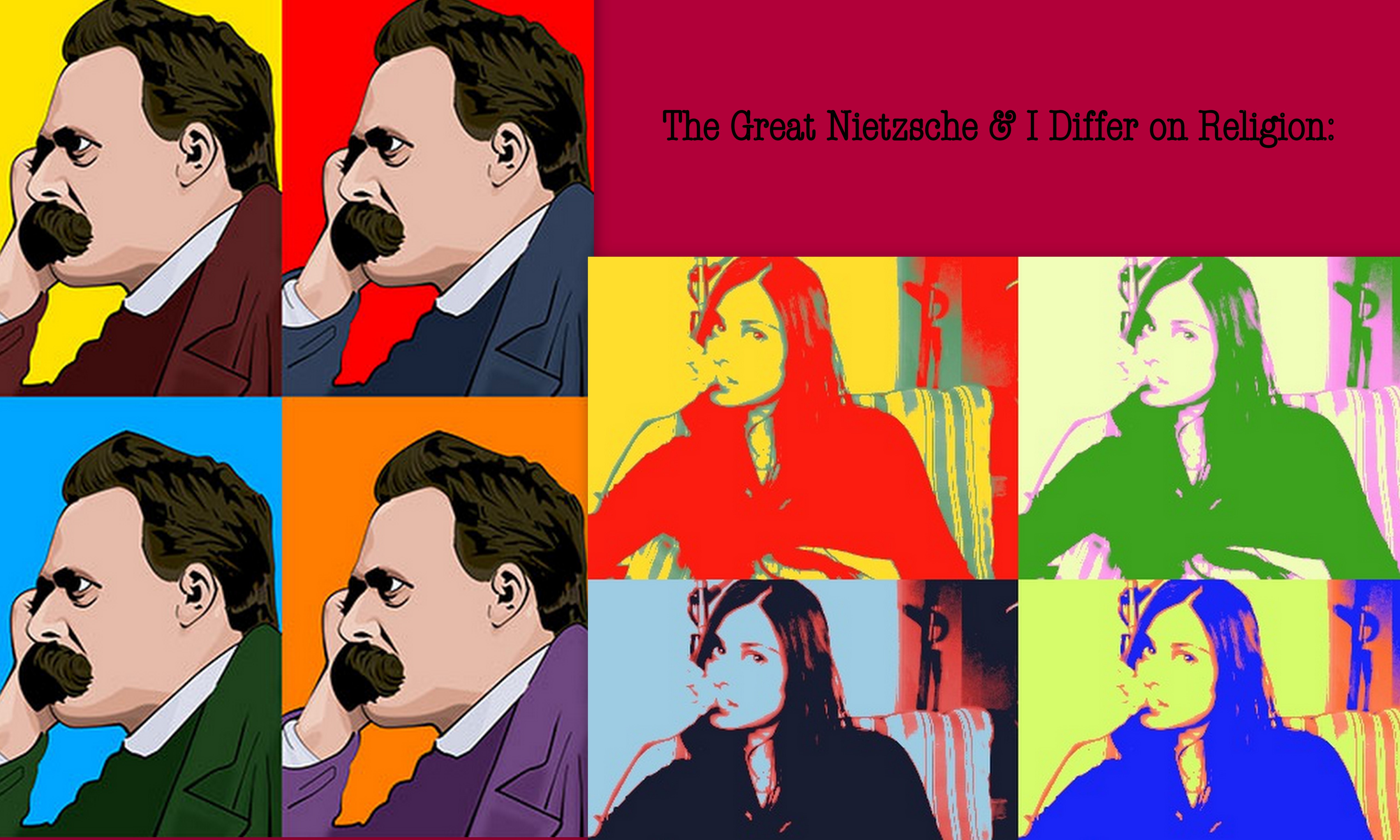
Friedric Nietzsche & Zainab Jeewanjee : Can't agree on Religion
There’s an amazing article this week at TruthDig.com by Mr. Chris Hedges entitled “After Religion Fizzles, We’re Stuck with Nietzsche”. Hedges’ gist is that the core teachings of Abrahamic faiths (Islam, Christianity and Judaism)“are now lost in the muck of church dogma, hollow creeds and the banal bureaucracy of institutional religion”
Not a new argument; criticism of organized religion for being dogmatic is as ubiquitous as my generations disdain for Michael Jackson (God Rest his Soul).
And Hedges’ does a fairly sound job of supporting a censure of religious institutions by the notion of their failure to “unequivocally denounce unfettered capitalism, globalization and pre-emptive war” concluding that “empowerment of the individual conscience which was the starting point of great ethical systems of civilization” from Confucius to Kant have been traded for adherence to poorly outlined ideologies touted by dogmatic religious institutions. He prescribes we revert to an introspective, individual questioning of authority to guide our moral sense. And I like it; I want to expand on that notion, especially since Nietzsche, although super duper fascinating always irked me with his too sweeping condemnation of religion.
To pick up where Hedges article leaves off; what does happen when we’re “stuck” with the emptiness of Nietzsche’s notion that there is no morality? Like Hedges Nietzsche criticizes religion as inherently dogmatic, but to a far greater extent. Nietzsche says organized religion is riddled with the voids created by an incorrect contention that fixed perspectives exist. I read his work Beyond Good and Evil last year wherein with Christianity in particular,
Nietzsche finds religion prescribes actions, if not an entire way of life based on faulty contentions; faulty in that they are rooted on a morality that is inherently relative; he might even say contrived.
Specifically contrived is morality rooted in asceticism that accompanies organized religious expectations such as those calling for chastity (think Catholic priests) or abstinence from both food and sexual pleasure in the form of fasting (think the Muslim Holy month of Ramadaan). Such boundaries according to Nietzsche give rise to a society of undiscerning masses who wallow, yet make every effort in their struggle to achieve nothing more than a kind of denial, suffering and ultimately, mediocrity.
On top of that, prescriptions of asceticism being rooted in religious truths assumed to be absolute, constant and certain come into question and eventual conflict in light of more modern rationality which is less rooted in faith and instead in science, as Hedges would agree. Thus atheism becomes more readily accepted as the concept of God in and of itself is less able to be reconciled with advances in science that defy so called truths upon which religious prescriptions for a faithful life are based.
So to accept that time and space are relative, denying that absolute truth can ever be experienced and that religious asceticism in specific is nothing more than a pacifying consolation for an individual, Nietzsche’s philosophy condemns Abrahamic faith for their prescription’s of ultimately, a lifetime of mediocrity.
Thus his subsequent explanation for increasing atheism is understandable, however makes religion out to be a dismal experience in utter ignorance. And the bleak realization of such an argument can immediately prompt a kind of defensiveness wherein such radical challenges are immediately contested.
Although I consider myself moderately religious with a most certain faith in a monotheistic God, without intentionally being defensive in response to Nietzsche’s criticism of religion, I find his assertions contradictory to a notion of faith. Because if his premise is that there are no absolutes, and the problem with religion is that it cannot easily be reconciled with science, which is often considered to be in and of itself a kind of certainty, then it is perhaps difficult to reconcile the very notion that absolute truths do not exist and perspectives are relative to time and space.
By arguing that something mostly accepted as absolute, certain and “true” as science is a reasonable explanation against the spread of theism, Nietzsche himself lends credibility to the notion that certain truths might actually exist.
To clarify: if institutionalized religion is embedded in dogmatism founded on untruths as proved by its inability to reconcile with the realities of science, then would science then not be, in its strong opposition to religion, a body of at least some truths? Especially given that science is today generally regarded as irrefutable given its own roots in empirical procedures and products.
Furthermore, this raises the inevitable question that, in the absence of religion or philosophy then, what is morality, or the “right thing to do”? Nietzsche may argue that there is no certain definition of what is moral since it would be relative to time and space. However, again, accepting that a certain epistemic confinement is a plausible result of the dogmatism of religion, then is faith not then a credible means to achieving morality since it is rooted not in any tangible, scientific or absolute truth?
Faith is then relative as it requires no truth. Given the absence of absolute truths, faith then becomes quite conducive to my understanding of Nietzsche in that it seamlessly accepts the possibilityofnot knowing for certain.
Of course, this can itself become dogmatic and therefore problematic when individuals reach an extreme wherein reason and scientific and other rationale are abandoned for fanatical faith and harmful ends. But bracketing the extreme and assuming moderation as the norm for most individuals of “faith”, religious spirituality, especially a sincere belief in an intangible God who Nietzsche himself describes as “incapable of making himself clearly understood”, then can be a strong, and perhaps ironically, “spiritual” acceptance in the notion of a relative existence.
***sigh*** So guess I’m gonna have to just beg to differ with the late, great Nietzsche on this one and send my props to Mr. Hedges for a very insightful piece 😉
Speaking to my grandmother whose in Karachi yesterday morning, she explained my cousins stayed home from elementary school as most schools had shut down this week. Karachi is the the largest, most bustling city in Pakistan, and despite being situated in the south, far removed from the hotbed of militants in northern Waziristan, terrorism has gradually spilled over from Afghanistan, crept into Pakistan and paralyzed the country. My grandmother described a city laden with tension where people live in a constant climate of uncertainty and increasing fear.
It was pressing to hear her tired voice describe the situation with a kind of detachment. Her tone was passive: an indication of hopelessness. And that hopelessness is not in reference to obliterating terrorists, because there’s little speculation on a military capacity to wipe out at most, 10 thousand terrorists. Rather, her passive tone is a worn out sound echoing 62 years of statehood rooted in insecurity. She’s seen Pakistan through three wars fought with India, including a civil war in the 70’s resulting in a cession of East Pakistan, one of the worlds largest refugee problems in the 1980’s and now the War on Terror fought on home soil. Her passivity is an exhausted acceptance of perpetual political insecurity.
The aforementioned video shows a younger generation, not yet exhausted. They’re shocked, frustrated by what’s happening in their country as they passionately raise their voices in protest against extremist Islamic groups who oppress the country.
Most ironic is that extremist groups bombed the Islamic University in Islamabad where these young men study. Testimony to how grossly extremists propagate an inaccurate view of Islam that terrorizes Muslims everyday.
Which brings me back to how imperative it is that Pakistani and US forces focus on uprooting and not just obliterating terrorists. Pakistan is home to the worlds 6th largest population, and the second largest Muslim country. That’s a strategic demographic in the War on Terror and for future international security. Ensuring terrorism is uprooted in the long term will require a sustained, multifaceted, military and non military approach. Few will argue against the necessity of economic development, the question really is how to pay for it. I’ve mentioned before that the Kerry Lugar bill is a fair, but insufficient attempt at doing this, and ultimately, Pakistan itself must uproot terrorism.
This critical time is an opportunity for Pakistani politicians to take responsibility and bring forth a detailed agenda that rallies current masses. A specific, well publicized plan of action, accepting but not relying on outside assistance is Pakistan’s best hope at engaging its citizens to wipe out terrorism for the long haul. Hopelessness, frustration and desire for Pakistani’s to develop economically and free themselves from terror poses a widespread opportunity to supplement the military offensive with civil support. That support is the capital with which to begin an agenda to uproot terrorism.
Grassroots organizations, women’s and educational groups whose ideologies run counter to extremist groups should be actively highlighted by the media and politicians.
A more proactive approach that is clearly visible works on two levels. One, it aggregates support in the country against extremism setting a future stage for more moderate masses. Secondly, it alleviates international fears of Pakistan becoming a failed state. Because not only do citizens like my grandma need hope, but the international community also watches in concern for Pakistan to define itself in unity and diametrically against extremism.
“Tonight we celebrate a great religion and its commitment to justice and progress. We honor the contributions of Americas Muslims and the positive example they set for so many”
No matter how one feels about Washington’s foreign policy, U.S. hegemony, or Americans in general, it’s hard to deny the appeal of our President’s sharp diplomacy. From making his first call in office to Palestinian Authority President Mahmoud Abbas, to his landmark speech in Cairo marking “A New Beginning” in U.S. relations with the Muslim world to hosting the annual White House Iftar, Barack Obama’s message to Muslims is drastically different than previous administrations. This administration extends a mature attempt to engage Muslims at home and abroad.
I use the word mature because previous presidencies naively boxed themselves in an almost solely hostile rhetoric of The War on Terror or simply lacked foresight to effectively convey that America is not adverse to Islam. Lacking foresight is critical because Islam’s global reach puts Muslims atop the list of the worlds fastest growing religions . So when President Obama shifts diplomatic rhetoric to a more mature tone with the Muslim world it’s to ensure progressive relations with this large and increasingly strategic demographic. And that’s why I think President Obama’s overtures are genuine. They fulfill our long term interests in garnering positive relations with a rapidly growing and influential Muslim world.
Regardless of whether his diplomatic overtures vastly alter policies, they are highly symbolic, and perceptions matter. American political discourse in the past referring to religion most often talked about “Judeo-Christian” values and beliefs without a mention of Muslims, even though Islam is the second largest religion in the world. Couple this with a political mis-focus on only extremist factions rather than on the moderate, majority of Muslims, just makes President Obama’s more astute diplomacy that much more valuable. Rather thanalienate Muslims across the globe, he shifts the context of US engagement to one of inclusiveness.
In his Ramadan greeting President Obama repeatedly emphasizes that U.S. relations with the Muslim world draw on commonalities citing rituals such as fasting, values of tolerance, advancing justice and respect as mutual goals that can be reached through cooperation. He specifies expanding education, fostering entrepreneurship, collaboration on science and eradicating global illnesses as instances where the US and Muslim world can engage toward more progressive relations. Not a bad idea. Let’s hope that liberal theories of humanity prove true and these ideas come to fruition.
Shahrukh Khan, one of the most famous men in the world was detained in New Jersey last week and thinks it was because of his Muslim surname. I don’t condone unreasonably preferential treatment for megastars, but something is amiss when terms like “Islamaphobia” and “Racial Profiling” are internationally understood within an American context.
Travelling from Vegas last year, as I handed my pass to board a flight back to DC I was stopped and asked to wait aside for reasons not disclosed. Four French nationals were told the same. As all the other passengers boarded, we waited for at least 15 minutes and were given no explanation for being pulled aside. Eventually a burly looking woman and imperturbable looking man in black security garb arrived and said we were to be frisked. One of the French nationals and I asked why this was necessary after having already cleared regular security to which they responded, it’s just “routine”. The response doesn’t qualify as a logical answer to the question, but neither guard seemed interested in engaging in sound argumentation: futility kept me from trying to get an accurate response. The burly one frisked me and a French female who had a duffle bag much larger and fuller than my over the shoulder bag. She didn’t search the French female’s duffle, but mine was searched at length despite having been through X-ray and manual security beforehand. I watched her tinker with my book, pens, makeup pouch, stuffed toy, and laptop and mentioned to her: “You forgot to check the other girl’s bag”. She said “what?” I repeated my comment as she re-fastened my bag and handed it back to me. I walked away as she started to answer figuring a response was likely to include the word “routine” and leave any reasonable person dissatisfied.
Homeland Securities explanation to Shahrukh Khan was identical: his treatment was “routine”. But Khan said he felt “humiliated” and in saying “we should not be treated on the basis of our color or nationality” made clear that he felt racially profiled. In my experience, I didn’t feel humiliated although I was dissatisfied, because as an American national, the only variable for which I received a more in depth check than the French female, was aapparently my race. It was discriminatory, and it didn’t feel nice.
I’m not vouching for less security necessarily, but it’s time a solution is explored if these “routine” searches/detentions are increasingly discriminatory extending to variables such as race, religious affiliation and nationality. We live in too rapidly a globalizing world for the United States to come across as unwelcoming.
I think a decision to omit the cartoons isn’t necessarily censorship. It treads a very delicate line, but may not cross over into that realm because it might not distort the authors message. Having said that, there isn’t soundness to the recurrent reasoning for omission: that it would inevitably yield a violent response, as the article and some of the quotations in it insist. Reza Aslan thinks the images should not be omitted, perhaps for this reason, or because he finds it is a form of censorship. But leaving the censorship issue aside momentarily, I think the larger issue here is the faulty reasoning. Because a republication of the images does not NECESSARILY yield a violent response (especially if the content is not intended, or aimed to rile controversy). On the contrary it might seek to explain the reasons why such cartoons are harmful, but the article leaves any discussion of the actual content of the book out, which is surprising. All we know is that the book is about the “Cartoons that shook the world”, we are given no further details on the concept, thesis or which direction the author takes in respect to the cartoons.
I suppose if I were in the position of editing/publishing a work like this, i might opt to omit hurtful images if they severely trample on religious sensitivities more so than demonstrate a constructive thesis on my part. Emphasis on “more so” and I would also take into account the relevance to my audience. But If the images are necessary in furthering a productive debate, then keep them in. Again however, the actual content of the book in question isn’t touched upon in the article.
This makes the article irresponsible and problematic by relying on a false premise that Muslims all over the world (remember they cleverly quote international Muslim Ambassadors) are a homogenous bunch of religious persons who are definitely going to respond violently to the republication of those cartoons. That’s a gross over simplification and sweeping generalization, It also completely ignores how significant factors of the books audience or intent for the republication can affect responses.
In the end, shouldn’t there be some stifling of very relevant, and critical information, or a distortion of information in some way for us to call an omission of offensive material censorship? If the images aren’t critical to the authors thesis, there’s little reason to include offensive material unless for trivial shock value. So critics claiming Yale is being “cowardly” need to more closely examine what a republication of such images really brings toward generating substantial debate on the issue at hand. Because otherwise they’re just whining against a tactful, harmless omission.




 Zainab B. Jeewanjee
 Zainab Jeewanjee