Posts Tagged ‘australia pakistan cricket’

h1

The End of Conservative Cricket

December 31, 2009

Test matches will disappear from cricket by the year 2020, and ironically, because of 20Twenty. After Pakistan’s frustrating loss against Australia today, batsman Mohammad Yousuf warns that Twenty20 cricket will ruin Pakistan’s game. He says:

“Because of Twenty20 cricket no player knows how to stay at the wicket anymore. Until players do not play with discipline and play ball to ball and leave balls they are supposed to we will struggle in ODIs, let alone Tests. If you are going to slog all the time what is the point? It is necessary that Pakistanis, the media, the board, the fans realise that we play as little Twenty20 as possible.”

Mohammad Yousuf is asking everyone to limit Twenty20 cricket at a time when it’s popularity is on the rise, Pakistan is the reigning World Champion and undoubtedly has the best players the game has seen (Afridi, Razzaq, Ajmal, Gul). He’s basically making a case for conservative cricket: or getting back to the basics of Test.

In Test’s even if you’re pitched a full toss at above average speed and there’s no one at long on or square leg, the skilled batsman refrains from smashing it out of the park.

Reason being the risk of getting out supersedes the worth of a six. However, that kind of discipline is the exact antithesis of 20Twenty cricket where you are required to play each ball as if it’s a potential six. But having the sense to resist potential sixers is but one part of the batting discipline needed in traditional cricket. It’s an overall psychological discipline where batsman must with extreme patience and consistency just hold one’s wicket. To do that, over after over for 5 days, knowing that the match could wind up in just a draw requires an extreme endurance that few batsman posses. In fact some of the best batsmen in the game who have mastered this don’t even play ODI’s anymore, like Rahul Dravid. Case in point, most teams don’t have players who specialize in Test, Dravid is actually a rare case. Mohammad Yousuf could then be on the right track: are players losing an edge in Test, and perhaps even skill by playing 20Twenty cricket?

20Twenty is the American equivalent of Home Run Derby: the game simply requires batsman to smash anything and everything out of the park. 8th man down must carry at least a 100% strike rate to give a team the depth required to be competitive in the game.

It’s less about psychological discipline, discerning batting or even batting skills for that matter. Because if the aim is to slog, you can take a whack at just about anything pitched your way. It requires a lot of power and little else. Anyone with training and enough arm strength to smack the ball around can be fairly successful. There aren’t rewards for consistency, patience or discipline. In fact, those qualities are counter productive in 20Twenty. In Tests you score runs by first discerning which balls are safe, whether that be after 5 or 50 overs, and then you nudge, or direct the ball into anticipated gaps.

It’s a whole different ball game, as they say in the States. So is Mohammad Yousuf correct in calling for a limit to 20Twenty? The conventional part of me who tends to resist change says yes. But the more spontaneous, forward thinking side of me says, hey, if that’s the natural progression of the game and Tests are inevitably obsolete, bring on a few more Shahid Afridi’s !

😉
h1

Down to the Last Ball – Electrifying Bowling & Gritty Batting

October 1, 2009

During yesterday’s Australia Pakistan match, my brothers and I got into a discussion on ODI bowling. I said:

what Pakistan could use now aside from openers are solid strike bowlers. The kind who authoritatively combine sheer pace with deadly accuracy to leave batting lineups trembling in defensive mode. Wasim Akram, Waqar Younus, Imran Khan and Shoaib Akhtar come to mind, who within just a few overs, could command a reversal of the course of entire matches allowing their team to defend even modest totals. These were the guys who made Hat Tricks look easy. As a kid I recall my wide eyed expectation that Akram or Younus would simply take multiple wickets to salvage any match where Pakistan was slipping. And they rarely let me down.

While the current lineup isn’t quite at that caliber yet, yesterday was still a nice taste of some electrifying Pakistani bowling. But first came batting. Though I initially recommended Akmal play it safe allowing more experienced batsmen to assume leadership, he did well to take big shots during opening innings. I didn’t anticipate Younis Khan and Shoaib Malik’s subdued batting or Afridi opening, so Akmal’s 44 off of 63 deliveries proved supportive. Still, conjuring just a 206 total shouldn’t have been difficult to chase, but the Pakistani squad made it a tough earned victory for the Aussies. Skipper Ponting described it best,

“I was chewing my finger nails up there for the last little bit. That ended up being closer than I thought was possible. We snuck across the line.”

I was nervous at the onset of the second innings when the Aussie run rate averaged around 6 after 10 overs compared to the Pakistani average that was just under 4. Watson opened well managing a strike rate of 109 with his partner Paine at around 72. But, just as the Aussies were:

“coasting at 140” a loss of “six wickets for 47 in a dizzying 12-over sequence that temporarily opened the door for India to leap-frog them into the next round of the tournament.”

Pakistani hopes skyrocketed as the Aussies scrambled to maintain wickets. Hussey and Ponting supported their openers with fair enough runs so that despite the fall of wickets, the run rate was maintained to sufficiency almost throughout. Almost throughout. Shoaib Malik took out the Aussie pillar Rikcy Ponting and at the 36th over Saeed Ajmal bowled Ferguson. Promptly thereafter, Naved-ul-Hassan took out Hussey who was looking more and more threatening leaving the Aussies 157 for 4.

Then came my second most missed Pakistani player, Mohammad Asif (second only to Abdur Razzaq), who made a very cool comeback bowling full outside off to Hopes. Hopes drove it upward straight to Younis and then Asif clean bowled batsman number 6 in the same over. That’s likely when skipper Ponting started chewing his finger nails. With just a couple tail enders left to chase roughly a half century and an electrified bowling to face, the last 9 overs were gripping. It wound up going to the very last ball where the Aussies managed to win it. And any game that winds up decisive based on the last ball is fine by me.

So it looks like Australia is in through the Semi’s with Dhoni and company’s tremendous thrashing of the West Indies not enough to take them forward. In any case, bring on New Zealand!

h1

Pakistan vs Australia: Playing for South Asia

September 29, 2009

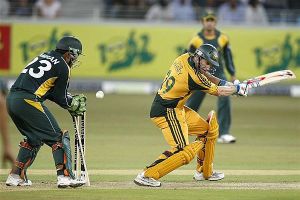
aussia pak cricket shot stumped

Even if peace talks are stalled between India and Pakistan, warming relations are on the cards for South Asian’s this week. With India’s chances of surviving the ICC Champions Trophy contingent to a Pakistan win on Wednesday against Australia, Dhoni and company will be watching closely in hopes for a victory for the men in green. So what’s it going to take:

  • Strong Opening:
    • Imran Nazir can’t be hasty. He has a tendency to get carried away after an early four, or six. Overconfidence can be a hinderance. And he can’t rely on hopes of weak fielding as he might have done in previous matches. He should play his natural game, hit a few boundaries overt time, but keep on guard.
    • Kamran Akmal has fair potential, even if he’s not my top choice for opener because of a lacking consistency. Key for him is simply: “don’t get out”. Allow Nazir to handle hiking up a solid run rate and understand that if his partner does get out, skilled batsman such as Malik and Afridi are behind him. Plus it’s well known that Pakistan can generate 100+ runs with middle/tail end batsman if need be. So Akmal should refrain from taking leadership, hold his wicket and play big shots if given safe opportunities to do so.
  • Discipline:
    • Umar Gul must be more careful. With a 9.16 economy in the India match, and zero wickets, he needs to step it up. Gul has to take charge as Pakistan’s most experienced opening bowler with this squad.  There’s no such thing as negligible extras when playing against the Aussies, it’s just too costly.
  • Wicket Taking:
    • When Australia loses a wicket, they face opposition with equal or even greater confidence than before. Their batting doesn’t falter, it goes up a notch. So what Pakistan needs to do is ensure a constant aggressiveness in bowling. Keeping an Aussie run rate down in the first five overs is critical. If you give the Aussies a chance to consistently gain confidence from the onset, they’ll run with it and it’ll be hard to chase/contain from there.
  • Fielding:
    • Shahid Afirdi & Shoaib Malik are the top fieldsmen. But it’s going to take a concerted effort on the entire Pakistan side to avoid weak fielding that  can wind up expensive in the end. The Australian concept seems to be that when a fielder drops a catch off their hit, they punish bowlers by hitting one out of the park, as if to consider the misfielding an opportunity for a bonus hit, or a free wicket of sorts. It’s an aggressive strategy underscoring the importance of fielding against this team.

The game plan for Pakistan ultimately is: Cautious Intensity. No extras, keep the Aussie run rate down, maintain wickets and the runs will come. Besides, Pakistan’s already secured their seat in the Semi Finals. A safe victory is really all we ask for. Well, in the case of the Indian squad, given that their survival is reliant on both a Pakistan win and an astronomical run rate against the West Indies in their next match, they might be hoping Pakistan get a little more than just a “safe” victory   😉