
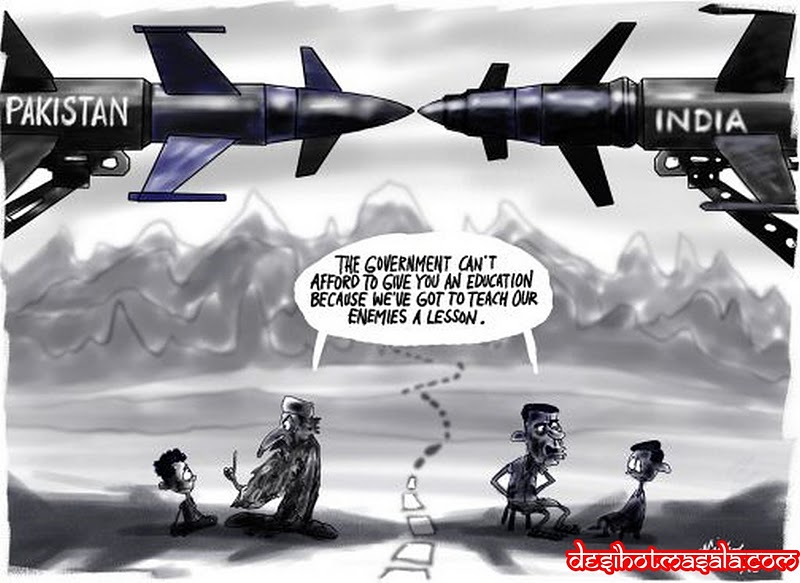
Futility of Military Motivated relations Minus Democratic Input
While working in D.C. some years back almost every Congress person, Think Tank and academic I came across was certain on one thing on nuclear proliferation: if an atomic bomb ever goes off again, it’s going to happen in South Asia. It was a dismal but resounding notion that I have even heard expressed amongst South Asians. Profound mistrust, three wars, land disputes, all spurred by a gory colonial partition 60 odd years ago has left Pakistan and India scarred in a way that makes cynics of even the best of us.
A realist might tell you that nuclear armed neighbors by way of deterrence have allowed India and Pakistan to refrain from war since testing their atom bombs, but even they would conclude war is inevitable. Liberals would make a case for enhanced trade to gradually spur economic interdependence to help avoid conflict, which is perhaps the most palatable idea, but statistics show that deepening trade between India and Pakistan has not yet improved relations:
“trade between India and Pakistan was at its highest ever in the year following Kargil. Even the Mumbai attacks have not significantly dented India-Pakistan trade relations. Pakistan trades with 100’s of countries, India being the 9th largest trading partner”
So if deepening trade and deterrence haven’t yielded what confidently could be considered lasting peace, what will it take? I’m of the opinion that realist and liberalist policies must be accompanied by ground level, macro scale diplomacy. Because while deterrence satisfies the all mighty military institutions, and trade satisfies highly influential business elites there’s little attention given to the masses; and by masses I mean billions of South Asians who have yet to even fathom peace as a possibility.
Call it ground level diplomacy, soft power or good ol’ winning hearts and minds: it’s the missing ingredient in bilateral relations. Resident Indian’s and Pakistani’s have a perceived animosity for one another that verges on the irrational. Catapulting cricket matches between both countries as akin to war, hate crimes against Muslims in India to cross border terrorism is absurd for states divided by man made, post colonial borders.
So the problem is not one of trade, or military might: it’s epistemic. Both countries must engage one another from the ground up. Shashi Tharoor, the decorated Indian Parliamentarian described the effectiveness of Indian soft power best at a TED conference last year:
“India’s soft power, its true of music, dance of arts, yoga, aryuveda, even cuisine. With these examples come the sense that in todays world its not the side of the bigger army that wins, it’s the one that tells a better story. And india is the land of a better story. Stereotypes are changing. Today people in Silicon valley people talk of IIT’s with same reverence of MIT”
Why not apply that soft power in Pakistan? And vice versa. I laud the Aman ki Asha initiative for doing exactly this. Launched by Pakistani media conglomerate Geo T.V. and on the Indian side, the Times of India, both companies have taken up the task of engaging both countries using soft power. As media houses, through television, print and web placements, they engage masses directly, finally sidestepping politically or economically motivated discourse both countries are used to. THeir mission statement reads:
Public opinion is far too potent a force to be left in the hands of narrow vested interests. The people of today must find its voice and force the rulers to listen. The awaam must write its own placards and fashion its own slogans. The leaders must learn to be led and not blindly followed. Skepticism about the given is often the genesis of faith. This skepticism has been brewing. It can be unleashed to forge a new social compact between the people of this region. A social compact based on a simple yet powerful impulse – Aman ki Asha. A desire for peace.
Aman ki Asha taps the widespread but underrepresented sentiments of commonality shared by South Asians. By engaging the masses directly with soft power it’s is a brilliant first step at mitigating the most potent problem in bilateral relations: mistrust. And what is most brilliant about the initiative is that could have teeth. Unlike countless other proposals for peace, Aman ki Asha uses mass media to speak to masses directly with a specifically outlined agenda:
“Issues of trade and commerce, of investments, of financial infrastructure, of cultural exchanges, of religious and medical tourism, of free movement of ideas, of visa regimes, of sporting ties, of connectivity, of reviving existing routes, of market access, of separated families, of the plight of prisoners, will be part of our initial agenda. Through debates, discussions and the telling of stories we will find commonalities and space, for compromise and adjustment, on matters that have bedevilled relations for over 60 years”
It sounds promising, because although I do not anticipate this dissemination of smart power to yield results immediately, if it’s done consistently it might have a capacity to democratize the push for peace. It ought not to be the military, or economic institutions setting the agenda, rather, policies should reflect the will of the people. Aman ki Asha is a hugely cooperative step in bilateral ties. More peaceful relations in South Asia can begin by reminding the masses of what my Pakistani born and raised mother said when she came back from a trip to India in 2005 “they (Indians) eat the same food, sound the same, act and even look the same as us”. With such strong commonality felt amongst everyday people, one questions the legitimacy of policymaking that has historically divided, rather than united South Asians. And if that sentiment disseminates, albeit gradually, there’s much to hope for in the future.


 Zainab B. Jeewanjee
 Zainab Jeewanjee