Futility of Military Motivated relations Minus Democratic Input
While working in D.C. some years back almost every Congress person, Think Tank and academic I came across was certain on one thing on nuclear proliferation: if an atomic bomb ever goes off again, it’s going to happen in South Asia. It was a dismal but resounding notion that I have even heard expressed amongst South Asians. Profound mistrust, three wars, land disputes, all spurred by a gory colonial partition 60 odd years ago has left Pakistan and India scarred in a way that makes cynics of even the best of us.
A realist might tell you that nuclear armed neighbors by way of deterrence have allowed India and Pakistan to refrain from war since testing their atom bombs, but even they would conclude war is inevitable. Liberals would make a case for enhanced trade to gradually spur economic interdependence to help avoid conflict, which is perhaps the most palatable idea, but statistics show that deepening trade between India and Pakistan has not yet improved relations:
“trade between India and Pakistan was at its highest ever in the year following Kargil. Even the Mumbai attacks have not significantly dented India-Pakistan trade relations. Pakistan trades with 100’s of countries, India being the 9th largest trading partner”
So if deepening trade and deterrence haven’t yielded what confidently could be considered lasting peace, what will it take? I’m of the opinion that realist and liberalist policies must be accompanied by ground level, macro scale diplomacy. Because while deterrence satisfies the all mighty military institutions, and trade satisfies highly influential business elites there’s little attention given to the masses; and by masses I mean billions of South Asians who have yet to even fathom peace as a possibility.
Call it ground level diplomacy, soft power or good ol’ winning hearts and minds: it’s the missing ingredient in bilateral relations. Resident Indian’s and Pakistani’s have a perceived animosity for one another that verges on the irrational. Catapulting cricket matches between both countries as akin to war, hate crimes against Muslims in India to cross border terrorism is absurd for states divided by man made, post colonial borders.
“India’s soft power, its true of music, dance of arts, yoga, aryuveda, even cuisine. With these examples come the sense that in todays world its not the side of the bigger army that wins, it’s the one that tells a better story. And india is the land of a better story. Stereotypes are changing. Today people in Silicon valley people talk of IIT’s with same reverence of MIT”
Why not apply that soft power in Pakistan? And vice versa. I laud the Aman ki Asha initiative for doing exactly this. Launched by Pakistani media conglomerate Geo T.V. and on the Indian side, the Times of India, both companies have taken up the task of engaging both countries using soft power. As media houses, through television, print and web placements, they engage masses directly, finally sidestepping politically or economically motivated discourse both countries are used to. THeir mission statement reads:
Public opinion is far too potent a force to be left in the hands of narrow vested interests. The people of today must find its voice and force the rulers to listen. The awaam must write its own placards and fashion its own slogans. The leaders must learn to be led and not blindly followed. Skepticism about the given is often the genesis of faith. This skepticism has been brewing. It can be unleashed to forge a new social compact between the people of this region. A social compact based on a simple yet powerful impulse – Aman ki Asha. A desire for peace.
Aman ki Asha taps the widespread but underrepresented sentiments of commonality shared by South Asians. By engaging the masses directly with soft power it’s is a brilliant first step at mitigating the most potent problem in bilateral relations: mistrust. And what is most brilliant about the initiative is that could have teeth. Unlike countless other proposals for peace, Aman ki Asha uses mass media to speak to masses directly with a specifically outlined agenda:
“Issues of trade and commerce, of investments, of financial infrastructure, of cultural exchanges, of religious and medical tourism, of free movement of ideas, of visa regimes, of sporting ties, of connectivity, of reviving existing routes, of market access, of separated families, of the plight of prisoners, will be part of our initial agenda. Through debates, discussions and the telling of stories we will find commonalities and space, for compromise and adjustment, on matters that have bedevilled relations for over 60 years”
It sounds promising, because although I do not anticipate this dissemination of smart power to yield results immediately, if it’s done consistently it might have a capacity to democratize the push for peace. It ought not to be the military, or economic institutions setting the agenda, rather, policies should reflect the will of the people. Aman ki Asha is a hugely cooperative step in bilateral ties. More peaceful relations in South Asia can begin by reminding the masses of what my Pakistani born and raised mother said when she came back from a trip to India in 2005 “they (Indians) eat the same food, sound the same, act and even look the same as us”. With such strong commonality felt amongst everyday people, one questions the legitimacy of policymaking that has historically divided, rather than united South Asians. And if that sentiment disseminates, albeit gradually, there’s much to hope for in the future.
Riaz Mohammad Khan is being considered for the position of Pakistan’s Special Envoy to India says Foreign Minister Shah Mahmood Qureshi. Attempting to resume talks that are stalled since the Mumbai atrocities, Minister Qureshi suggests using “backchannel diplomacy” through informal talks and in parallel with a formal peace process to achieve a warming of relations and overall progress in relations. In a recent statement to Indian TV networks, Qureshi clearly states he is “instructed by the President to move on. We want to normalize with India”. Such top level recommendations reflect Islamabad’s growing desire for more progressive relations with their neighbor, as consistently pursued by the Zardari administration.
Attributing initial moves toward back channel diplomacy to Musharraf era policies in resolving the Kashmir issue with India, Qureshi stresses that progress can only be made if both “front and back channel (diplomacy) move in tandem”. It’s a reasonable assessment given relations have been held up despite three high level meetings between leaders at the sidelines of international summits since June. Back Channel diplomacy, being secret and inherently less formal can eliminate domestic political concerns policymakers face that might stifle open, progressive discussion.
With a climate of mistrust exacerbated by the Mumbai atrocities and on the Pakistan side, claims that India is constantly funding militant separatists in Baluchistan, back channel diplomacy can mitigate both states political need to formally construct ever toughening stances against one another.
The Baluchistan and Mumbai issues are highly sensitive to citizens in both countries and assuaging those concerns is rightfully a priority for politicians on all ends. As a result, official talks between India and Pakistan wind up inherently staunch as they are subject to international media portrayals and reactionary sensitivities of masses in either country. This has done little to advance peace talks in any tangible way. And because the United States has a stake in ensuring stability in Pakistan given increased investment in the form of the Kerry Lugar bill and additional troops to Afghanistan, perhaps special envoy Holbrooke, or another appointed official on behalf of Washington might serve to mediate initial attempts at back channel diplomacy.
This summers meeting between Pakistani Prime Minister Gilani and Indian counterpart Manmohan Singh at the Non-Aligned Summit (NAM) resumed cooperative talks since they had stalled after the Mumbai atrocities. The summit marked a breakthrough in Indian-Pakistani relations when both sides decided to bracket issues of terrorism from future peace talks, by signing an agreement that identifies terrorism as the tantamount, mutual interest at this time. But the meeting has proven costly for Prime Minister Singh who some speculate, in attempt to leave behind a legacy of progressive cooperation with Pakistan, might have gone too far. Members of the opposition BJP party, and even some in his own Congress party say the NAM declaration does little else but soften India’s position in foreign policy to Pakistan.
Singh addressed criticism in Parliament during debate with a BJP member who accused him of “surrendering” and “walking into the Pakistani camp”. The prime minister countered that unless tensions and possible war are desired, such engagement is necessary and by in large, did not retract his statements. Although, he did try and recover some political base by later clarifying: “ talks between the two countries on broader issues like trade and travel cannot continue unless Pakistan pursues strong action against terror”. The clarification however, maintains his stance that peace talks can take place bracketing concerns on terrorism but would still allow leeway for trade and travel issues to be used as leverage later. Delinking peace talks thus leaves open the possibility of including Kashmir in future discussions with Pakistan, (although there is no specific mention of Kashmir in the agreement), and could mark a beginning of more progressive dialogue. Singh specifically cited Prime Minister Gilani’s providing an additional dossier on the Mumbai atrocities at the NAM summit had convinced him of Pakistan’s commitment to uprooting terrorist groups given that:
“this is the first time that Pakistan has ever formally briefed us on the results of an investigation into a terrorist attack in India. It is also the first time that they have admitted that their nationals and a terrorist organization based in Pakistan carried out a ghastly terrorist act in India.”
Under current leadership it seems relations are moving with some positive direction, with emphasis on the word “some”. Because such instances for optimism are not entirely rare in South Asian history. A recent article in Dawn reminds us that while positive dialogue takes place,
“India-Pakistan relations do not move in a straight line. They zigzag from crisis to crisis. In the interregnum the two countries either engage in negotiations or struggle to revive an interrupted dialogue”
That’s a very perceptive notion. The agreement at NAM is hopefully indicative of future cooperation, but history has shown us a reality that the arms race in South Asia tends to impede diplomatic progress. Ultimately, the message conveyed with development of arms, is immediate, tangible, and potentially hostile. On the other hand, diplomacy is gradual, inherently more subtle and less concrete.
So earlier this week on the anniversary celebrating India’s retaking of military posts in Kargil when Delhi symbolically launched its nuclear submarine, the INS Arihant (Destroyer of the Enemies) realpolitik dictates a clear message to Pakistan that is explained by their Foreign Office spokesman Abdul Basit:
‘continued induction of new lethal weapon systems by India’ is ‘detrimental to regional peace and stability’. The obvious concern in Pakistan then is whether this capability is a potential “platform to launch nuclear missiles”
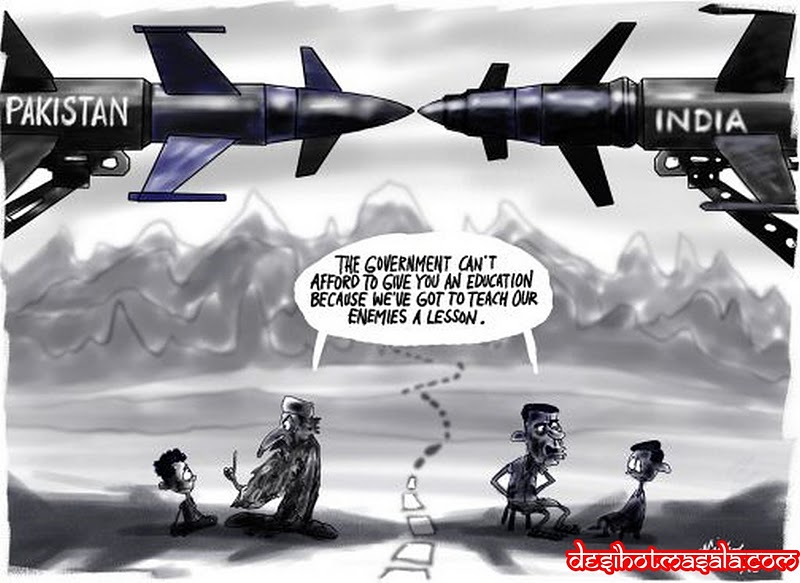
Thus when either neighbor develops such armaments, basics of power politics teaches that the risk of not responding with deterrent armaments could be akin to state suicide. Whether or not one assumes conflict to be inevitable , an arms race is almost certain in situations like this. So, even though Pakistan is unlikely to announce nuclear submarine capability soon, in some capacity armaments of defense will be sought to counter India’s recent development. This will be considered necessary even though the Indian launch is directed at China’s rapid military modernization and not limited to a focus on Pakistan. Realpolitik will still drive Islamabad to invest in counter armaments despite the fact that Pakistan is heavily invested in the costly War on Terror, and more than ever in need of funding for social developments and aid for the largest refugee problem in the world.
International summits such as the Non Aligned Movement or even SAARC meetings which yield progressive diplomacy then work secondary to an expensive, and expansive arms race which in turn, perpetuates a now notorious and mutual mistrust that plagues South Asia. So, Prime Minister Singh’s alleged “softening” with Pakistan might be conciliatory in a diplomatic way, but continued development of armaments eclipses that rhetoric. Progressive relations will ultimately require more tangible approaches that enhance a meaningful trust rather than perpetuate an arms race.
Muhammad Ali Jinnah, better known as the founder of Pakistan when India was divided in 1947 is making headlines today with controversy surrounding ex-Indian Parliamentarian Jaswant Singh’s recent book: India – Partition – Independence. Immediately following the books release, Singh was expelled from his position in the Bhartiya Janata (BJP) party, protests wherein the book was burned and a prompt ban on the work in Gujarat ensued. But why the uproar?
In a recent interview, Singh reveals the following views on Jinnah that are now apparently too controversial in India, but receiving mostly praise across Pakistan:
Jinnah was an Indian nationalist
He joined the Indian Congress party before the Muslim League implying an original loyalty to a United India and eventual shift to non secularism as a result of Congress party politics later
Jinnah fought the British for an Independent India, in tandem with fighting “resolutely and relentlessly” for Muslim rights in India
Jinnah is admirable for being a self made man, having created a position in politics for himself without the luxury of prior wealth or status
Jinnah was not anti-Hindu
Jinnah failed insofar as he received a “moth eaten” piece of divided India in the form of Pakistan and left Muslims who stayed back in India without sufficient guidance
Gandhi himself referred to Jinnah as a great Indian, so there should be no controversy in recognizing him as such today
Muslims in India today are downtrodden, live in pain and are “robbed of the essence of psychological security”
Both Indian Muslims and Pakistani’s have paid a price for Partition since both would have been stronger under a united India
To those who have not grown up or spent much time in South Asia, it may be difficult to understand why such ideas can be controversial and strike such polar chords in the hearts and minds of people divided by a man made border only 60 years ago. But the division of India, into two states resulting in an independent Pakistan saw extreme violence, mass refugee migration and that carnage left a lasting scar on South Asian mindsets. Put in a most blunt form: India suffered the bitter taste of a fractured state that is rooted among the great civilizations in history. And Pakistan suffered the bitter reality of as Singh put it, “a moth eaten”, post colonial state with perhaps an inevitably fractured and frail territory from inception. From the bizarre geopolitical landscape of Bangladesh not contingent to, yet officially part of Pakistan to the conflict over Kashmir at the very onset of partition, Singh makes a fair point in explaining partition caused profound suffering on both ends. The subsequent bitterness is manifest in perpetual hostility between both states in the form of conflicts, and in India, even on a communal level where according to Singh, Muslims are still downtrodden.
So praising Jinnah as a “great man” in India may be akin to condoning the very fracturing of India. In Pakistan, it’s lauded as an admission that their founder heroically created a homeland where Muslims would no longer be downtrodden. Singh’s work also might acknowledge that partition dealt an unfair hand to Pakistani’s, an idea that can come across as unpalatable on the Indian side. But relying on interviews from Jaswant Singh on the book so far, I think the controversy is a tired insinuation of hostility from the state. Banning the book on the grounds that:
only fuels a hostile polarization of India and Pakistan. Mind you, India and Pakistan as states are increasingly polarized, which in turn results in a division of peoples. Because my guess is that had government kept its hands out of censoring Singh’s book it might have spoken to the hearts and minds of South Asian’s disseminating novel ideas that are not divisive. Noam Chomsky once said that “states are violent institutions”, in South Asia, at the very least they are bitter, but people inherently are not. Singh’s work might have tapped into that sentiment and in the banning of it, states tighten their grip on citizens by perpetuating division and hostility in South Asia. Against a backdrop of a desire for economic growth, stability and globalization, that kind of bitterness is stale 60 odd years later. So I’m looking forward to reading the book and am lucky that my copy was reserved before the ban, in safe hands far from from protests and government intervention.



 Zainab B. Jeewanjee
 Zainab Jeewanjee