
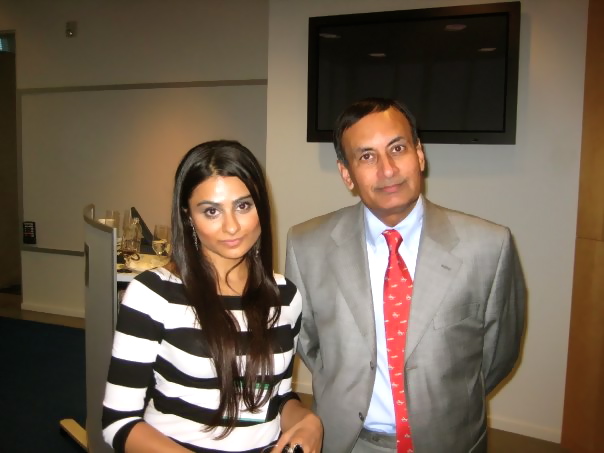
Zainab Jeewanjee with Ambassador Hussain Haqqani
“30 years of this whole business that started with the jihad against the Soviet Union is what we are trying to deal with the aftermath of. Its 30 years of these groups, supporting them, funding them, the opening of radical madrassahs in various parts of the country. Now I think we’ve done a decent job in the last two years of beginning the cleanup”
Pakistan is serious about cleaning up terrorism, but the mess runs deep. And If you want to share in an insightful discussion on the Wikileaks reports, I recommend watching Charlie Rose from last night. Because Pakistan pulled out the big guns in responding to the reports that suggested their Interservices Intelligence Agency is “aiding” the enemies in Afghanistan. Ambassador Hussain Haqqani was Rose’s guest and spoke directly to American anxieties that Pakistan is not entirely interested in ousting terrorists from the region. Specifically responding to the question of ISI links to the Taliban, Haqqani said:
“It goes back to the soviet invasion of Afghanistan. The CIA and ISI both worked with the Mujahedeen who morphed into Taliban. But now the Pakistani military and ISI are conducting successful military operations in SWAT and South Waziristan.
He elaborated:
“We’ve Taken out extremists and 74 ISI personnel have been killed in the past two years. With as many as 233 injured. That alone should be sufficient to convince people that was then and now is now and Pakistan is standing firmly on the side of those who want to eliminate the Taliban and extremists”
The statistics were particularly hard hitting. They brought a human element to our somewhat sterilized discussion about Pakistan here in the states. Being geographically removed, and with a vastly distinct culture, we are mostly informed of how the government in Islamabad deals with our administration in D.C., resorting to diplomatic sound bites and news for our information. But Haqqanis statistics provoke us to realize that just as we have struggled in Afghanistan, Pakistan too has sacrificed greatly as an ally in our war and continues to be deeply invested in combating terror.
Haqqani reminds us that the Wikileaks story is just that; a whistleblower. Without subtracting from the value of revealing what governments might otherwise keep classified, the Ambassador offered facts that quell sensationalized reception of the reports.
Rose asked weighty questions in trademark straightforwardness allowing us a chance to get answers to that the Wikileaks story leaves us lingering with. For instance, “what keeps Pakistan from doing more”; a question even those with ample knowledge and understanding of history and ground realities who can put the Wikileaks story into context sometimes wonder. Rose speculated it was a concern with India, and a fear of U.S. withdrawal. The Ambassador responded:
“There is a concern that India is not yet reconciled to our nationhood and statehood. Those are concerns reflected in public opinion and government has to deal with view that the US has not been a consistent friend of Pakistan and if we do too much at the behest of US they could leave us in the lurch and walk away again. The Biggest concern is the US can actually leave projects incomplete it has happened in the past US assistance and economic aid suspended arbitrarily and at short notice. Things have been left incomplete. They have had a very difficult relationship in the past 6 decades. We are trying tot address the totality of these issues”
It is no secret that India Pakistan relations are a primary driver of action in South Asian politics so the real nugget in the Ambassador’s above response is the talk of Pakistani Public opinion.
One of the first rules we learn in politics is that perceptions matter and what our pundits and political speechwriters have left out of the conversation is how Pakistani opinions factor into Islamabad’s policymaking.
The Obama administration made clear by way of allocating funding in the Kerry Lugar bill that America would no longer support military regimes at the expense of democracy in Pakistan, yet we still tend to leave consideration of Pakistani public opinion out of our own expectations. Apprehensions of U.S. foreign policy are increasingly common as Pakistan deteriorated economically, politically in overall security post 9/11.
Ambassador Haqqani did an eloquent job of explaining this tremendous sensitivity with which Islamabad must balance its interest in continuing bilateral cooperation with D.C. while alleviating a rampant fear amongst Pakistani citizens that the United States might not be trustworthy, or as the Ambassador put it “ungrateful” for all their country does.
And although Ambassador Haqqani concluded on a positive note , citing increased military cooperation in fighting terrorism and tripartite agreements on trade, he gave viewers a clear view of the “totality” and complexity of issues from the Pakistan side.
To tally Islamabad’s task list thus far: in addition to 30 years of deep cleaning, speedy recovery from loss of life, toil, treasure and time, one must add mending 60 years of mistrust with the worlds superpower to Pakistan’s list of things everyone wants done yesterday.
So let’s think twice, maybe even thrice before sponging the Wikileaks reports without an understanding of context and implicating Pakistan for not doing enough. Prime Minister Cameron, that’ means you.


 Zainab B. Jeewanjee
 Zainab Jeewanjee