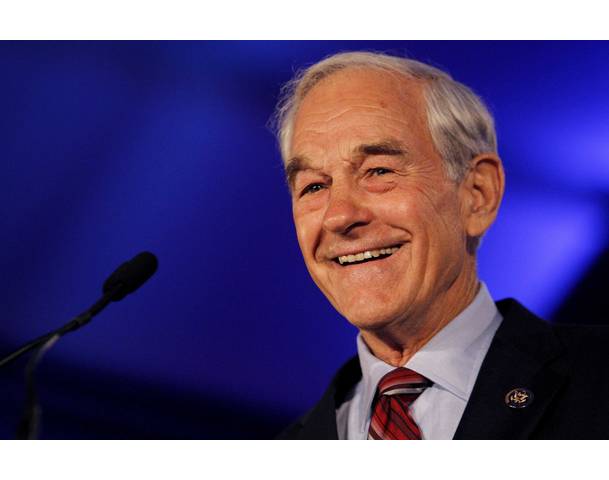
Ron Paul speaks during the Republican Leadership Conference: 2011
Is it just me, or are seemingly incessant GOP debates the past few months allowing President Obama’s lack of public exposure to seem more and more like solid leadership? The Republican lineups simplistic, square and reactionary focus on “Anti-Obama” rhetoric especially on foreign policy has highlighted a resoundingly hawkish stance on Iran with little attention to our current engagements in Afghanistan and Pakistan. And while it may be expedient amongst a certain political base to try and one-up each other in aggressive foreign policy talk, only Ron Paul challenges the party line on Americas role in the world.
When it comes to Pakistan, compared to Democrats Republicans have a consistent history of preferring to work closely with the military establishment in Islamabad. While there is a level of bipartisanship post 9/11, (case in point is Obama’s continuation of Bush era drone use with little debate), Republicans have through the Cold War and beyond preferred dealing with the military establishment rather than focusing on democratic, or liberal institution building. Which is not necessarily an entirely erroneous policy; part of the rationale is that state building is expensive in blood, toil, time and treasure and rarely feasible. Further, there are an endless number of constraints and uncertainties that profoundly hinder institution, or democratic state building in a place like Pakistan, rendering Republican policies simply pragmatic.
Which brings us to current policy: the bipartisan endorsed “Enhanced Partnership with Pakistan Act” (S. 1707) enacted in 2009 has yet to bear tangible fruit. Granted the aforementioned that institution building is time exhaustive, the fact remains that Pakistan has deteriorated politically, in the realm of security and economically. And having watched everyone from Gov. Romney, Sen. Santorun, Gov. Perry, Rep. Bachmann and yes even the soft spoken Gov. Huntsman, reiterates hawkish foreign policy while refusing to acknowledge a need for meaningful improvement. In the Republican camp only Rep. Ron Paul’s extreme calls for an isolationist posture offer some semblance of change. And because his prescriptions have yet to be tried, the utility of his ideas have yet to be tested. And now may be a time to consider his stance since they call for exactly what the Pakistani public wants right now.
Referring to our policies to Pakistan as nothing short of “Bombs for Bribes” Ron Paul acknowledges the nobility, yet inherent futility in calling for democratic institutions in places of strategic engagement. He understands that we are already engaged in “130 countries” with “700 bases around the world” and in this speech against the Enhanced Partnership with Pakistan Act, he bluntly explains:
“the way we treat our fellow countries around the world is we tell them what to do and if they do it, we give them money. If they don’t we bomb them. Under this condition we are doing both. We are currently dropping bombs in Pakistan and innocent people get killed. If you want to promote our good values and democratic processes, you can’t antagonize the people”
He goes on to suggest dialogue and trade as alternatives to current policy. And although his statement is simplistic and was made in 2009, it highlights Ron Paul’s isolationist, more economically focused prescriptions on foreign policy that seek to reduce our military footprint abroad based on pragmatic constraints, like military and fiscal overstretch. And these calls seem more reasonable than before, especially when it comes to Pakistan and the fact that our aid has yet to yield satisfactory results. So while the Obama administration continues engagement and GOP candidates refuse to acknowledge much concern over current policy to Pakistan, can Ron Paul really be the only alternative available?
Someone once considered completely out of left, excuse me, right field, could be the reminder we need to moderate our engagement with countries of interest. Because what is interesting is that current rhetoric in Pakistan is very much in line with Ron Paul’s ideas. Ron Paul isn’t touting conspiracy theories, nor does he echo far left foreign policy thinkers like Noam Chomsky. Rather, his past statements on our engagement in Pakistan as “inadvertently causing chaos” and “violating security and sovereignty” are exactly what the average Pakistani seems to feel and hears about in their mainstream TV, and print media. Takeaway for us means, it’s a perception the is realistic; perhaps more so than current policy reflects.
In fact, legendary cricket star turned politician Imran Khan’s recent surge in popularity is in large part due to his highly critical foreign policy rhetoric that vociferously calls for D.C. to adopt a more isolationist stance so Pakistan might reclaim lost autonomy. Imran Khan steadily built support for his party on the continued observation that America’s “War on Terror” has intensified insecurity and his subsequent promises to curtail American involvement is a first step in alleviating Pakistan’s problems.
He underscores Ron Paul’s sentiment that perceptions urgently matter in a climate where American intervention is increasingly received hostilely. Both politicians insistence on winnings hearts and minds renders Ron Paul’s foreign policy prescriptions worthy of consideration. Imran Khan’s recent ascendency and Governor Paul’s gradually increasing support marks a convergence in shifting to a direction of a less militarized approach to Pakistan. Two men once considered out of the realm of politician viability now increasingly resonate in their respective publics; policymakers ought to take note.
Reason We Should Remain Neutral –Quite simply: “After two terms as prime minister, he’s remembered for rampant corruption, nuclear proliferation, and his penchant for cozying up to Islamist militants“
Pervez Musharraf or Asif Zardari:
Reason We Should Remain Neutral –Well: “at the behest of Washington, General Pervez Musharraf, who was president at the time, arranged the amnesty that allowed Zardari and his wife, Benazir Bhutto, to return from exile so she could lead her Pakistan Peoples Party in elections. Bhutto was assassinated, and her husband became prime minister. Not without reason, many Pakistanis who are angry about Zardari’s corruption and ineffectiveness hold the United States responsible for imposing him on their country”
Pakistan Military:
Reason We Should Remain Neutral –Perpetuating rampant blame that one too many American backed military dictators have prevented democracy from ever taking root in Pakistan can’t help growing weariness of cooperation with our government.
Noteworthy example –Backing General Zia-ul-Haq in the 1980’s with his leadership key to training the Mujahideen (now known as Al Qaeda) to oust the Soviets from Afghanistan. Not coincidentally, Zia’s regime is remembered as the time Pakistan shifted from being a socially progressive, and moderate Islamic state, to imposing severe, fundamentalist religious policy reforms.
Chief Justice Iftekhar Chaudhry:
Reason We Should Remain Neutral: Under a sugar-coated banner of “democracy”, the Chief Justice is too blatantly partisan for us to support. His recent decision to repeal the National Reconciliation Ordinance, which set wheels in motion for regime change is widely understood as nothing short of a ploy for power and done in the politics of retribution.
This leaves neutrality as not only our most wise option, but also perhaps our most ethical route. Restraint in supporting any particular regime could mean history points one less finger in our direction should anything go less than perfect as we deepen involvement in Af-Pak. Simultaneously, neutrality assures Pakistani masses who are increasingly skeptical of cooperation with the United States that they have 100% autonomy in political processes.
Well publicized neutrality on a looming regime change could be a valuable opportunity to demonstrate a genuine interest in Pakistan as they transform politically and we require their support in the War on Terror.
NYTIMES does a good job of publishing weekly articles on the Af-Pak situation. And a recent piece had a very enticing title: “The Demons that Haunt Pakistan” . It conjured deep curiosity and I delved into it anticipating the “demons” referred to how terrorists have paralyzed the country since 9/11.
Instead, the writer interviews one oddball Psychiatrist who says the “Gucci suit” wearing Americans are the real terrorists and Blackwater is luring his hired help to engage in a grand U.S. conspiracy to destroy Pakistan. Based on this sole, very erratic viewpoint, she presumes that like a “teenager” Pakistan is “self-conscious, emotional, quick to blame others for its troubles” and is where conspiracy theories are “pervasive”.But the presumption that Anti-Americanism supersedes resentment of actual terrorists who have is not well founded. In fact, only at the end of the article does she acknowledge the moderate Pakistani viewpoint:
“Islam treats foreigners according to their wishes,” It’s not what these people (terrorists) say — killing them or asking others to terrorize them,” he said contemptuously of the militants. “We must treat everybody equally. Christians, Jews, Muslims”
The author refers to this as the “unlikely exception”, but on the contrary, this perspective is more likely to be found in Pakistan. The gentleman expressing this view is working class and the masses are working class. They’re not doctors or professionals whom the author erroneously cites as the norm. Further, it’s the working classes who struggle most with terrorism, not the sliver of Pakistan’s elite population who maintain comforts despite political upheaval. So the implication that demon-esque Anti Americanism is rooted in spectacular conspiracy theories is unlikely:
The majority masses are far more skeptical of Pakistani policymakers and domestic corruption than of Blackwater and the American, or Indian government for that matter.
More accurately on India, the author cites counter productive policies in Pakistan that maintained, rather than obliterated the feudal system and attributes the profound struggles of Partition to subsequent skepticism that has been harbored by both countries for one another since. Plus, having fought three wars in just 62 years, she explains it’s “natural that Pakistan’s security concerns focus more on its eastern border with India” and “not irrational” for Pakistan to resent American calls for change in this strategy.
The piece goes on to explain resentment of American policymaking viewed as “U.S. single-mindedly pursues it’s own interests as it did in the 80’s when it was confronting the Soviets”. And therein lies skepticism for the United States in Pakistan: it’s rooted in abandoning ship post the Soviet-Afghan war. Leaving Pakistan with one of the worlds largest refugee problems well ISI/CIA trained extremist Islamist militants in a developing country hasn’t boded well 20 years later. As a partial result, Pakistan hasn’t developed, it’s deteriorated. Cooperation in our Afghan operation in the 80’s isn’t perceived as productive. Thus,
Current skepticism of U.S. expansion in the Af-Pak war is not a matter of irrational, conspiracy theories or bitterness for all things American, it comes after prolonged, and now daily struggle against extremist Islam, and terrorists who massacre Pakistanis almost daily since 9/11.
President Obama stayed true to his word. During the presidential campaign last year, he vowed to hunt down Al Qaeda in Pakistan and after months of deliberation with Congress, his focus on deepening military involvement in the region has come to fruition. 30,000 more troops are promised to the Af-Pak war and in his speech yesterday, Obama focused squarely on the “inextricable” link Afghanistan and Pakistani security share. He insisted the “NWFP” is where terrorist leadership including 9/11 masterminds Osama bin Laden and Ayman al Zwahiri find “safe haven” and reiterated an urgency to pass the Kerry Lugar bill. But overall,
No new strategy was laid out. We’re sending more troops without any information that an improved plan is in place. With an increased focus on Pakistan knowing it has deteriorated since the War on Terror began, it is critical to see details of a more effective Af-Pak strategy.
Politicians, pundits, scholars, journalists and even bloggers like myself have called for increased intelligence sharing and military training from our end to Pakistani forces to uproot terrorists. And President Obama briefly, but finally acknowledged this would take place. However, it was said almost in passing relative to 9/11 rhetoric reminding us that we must stand in solidarity with our allies and expand our efforts in the war on terror. Which is important, however, after 8 long years of conflict and heavy taxpayer dollars allocated to this war in a downward economy, I expected at least some details of a revamped approach. Otherwise there’s a fear that more of the same will lead to more of the same: an escalation of our engagement and simultaneous worsening in the region.
There’s a very good piece in the Los Angeles Times explaining this troop surge is a replay of our approach in Iraq. The idea is that a temporary troop surge with predetermined date of withdrawal allows domestic security forces time to develop so that when our troops leave, they manage security to a large extent on their own. However, experts in the article point out that Afghanistan is vastly different from Iraq and a troop surge might not yield similar success in this case. Also, there’s little mention of Pakistan because a
troop surge would not apply to Pakistan where established military and paramilitary security forces already exist. Thus Obama’s square focus on Pakistan in tandem with a troop surge is incomplete without additional details on a revamped strategy.
And the Kerry Lugar bill is not sufficient. The fact that President Obama at the beginning of his speech still urges us to support the legislation despite widespread skepticism at home and in Pakistan, is testimony to how much a new plan is needed. Let’s hope we hear one soon.
Zainab Interviews the Honorary Sharifuddin Pirzada
Q & A BREAKDOWN
PAST LEADERS: Jinnah
2:39 – 3:17 – Former BJP Parliamentarian Jaswant Singh authored a book on Jinnah that is receiving a lot of controversy, having actually worked with Jinnah, can you share your thoughts on the book ?
3:20 – 4:42 – In recent interviews, Singh has said Muslims in India are “robbed of their psychological security” and basically downtrodden. He says what Jinnah should have done is left some advice for Indian Muslims who stayed back and didn’t migrate to Pakistan after partition, what do you think Jinnah might have said?
4:44-6:01 – He also refers to Jinnah as a “nationalist” not at all Anti-Indian, please expand
6:01-7:34 – Referring to politics, when Jinnah split from the Congress party eventually formulating a two state idea later in his career, were there any politics referring to Nehru or Gandhi that had an impact on decision making? Jaswant Singh makes a mention to some, what does your experience tell us?
7:35: – 8:15 – You’ve mentioned previously that Jinnah was a self made man, more details?
8:15 – 8:55 : Tell us about your experience with Jinnah, its a rare treat for us to have your insight
8: 55 – 9:22 – Further details, conclusion on Jinnah.
“Jinnah had the Charm of Churchill, Dignity of de Gaulle, Magnetism of Mandela, and Objectivity of Obama”
CURRENT LEADERS : Musharraf
9:23 – 10:47 – Shifting to current leaders now, lets talk about Musharraf. You’ve got great experience, tell us about your work with the former General and Leader of Pakistan.
10:48 – 11:55 – How did your work with Musharraf expand during his tenure?
12:56 – 13:45 – You served on the national security council & as senior advisor to Gen. Musharraf, tell us howthe context of national security in Pakistan changed after 9/11. Specifically what came on the agenda, what were the immediate concerns and interests and what drove the decision to behave the way Pakistan did at the time?
13:45 – 15:48 – Recent polls indicate a majority of pakistanis think Musharraf should be punished for treason as per laws under article 6 of the Constitution, how do you feel about that?
15:48 – 14:55 – Do you think it’s a valid case that Musharraf be tried for treason?
14:54 – 15:38 – Regarding an increasingly free media in Pakistan, please offer further insight
15:38 – 16:16 – There’s a contention that the currently free media be attributed to Benazir Bhutto’s regime wherein sateilite technology allowing expanded media was put in place, while others assign credit to Musharraf. Can you clarify this?
16:16 – 18:39 – Do you think it was the state of emergency and sacking of the judiciary that caused Musharraf to lose elections?
18:42 – 19:35 – Final question on Musharraf, what do you think his legacy would be?
“The Media is very free in Pakistan, and Musharraf is to be given a great deal of credit for that”
CURRENT LEADERS : Zardari
19:48 – 20:55 – Recent military achievements in SWAT and international trade deals penned by Zardari paint a somewhat rosy picture for the future, what are your thoughts on him so far?
US – PAKISTAN RELATIONS:
20:57 – 23:14 – There’s a US special envoy in the region, drone attacks continue, the west is pushing for rapid democratization and are heavily investing in counterterrorism through cooperation with Pakistan while Islamabad hopes to secure itself and expand economically in this engagement. But there’s a long history of cooperation but still a lot of skepticism on both sides, do you think current engagement with a new administration who promises more diplomacy will yield different results than we’ve seen in this alliance?
23:14 – 24:52 – What advice might you offer President Obama or the State department in terms of engaging Pakistan?
“Pakistan was member of SEATO and CENTO but certain conditions were not fulfilled and there is a strong section of Pakistan who has reservations with a cordial relationship with the United States”
PAKISTAN & THE MUSLIM WORLD
24:55 – 25:11 – Your position at the Organization of Islamic Conference?
25:13 – 25:57 – On the Israeli Palestinian issue, how do you assess the current two state solution that Obama has put forward? How viable is it?
25:57 – 26:25 – What is Pakistan’s diplomatic/official stance on the Israeli Palestinian Issue?e Islamic Conference
12:25 – 26:35 – What are the main priorities of the Organization of the Islamic Conference?
“The Palestinian Issue followed by Kashmir are of top priority to the Organization of Islamic Conference”
PAKISTAN BORDER RELATIONS : INDIA & AFGHANISTAN:
26:35 – 27:42 – Manmohan Singh & Prime Minister Gilani at the NAAM summit this summer agreed to bracket issues of Terrorism and move forward on peace talks and trade issues. Such rhetoric is not new, and might not reach fruition, so do you see anything being resolved in Kashmir anytime soon, without the help of the US?
27:44 – 28:44 – Elections in Afghanistan are being contested between Abdullah Abdullah and incumbent Karzai. Pakistan doesn’t seem keen on either because both signal a warming of relations between Kabul & New Delhi which is believed to come at a direct expense to Islamabad. How do you feel about that?
America can facilitate peace talks between India and Pakistan on Kashmir, but on the whole, people of Kashmir are still suffering and struggling. The approach of prime ministers has been positive, but an extremist element in India exists which doesn’t want this. To stop suffering in Kashmir, a solution must be reached.
PAKISTAN’S INTERNATIONAL FUTURE:
28:44 – How do you see geopolitics playing out in the next decade for Pakistan, given amplified US presence, including super embassies being constructed in Pakistan/Afghanistan, perpetually stalled relations with India, a very likely nuclear neighbor in Iran, and increasingly influential China and polarized Russia, what does Pakistan look like ten years from now?
“Pakistan in the next ten years must concentrate on democratic set up, economic development & maintaining cordial relatoins with Islamic countries. There are two great friends of Pakistan: Saudi Arabia, the other is China. That’s a good starting point”
What happens when a majority of one country’s citizens opt for martial law but the democratically elected government in power including judicial, executive and legislative branches are against a military takeover? It’s quite the political conundrum because either side offers legitimate democratic authority, but they’re diametrically opposed. A rational answer is to let the democratically elected government fulfill it’s term and allow citizens to elect politicians to office who will support martial law in the next term. That might work in a fully functional democracy backed by institutions that can uphold legitimacy and granted the state is sufficiently secure. However, in light of decreasing security, severe economic downturns and age old skepticism of U.S. actions in Pakistan, ever so gradually the country shifts it’s gaze toward the military.
Decreasing Security :: To offer partial explanation in a nutshell: Since 2001, terrorists fleeing Operation Enduring Freedom in Afghanistan, spilled over into Pakistan at the nebulous northern border areas which are historically autonomous from federal regulation. The fact that Pakistan already housed one of the worlds largest refugee populations allowed this spillover a massive and destitute demographic from which to exploit support. As a result, we now see unprecedented terrorism in Pakistan where Al Qaeda and the Taliban had no significant presence prior to 9/11.
Skepticism of U.S.’s Role in Pakistan:: Since the inception of Pakistan in 1947, bilateral realations with the United States have been defined by cooperation wherein Pakistan served as a proxy for U.S. Containment throughout the Cold War (i.e. security pacts like SEATO, CENTCOM, then aiding our Afghan led defense against Soviet incursions in the 1980’s). In exchange, Pakistan’s military with U.S. support, bolstered itself as the strongest, most efficient and stable institution in Pakistan. Some argue civilian governments and democratic institutions were thus never given an opportunity to compete with such a well funded, strongly backed military. And therein we find multifaceted dimensions that help explain the controversy over current U.S. support of Pakistan. Former Pakistan to U.S. ambassador Maleeha Lodhi describes the Kerry Lugar bill:
“the offending part of the legislation sets up the country as hired help and puts the military in the dock, presumed guilty on many counts and having to prove its innocence to Washington”
Pakistan is “hired help”, that’s the crux of skepticism on the Kerry-Lugar bill. Concern is rooted in a long history of cooperation with the United States that some argue created a behemoth military institution costing them a fair chance at democracy. In attempt to address that very concern, the Kerry Lugar bill mentions no military aid in exchange for cooperation on the War on Terror, unlike previous assistance packages from the Cold War. Ironically, bleak affairs in Pakistan now which are partially a result of pervious cooperation, particularly during the Soviet Afhgan war, prompt arguments that the military is exactly what needs support right now. Thus, the Lugar Bill receives not only skepticism from Pakistan’s strongest institution, but increasingly the public.
Although Secretary Clinton and Senators Kerry and Lugar have made no indication of altering the bill, to avoid future skepticism and potential resentment of U.S. involvement in Pakistan it could be wise to make changes so as to not sideline the military at this critical period in our War on Terror. Unlike previous Republican presidencies, the Obama administration is committed to dealing with civilian governments in Pakistan. It’s a noble idea and even though i don’t suspect that as the military gains legitimacy the civilian government will collapse soon, we should think twice before riling such concern over a bill that has just a 5 year life span. Central and South Asia are critical regions for our interests and we may need to engage strategically positioned Pakistan in more years to come. So a backlash by the most powerful institution in that country is something we should anticipate, and work actively against.
At the heels of Pakistan’s offensive against militants in South Waziristan, terrorists brazenly staged an attack on military headquarters this weekend. Commandos responded swiftly, taking out 9 of the militants, capturing their ring leader and freeing 39 hostages. Despite success in ending the siege, the incident demonstrates a worsening Af-Pak situation and beseeches a new strategy.
Our administrations new strategy is defined by an increase in troops to Afghanistan, focusing military efforts squarely on Al Qaeda (less focus on Taliban) and expanded funding to Pakistan by way of the Kerry Lugar bill. And while the troop surge and emphasis on Al Qaeda are debated at length in D.C., the Pakistani media is abuzz on the Kerry Lugar bill. There are calls by The Awami League Party (representing the NWFP regions & a predominantly Pashtun population) that the bill allow for an “uninterrupted flow of non military assistance” while other politicians vouch against the legislation altogether. Tehrik-e-Insaaf chairman Imran Khan said the bill “enslaves” Pakistan and can only benefit the top echelons of government referring to past corruption allegations on senior government officials. Similarly, pundits were all over Pakistani television in the past week, echoing concerns about corruption, lack of support to the military, too many strings attached to funding, and how the bill threatens sovereignty. This morning Foreign Minister Shah Mahmood Qureshi flew to D.C. to discuss theseconcerns just as rumours that Pakistan’s Ambassador to the United States is losing his post becayse of not entirely positive comments regarding the Kerry-Lugar legislation. Suffice to say, the Enhanced Partnership with Pakistan Actmeant to extend a new strategic hand of cooperation to Islamabad is not off to the positive start intend
In fact, Senator Kerry’s office directly responded to popular skepticism in a recent report.
Addressing concerns that the bill would invade state soveriegnty: Senator Kerry explains the bill funds “schools, roads, energy infrastructure and medical clinics” and that “those seeking to undermine” a US/Pakistan in that endeavor are doing so to “advance narrow partisan or institutional agendas“.
Regarding the idea that the legislation comes with too many strings attached, Kerry emphasizes that the $7.5 billion annual pledge is for “unconditioned non military aid” and comes with “strict measures of financial accountability” referring specifically to Executive Branch oversight on the use of these funds.
This is contentious to Pakistan because it’s maybe the first time external oversight is imposed on assistance from the United States. And while the bill does a great job of outlining funds for social infrastructure intended to find it’s way to everyday citizens, on the issue of sovereigty, the real sticking point is regarding a potential subversion of the Pakistani military. Senator Kerry insists that the bill’s:
“focus is on nonmilitary assistance to the people of Pakistan” and military aid is contingent to “cooperation on nonproliferation“. However, the bills funding is rooted in “significant efforts towards combating terrorist groups” and the “Pakistani military not subverting the political or judicial process” to ensure “common goals” of “security and democracy“.
This irks Pakistani’s for a number of reasons. Firstly, there’s ambiguous wording. “Cooperation on nonproliferation” is vague enough to translate as potentially linking funds to Pakistan giving up their right to maintain armaments comparable to neighboring India. Similarly, “significant efforts toward combating terrorism” gives no reference for how this will be measured.
On the Pakistan side, the worry is that “significant efforts”, according to their definition might not match a U.S. definition of success. Plus there might continue to be a disagreement on the idea of “combating terrorism”. It’s a contention we’ve seen play out as D.C. repeatedly called for heightened efforts on combating the Taliban, quitely but surely opposing Pakistan’s attempts at negotiating with those groups rather than employing just a military offensive, (a policy we’re now reverting).
Also, delinking assistance from the military is unprecedented and freightening to some because while it is necessary to develop schools, and social, democratic infrastructure for long term development, in the immediate term there are widespread security breaches with weekly suicide attacks, an ever growing incursion from Afghan militants on the northern border and drone attacks that result in collateral damage.
So Pakistans concerns echo a need for both immediate security and long term development, but not at the expense of one another.
Keep in mind, the widely held, and all but true notion that Pakistan is perhaps the only place where the military controls a country, and not vice versa. That idea is rooted in that their military is historically the strongest, most stable and legitimately accepted institution. Let me emphasize that last part: it’s historically the most legitimately accepted institution in Pakistan in an absence of stable democratic institutions never having developed. Meaning, in times of economic, social and political uncertainty, the military has historically responded most efficiently in alleviating situations since 1947. Whether one accepts the idea that the military creates a perpetual cycle of uncertainty within which to assume power periodically, or the military responds to the shortcomings of civilian governments in the absence of democratic instiuttions (chicken & egg argument), either way, the military’s been relatively effective in handling crises in Pakistan in comparison to civlian regimes. So given the current enviornment of insecurity, people are weary of a hopeful promise for “long term” moves toward “democracy” that might comes at the expense of insufficient assistance to their military who has a capacity to alleviate immediate security concerns.
I think democracy is the ultimate route to security for Pakistan, but despite Executive branch oversight and our “long term” commitment defined by only 5 years of funding, Pakistan’s concerns are understandable. Given a long history of cooperation, Pakistan is more used to US assistance through bilateral relations with a Republican government in DC (think General Zia/Raegan, General Musharraf/Bush, Ayub Khan/Eisenhower, Yahya/Nixon) and the Kerry Lugar bill is a staunch reverasal of our foreign policy with Islamabad. Perhaps finding value in previously crafted policies to Pakistan in combination with our current legislative proposals is an optimal solution to quelling the enahanced concern of our enhanced cooperation.



 Zainab B. Jeewanjee
 Zainab Jeewanjee