
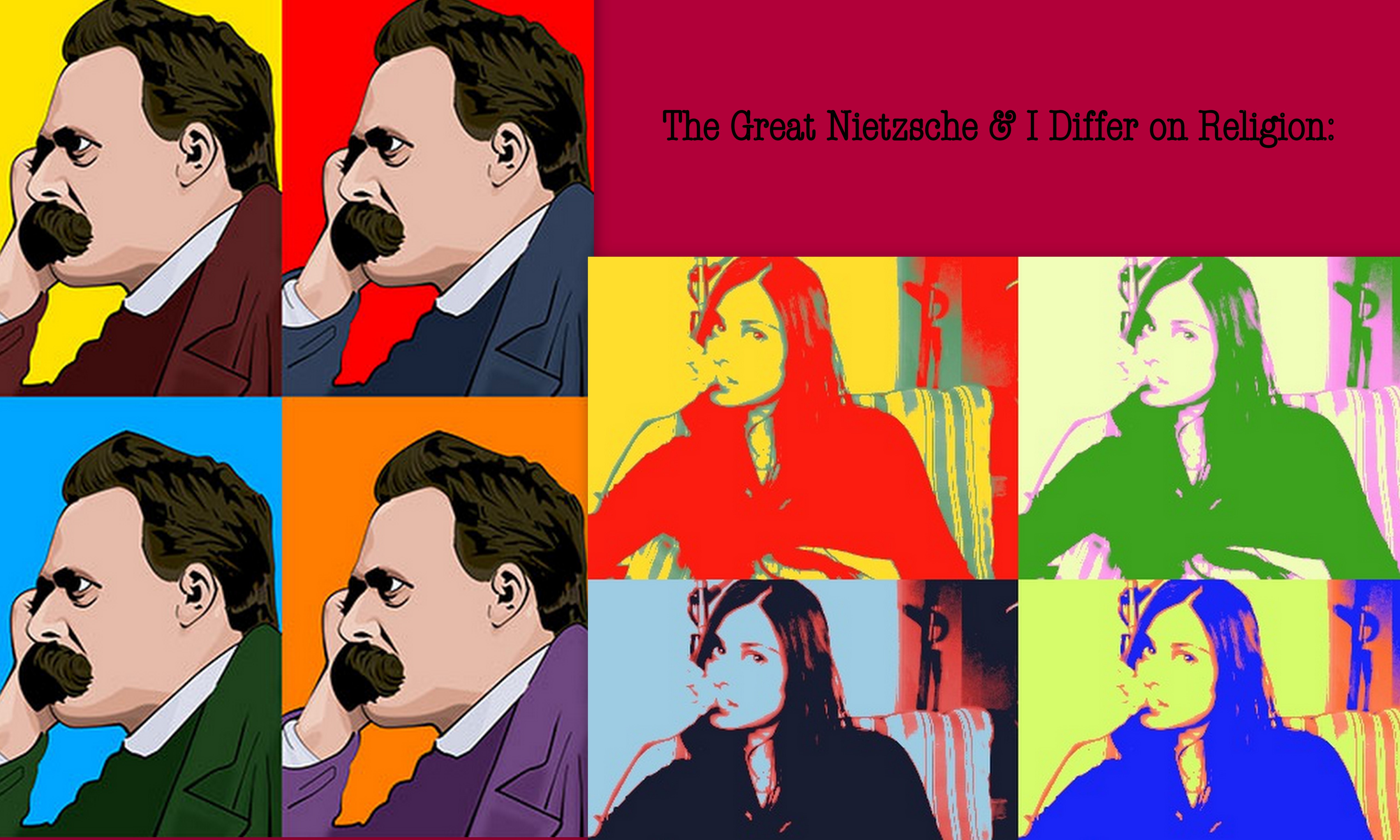
Friedric Nietzsche & Zainab Jeewanjee : Can't agree on Religion
There’s an amazing article this week at TruthDig.com by Mr. Chris Hedges entitled “After Religion Fizzles, We’re Stuck with Nietzsche”. Hedges’ gist is that the core teachings of Abrahamic faiths (Islam, Christianity and Judaism) “are now lost in the muck of church dogma, hollow creeds and the banal bureaucracy of institutional religion”
Not a new argument; criticism of organized religion for being dogmatic is as ubiquitous as my generations disdain for Michael Jackson (God Rest his Soul).
And Hedges’ does a fairly sound job of supporting a censure of religious institutions by the notion of their failure to “unequivocally denounce unfettered capitalism, globalization and pre-emptive war” concluding that “empowerment of the individual conscience which was the starting point of great ethical systems of civilization” from Confucius to Kant have been traded for adherence to poorly outlined ideologies touted by dogmatic religious institutions. He prescribes we revert to an introspective, individual questioning of authority to guide our moral sense. And I like it; I want to expand on that notion, especially since Nietzsche, although super duper fascinating always irked me with his too sweeping condemnation of religion.
To pick up where Hedges article leaves off; what does happen when we’re “stuck” with the emptiness of Nietzsche’s notion that there is no morality? Like Hedges Nietzsche criticizes religion as inherently dogmatic, but to a far greater extent. Nietzsche says organized religion is riddled with the voids created by an incorrect contention that fixed perspectives exist. I read his work Beyond Good and Evil last year wherein with Christianity in particular,
Nietzsche finds religion prescribes actions, if not an entire way of life based on faulty contentions; faulty in that they are rooted on a morality that is inherently relative; he might even say contrived.
Specifically contrived is morality rooted in asceticism that accompanies organized religious expectations such as those calling for chastity (think Catholic priests) or abstinence from both food and sexual pleasure in the form of fasting (think the Muslim Holy month of Ramadaan). Such boundaries according to Nietzsche give rise to a society of undiscerning masses who wallow, yet make every effort in their struggle to achieve nothing more than a kind of denial, suffering and ultimately, mediocrity.
On top of that, prescriptions of asceticism being rooted in religious truths assumed to be absolute, constant and certain come into question and eventual conflict in light of more modern rationality which is less rooted in faith and instead in science, as Hedges would agree. Thus atheism becomes more readily accepted as the concept of God in and of itself is less able to be reconciled with advances in science that defy so called truths upon which religious prescriptions for a faithful life are based.
So to accept that time and space are relative, denying that absolute truth can ever be experienced and that religious asceticism in specific is nothing more than a pacifying consolation for an individual, Nietzsche’s philosophy condemns Abrahamic faith for their prescription’s of ultimately, a lifetime of mediocrity.
Thus his subsequent explanation for increasing atheism is understandable, however makes religion out to be a dismal experience in utter ignorance. And the bleak realization of such an argument can immediately prompt a kind of defensiveness wherein such radical challenges are immediately contested.
Although I consider myself moderately religious with a most certain faith in a monotheistic God, without intentionally being defensive in response to Nietzsche’s criticism of religion, I find his assertions contradictory to a notion of faith. Because if his premise is that there are no absolutes, and the problem with religion is that it cannot easily be reconciled with science, which is often considered to be in and of itself a kind of certainty, then it is perhaps difficult to reconcile the very notion that absolute truths do not exist and perspectives are relative to time and space.
By arguing that something mostly accepted as absolute, certain and “true” as science is a reasonable explanation against the spread of theism, Nietzsche himself lends credibility to the notion that certain truths might actually exist.
To clarify: if institutionalized religion is embedded in dogmatism founded on untruths as proved by its inability to reconcile with the realities of science, then would science then not be, in its strong opposition to religion, a body of at least some truths? Especially given that science is today generally regarded as irrefutable given its own roots in empirical procedures and products.
Furthermore, this raises the inevitable question that, in the absence of religion or philosophy then, what is morality, or the “right thing to do”? Nietzsche may argue that there is no certain definition of what is moral since it would be relative to time and space. However, again, accepting that a certain epistemic confinement is a plausible result of the dogmatism of religion, then is faith not then a credible means to achieving morality since it is rooted not in any tangible, scientific or absolute truth?
Faith is then relative as it requires no truth. Given the absence of absolute truths, faith then becomes quite conducive to my understanding of Nietzsche in that it seamlessly accepts the possibility of not knowing for certain.
Of course, this can itself become dogmatic and therefore problematic when individuals reach an extreme wherein reason and scientific and other rationale are abandoned for fanatical faith and harmful ends. But bracketing the extreme and assuming moderation as the norm for most individuals of “faith”, religious spirituality, especially a sincere belief in an intangible God who Nietzsche himself describes as “incapable of making himself clearly understood”, then can be a strong, and perhaps ironically, “spiritual” acceptance in the notion of a relative existence.
***sigh*** So guess I’m gonna have to just beg to differ with the late, great Nietzsche on this one and send my props to Mr. Hedges for a very insightful piece 😉


 Zainab B. Jeewanjee
 Zainab Jeewanjee