On the second day of a five-day test match between England and Pakistan,picture yourself as a young bowler, just out of your teens and already being anticipated as the next Wasim Akram.You represent a country that’s flooded by pain and suffering of natural disaster, plus the torment of an unnatural flood of arms, and terrorism. To top it off your home turf is off limits because of lacking security and you’re playing cricket on a foreign ground; in a country who ruled you in colonial grip for over 200 years, a tinge that might linger 63 years later.
The stage is set. The batting lineup has already let you down, and your bowling is expected to carry the team to a respectable outcome.But the angels above have arranged for ideal weather conditions and a pitch perfect for your deadly pace. The Gods are giving Pakistan an opportunity for redemption.
You take to the pitch and imagine sending a fierce, fast, reverse swinging bowling onslaught on the opponent. They’ve already overtaken your score yesterday, so you’re aiming to contain them, preserving the scant runs your side managed, and bowl the opposition out as soon as possible. You take a run up. Jogging 20 yards toward the batsman; you release the ball and he is confounded. You feel a rush of excitement. Batsman nicks it, sending the ball aloft for the simplest of catches. Your excitement steadily intensifies and you think to yourself; the Gods are on my side.You watch the ball elevate into the sky, higher, and higher and slowly descend. The Gods have arranged for it fall directly in front of first slip, and you eye your teammate’s hand intently. The ball falls directly into his palms and you feel relieved; this is the one job you can count on first slip to do. He also happens to be a top order batsman who should be longing to save face and take this crucial wicket to make up for his less than sufficient run rate. You take into account the team has already let three catches go, optimism pervades and you think, “we definitely have this one”.
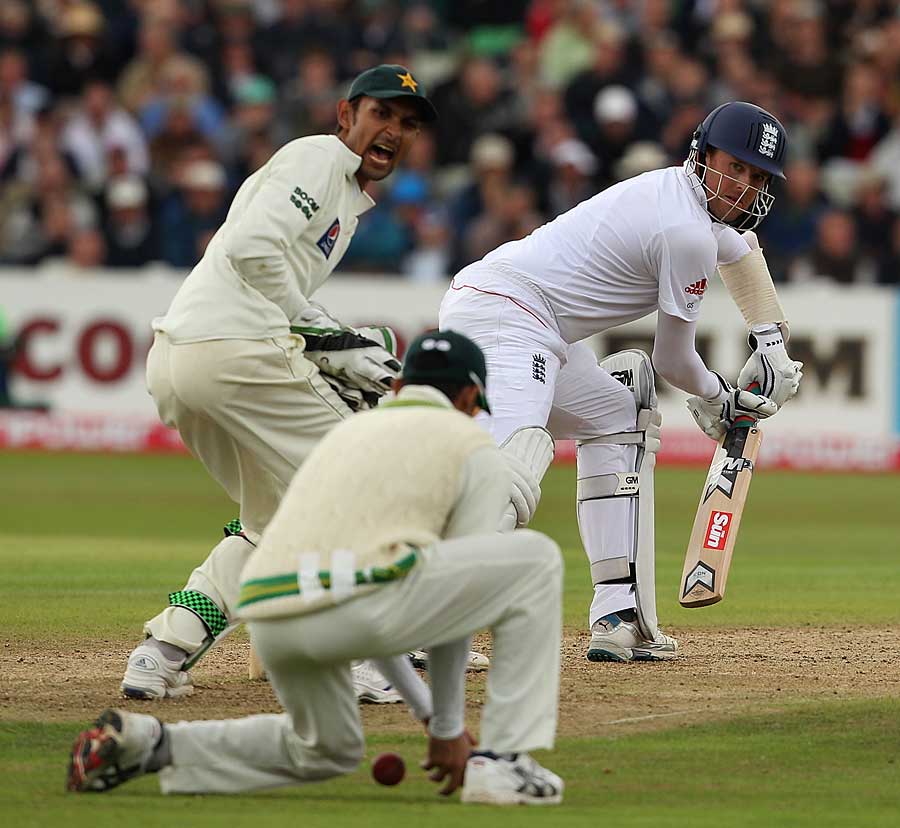
Pakistan another Drop Catch in Cricket vs England - August 2010
Every millisecond feels like miles as the ball falls into first slips hands. Fielders jump in victory and the crowd cheers but simultaneously, first slip drops the ball as it falls dead into the still green grass.
For a second maybe no body saw it, but the bowler is crestfallen.Excitement deflated. With a tear that never fell, he looks at the young man at slip. Slip stares back at him and with words he can’t muster, the bowler bravely smiles. His heart is racing with a million emotions but zero time to reflect on any of them, the bowler desperately focuses. His brain wants to let something out to his teammate, on his team who didn’t score enough runs, and dropping no less than 4 catches squandering opportunities the Gods laid out in this match.
I couldn’t take it anymore. I got up and made myself tea. Even thousands of miles away from England, even farther away from Pakistan, I didn’t want to face the complexities of what that bowler might have felt.So I raise my hands in prayer to whoever controls the world around us and say please, give Pakistan a break.
It reminds me of Earnest Borgnine in the Poseidon Adventure when he looks up to God in the middle of disaster and cries: “What more do you want of us? We’ve come all this way on our own no help from you. We did ask you to fight for us but damn it, don’t fight against us!”
Give Pakistan a break. I urge everyone who reads this article that as the brave bowler took strength to smile, recuperate and move forward, if you do nothing else, donate to the flood victims. Pakistan needs hope right now, and every contribution, big or small, will go a long way for those in need.
NYTIMES does a good job of publishing weekly articles on the Af-Pak situation. And a recent piece had a very enticing title: “The Demons that Haunt Pakistan” . It conjured deep curiosity and I delved into it anticipating the “demons” referred to how terrorists have paralyzed the country since 9/11.
Instead, the writer interviews one oddball Psychiatrist who says the “Gucci suit” wearing Americans are the real terrorists and Blackwater is luring his hired help to engage in a grand U.S. conspiracy to destroy Pakistan. Based on this sole, very erratic viewpoint, she presumes that like a “teenager” Pakistan is “self-conscious, emotional, quick to blame others for its troubles” and is where conspiracy theories are “pervasive”.But the presumption that Anti-Americanism supersedes resentment of actual terrorists who have is not well founded. In fact, only at the end of the article does she acknowledge the moderate Pakistani viewpoint:
“Islam treats foreigners according to their wishes,” It’s not what these people (terrorists) say — killing them or asking others to terrorize them,” he said contemptuously of the militants. “We must treat everybody equally. Christians, Jews, Muslims”
The author refers to this as the “unlikely exception”, but on the contrary, this perspective is more likely to be found in Pakistan. The gentleman expressing this view is working class and the masses are working class. They’re not doctors or professionals whom the author erroneously cites as the norm. Further, it’s the working classes who struggle most with terrorism, not the sliver of Pakistan’s elite population who maintain comforts despite political upheaval. So the implication that demon-esque Anti Americanism is rooted in spectacular conspiracy theories is unlikely:
The majority masses are far more skeptical of Pakistani policymakers and domestic corruption than of Blackwater and the American, or Indian government for that matter.
More accurately on India, the author cites counter productive policies in Pakistan that maintained, rather than obliterated the feudal system and attributes the profound struggles of Partition to subsequent skepticism that has been harbored by both countries for one another since. Plus, having fought three wars in just 62 years, she explains it’s “natural that Pakistan’s security concerns focus more on its eastern border with India” and “not irrational” for Pakistan to resent American calls for change in this strategy.
The piece goes on to explain resentment of American policymaking viewed as “U.S. single-mindedly pursues it’s own interests as it did in the 80’s when it was confronting the Soviets”. And therein lies skepticism for the United States in Pakistan: it’s rooted in abandoning ship post the Soviet-Afghan war. Leaving Pakistan with one of the worlds largest refugee problems well ISI/CIA trained extremist Islamist militants in a developing country hasn’t boded well 20 years later. As a partial result, Pakistan hasn’t developed, it’s deteriorated. Cooperation in our Afghan operation in the 80’s isn’t perceived as productive. Thus,
Current skepticism of U.S. expansion in the Af-Pak war is not a matter of irrational, conspiracy theories or bitterness for all things American, it comes after prolonged, and now daily struggle against extremist Islam, and terrorists who massacre Pakistanis almost daily since 9/11.
President Obama stayed true to his word. During the presidential campaign last year, he vowed to hunt down Al Qaeda in Pakistan and after months of deliberation with Congress, his focus on deepening military involvement in the region has come to fruition. 30,000 more troops are promised to the Af-Pak war and in his speech yesterday, Obama focused squarely on the “inextricable” link Afghanistan and Pakistani security share. He insisted the “NWFP” is where terrorist leadership including 9/11 masterminds Osama bin Laden and Ayman al Zwahiri find “safe haven” and reiterated an urgency to pass the Kerry Lugar bill. But overall,
No new strategy was laid out. We’re sending more troops without any information that an improved plan is in place. With an increased focus on Pakistan knowing it has deteriorated since the War on Terror began, it is critical to see details of a more effective Af-Pak strategy.
Politicians, pundits, scholars, journalists and even bloggers like myself have called for increased intelligence sharing and military training from our end to Pakistani forces to uproot terrorists. And President Obama briefly, but finally acknowledged this would take place. However, it was said almost in passing relative to 9/11 rhetoric reminding us that we must stand in solidarity with our allies and expand our efforts in the war on terror. Which is important, however, after 8 long years of conflict and heavy taxpayer dollars allocated to this war in a downward economy, I expected at least some details of a revamped approach. Otherwise there’s a fear that more of the same will lead to more of the same: an escalation of our engagement and simultaneous worsening in the region.
There’s a very good piece in the Los Angeles Times explaining this troop surge is a replay of our approach in Iraq. The idea is that a temporary troop surge with predetermined date of withdrawal allows domestic security forces time to develop so that when our troops leave, they manage security to a large extent on their own. However, experts in the article point out that Afghanistan is vastly different from Iraq and a troop surge might not yield similar success in this case. Also, there’s little mention of Pakistan because a
troop surge would not apply to Pakistan where established military and paramilitary security forces already exist. Thus Obama’s square focus on Pakistan in tandem with a troop surge is incomplete without additional details on a revamped strategy.
And the Kerry Lugar bill is not sufficient. The fact that President Obama at the beginning of his speech still urges us to support the legislation despite widespread skepticism at home and in Pakistan, is testimony to how much a new plan is needed. Let’s hope we hear one soon.
At the heels of Pakistan’s offensive against militants in South Waziristan, terrorists brazenly staged an attack on military headquarters this weekend. Commandos responded swiftly, taking out 9 of the militants, capturing their ring leader and freeing 39 hostages. Despite success in ending the siege, the incident demonstrates a worsening Af-Pak situation and beseeches a new strategy.
Our administrations new strategy is defined by an increase in troops to Afghanistan, focusing military efforts squarely on Al Qaeda (less focus on Taliban) and expanded funding to Pakistan by way of the Kerry Lugar bill. And while the troop surge and emphasis on Al Qaeda are debated at length in D.C., the Pakistani media is abuzz on the Kerry Lugar bill. There are calls by The Awami League Party (representing the NWFP regions & a predominantly Pashtun population) that the bill allow for an “uninterrupted flow of non military assistance” while other politicians vouch against the legislation altogether. Tehrik-e-Insaaf chairman Imran Khan said the bill “enslaves” Pakistan and can only benefit the top echelons of government referring to past corruption allegations on senior government officials. Similarly, pundits were all over Pakistani television in the past week, echoing concerns about corruption, lack of support to the military, too many strings attached to funding, and how the bill threatens sovereignty. This morning Foreign Minister Shah Mahmood Qureshi flew to D.C. to discuss theseconcerns just as rumours that Pakistan’s Ambassador to the United States is losing his post becayse of not entirely positive comments regarding the Kerry-Lugar legislation. Suffice to say, the Enhanced Partnership with Pakistan Actmeant to extend a new strategic hand of cooperation to Islamabad is not off to the positive start intend
In fact, Senator Kerry’s office directly responded to popular skepticism in a recent report.
Addressing concerns that the bill would invade state soveriegnty: Senator Kerry explains the bill funds “schools, roads, energy infrastructure and medical clinics” and that “those seeking to undermine” a US/Pakistan in that endeavor are doing so to “advance narrow partisan or institutional agendas“.
Regarding the idea that the legislation comes with too many strings attached, Kerry emphasizes that the $7.5 billion annual pledge is for “unconditioned non military aid” and comes with “strict measures of financial accountability” referring specifically to Executive Branch oversight on the use of these funds.
This is contentious to Pakistan because it’s maybe the first time external oversight is imposed on assistance from the United States. And while the bill does a great job of outlining funds for social infrastructure intended to find it’s way to everyday citizens, on the issue of sovereigty, the real sticking point is regarding a potential subversion of the Pakistani military. Senator Kerry insists that the bill’s:
“focus is on nonmilitary assistance to the people of Pakistan” and military aid is contingent to “cooperation on nonproliferation“. However, the bills funding is rooted in “significant efforts towards combating terrorist groups” and the “Pakistani military not subverting the political or judicial process” to ensure “common goals” of “security and democracy“.
This irks Pakistani’s for a number of reasons. Firstly, there’s ambiguous wording. “Cooperation on nonproliferation” is vague enough to translate as potentially linking funds to Pakistan giving up their right to maintain armaments comparable to neighboring India. Similarly, “significant efforts toward combating terrorism” gives no reference for how this will be measured.
On the Pakistan side, the worry is that “significant efforts”, according to their definition might not match a U.S. definition of success. Plus there might continue to be a disagreement on the idea of “combating terrorism”. It’s a contention we’ve seen play out as D.C. repeatedly called for heightened efforts on combating the Taliban, quitely but surely opposing Pakistan’s attempts at negotiating with those groups rather than employing just a military offensive, (a policy we’re now reverting).
Also, delinking assistance from the military is unprecedented and freightening to some because while it is necessary to develop schools, and social, democratic infrastructure for long term development, in the immediate term there are widespread security breaches with weekly suicide attacks, an ever growing incursion from Afghan militants on the northern border and drone attacks that result in collateral damage.
So Pakistans concerns echo a need for both immediate security and long term development, but not at the expense of one another.
Keep in mind, the widely held, and all but true notion that Pakistan is perhaps the only place where the military controls a country, and not vice versa. That idea is rooted in that their military is historically the strongest, most stable and legitimately accepted institution. Let me emphasize that last part: it’s historically the most legitimately accepted institution in Pakistan in an absence of stable democratic institutions never having developed. Meaning, in times of economic, social and political uncertainty, the military has historically responded most efficiently in alleviating situations since 1947. Whether one accepts the idea that the military creates a perpetual cycle of uncertainty within which to assume power periodically, or the military responds to the shortcomings of civilian governments in the absence of democratic instiuttions (chicken & egg argument), either way, the military’s been relatively effective in handling crises in Pakistan in comparison to civlian regimes. So given the current enviornment of insecurity, people are weary of a hopeful promise for “long term” moves toward “democracy” that might comes at the expense of insufficient assistance to their military who has a capacity to alleviate immediate security concerns.
I think democracy is the ultimate route to security for Pakistan, but despite Executive branch oversight and our “long term” commitment defined by only 5 years of funding, Pakistan’s concerns are understandable. Given a long history of cooperation, Pakistan is more used to US assistance through bilateral relations with a Republican government in DC (think General Zia/Raegan, General Musharraf/Bush, Ayub Khan/Eisenhower, Yahya/Nixon) and the Kerry Lugar bill is a staunch reverasal of our foreign policy with Islamabad. Perhaps finding value in previously crafted policies to Pakistan in combination with our current legislative proposals is an optimal solution to quelling the enahanced concern of our enhanced cooperation.




 Zainab B. Jeewanjee
 Zainab Jeewanjee