I’m crestfallen, but not surprised by team Pakistan’s performance today against the West Indies in the World Cup. By showing up to International Crickets biggest tournament with apparently very little preparation, one shouldn’t have expected anything different than what’s happening.
Truth is, the teams they have lost to so far are not playing spectacular cricket, rather, Pakistan lacks the basic components of a world class team:
1. No Specialist Wicket Keeper. Pakistan is essentially playing without a wicket keeper and I wonder if that has ever happened in the history of the World Cup. Also, I’ve said it before and I’ll say it again, a specialist wicket keeper must also be a spectacular bat as a requisite in one day international cricket in the past 20 years: think Australia’s Adam Gilchrist, Sri Lanka’s Kumar Sangakkara and India’s M.S. Dhoni. Yet, selectors (PCB), commentators (Ramiz Raja) coaching (Waqar Yunus) refuse to address why specialist wicket keeper and in form batsman Sarfaraz Ahmed is not on the team now. And with every Akmal butterfingers drop, Sarfaraz’s absence is sorely missed. Yahoo Sports puts it well:
Surprisingly, regular wicketkeeper Sarfraz Ahmed, who had scored prolifically against Australia and New Zealand in last year’s test and ODI series in the UAE, is yet to get his first Cricket World Cup match.
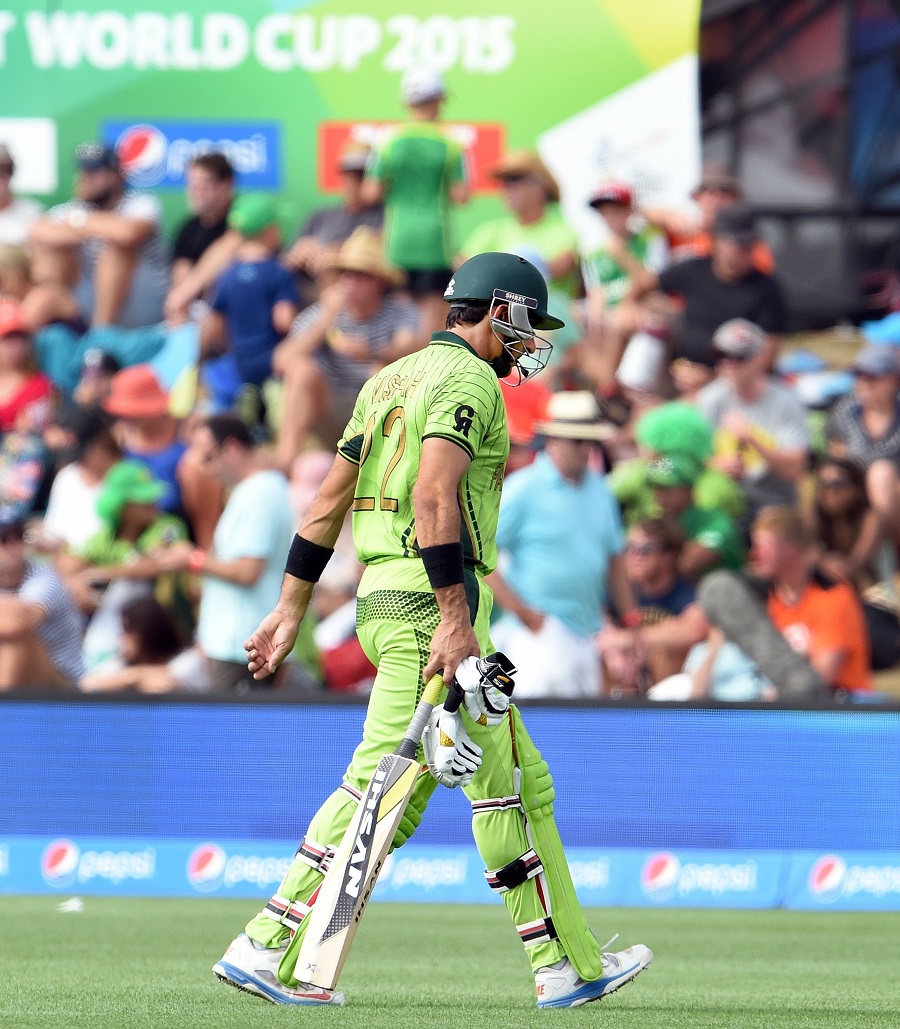
2. Zero Team Leadership: Starting from the top with mind boggling selections of the PCB, to Waqar Younus as a clueless coach and Misbah ul Haq as a most lackluster, demoralizing captain. Waqar consistently baffles everyone with his selection of bowlers and his misplacing batsman in the order (i.e. consistently selecting or opening with Younus Khan or putting him at the most valuable #3 spot, or not playing spin bowler Yasir Shah against the Windies who have trouble with spinners, but playing him against India who traditionally does okay with spinners). Then, Misbah who is the only captain out of every team i’ve seen, including the minnows who seems incapable of competitive, encouraging positive athletic leadership– which is a requisite of a captain for any sport! Battling legend Javed Miandad summarizes Misbah’s leadserhip succinctly
This is aside from the fact that Misbah’s field placements CONSISTENTLY cost us matches (i.e. putting one of our least mobile fielders, Mohammad Irfan at mid wicket and long on), one is left scratching their head — what on earth is Misbah’s strategy, let alone rationale for winning?
Shoaib Akhtar agrees, he scathingly commented today “We are heading for disaster. I have never seen a more selfish and coward captain like Misbah,”
Remember Shahid Afridi as captain of Pakistan’s 2011 world cup team? THAT was world class leadership: Afridi led an inexperienced side that was underestimated by all, from the front, and launched them to exceeding all expectations. He was positive, motivational, competitive and strategic — Misbah doesn’t compare, and his captaincy is costing Pakistan win after win 😦
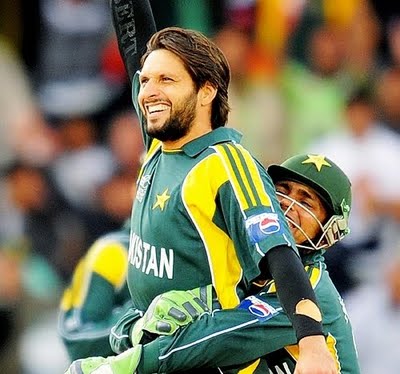
Shahid Afridi’s Pretty Chiseled
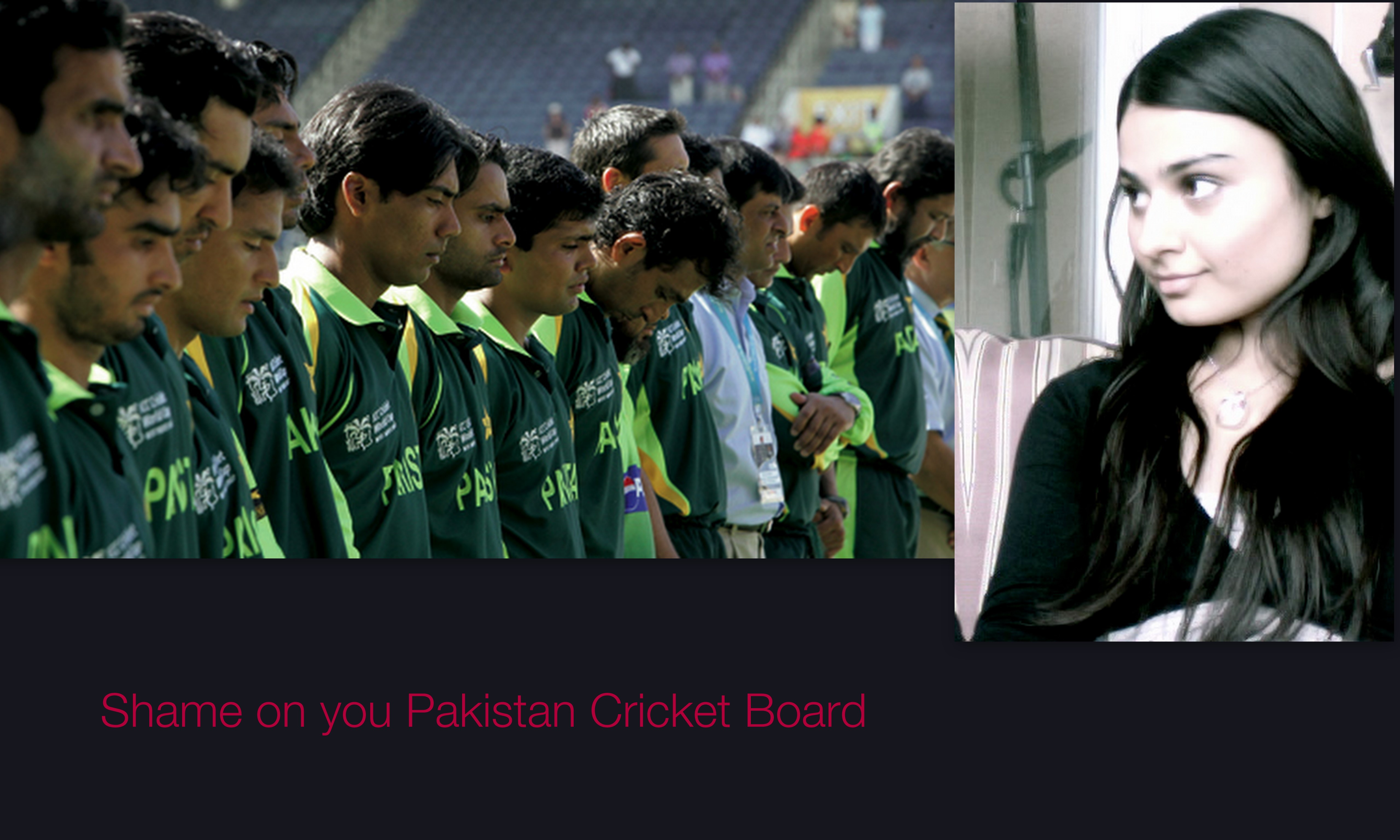
3. No Batsmen Groomed for the World Cup: Shame on the PCB: Pakistan it seems is the only team who squandered the past 4 years without grooming enough batsmen for this tournament.
Inventor of the deadly “doosra” delivery, former master spinner Saqlain Mushtaq explains “The whole nation feels let down and is understandably angry. You don’t expect such unprofessional decisions from a professional management,” he said.
Constantly yanking batsman with in form, winning performances like Fawad Alam, refusing to play Mohammad Hafeez when he insists he is ready, and wasting world class batsman like Umar Akmal and Shahid Afridi as lowest order players and instead playing non performing batsmen who consistently cost us key matches, like Younus Khan, Pakistan has yet to have a reliable opening duo, let alone stable batsmen to follow. And with Waqar Younus as coach admitting he’s still “experimenting” with the order (with dire results), Pakistan is painfully unprepared for the World Cup 2015.
Don’t expect major wins from a team that lacks the most basic components for crickets biggest tournament. I’m looking forward to tomorrows South Africa vs. India game. A.B. de Villiers, Hashim Amla and company — now that’s a team to be excited about.
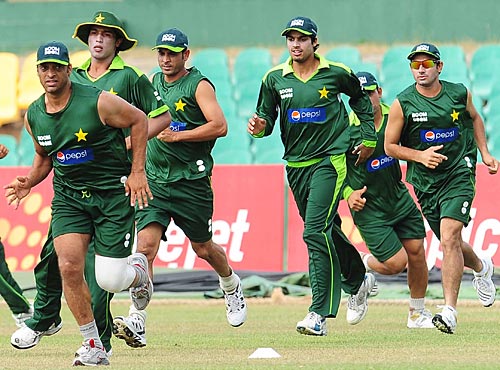
Pakistan Warms up for the Asia Cup India Match - June 2010
Well, it’s that time again. An India vs. Pakistan ODI match will be underway in a few moments. And there’s nothing like India-Pakistan cricket. For better or worse, it’s THE epic rivalry; it get’s catty, intense, fans are insanely polarized. It’s basically crickets equivalent to the NHL’s Crosby / Ovechkin rivalry. For my non-sports readers, it’s akin to team Aniston vs team Angelina. (for the record: I’m team Ovechkin and Angelina respectively)
But whether you’re a Pakistan or India fan, both teams are somewhat evenly matched at this time with Pakistan having more depth and raw talent, and India with firm composure, more consistent experience and better record in recent history. So it’s likely going to be a nail biter, winding down to the final over to determine a winner.
So, what’s it going to take for the men in green? Here’s what’s swimming around my head before the game:
Afridi: Stay the same. Awesome performance in the last game as skipper. In typical Afridi character he lived up to the “boom boom” title and strong character we expect from him. With 110 off of 75 it was his natural game catapulted to great heights with leadership and consistency. Good news is he has a tendency to excel against India. Let’s hope that form is maintained.
Salman Butt: Hold your wicket yo. He usually does, but it’s not always certain, yet crucial that he does so today. The Indian bowling attack looks mediocre, but don’t underestimate their pace bowling. Zaheer Khan is in the attack and Nehra could do harm too.
Abdur Razzaq: My favorite All rounder must be the Danger Man today. What does that mean? It means if we need it, you make 14 runs an over. No questions asked. Oh, and when we need those key maiden overs in the last hour of their lineup, keep up the bowling defense.
Kamran Akmal: Please no butterfingers. This is a world class game and an epic rivalry, no room for drop catches. Also, be quicker on the stumpings. Be a solid bat; a clutch hitter picking up the run rate consistently as a lower order batsman and even more so if you’re pushed up the order.
Mohammad Aamer: Come in strong and shut down Sehwag. Perhaps cut him some slack early on, get him into a slogging mindset then throw on pressure with an ultra slow ball. Sehwag’s bat is so fast that this is bound to be confusing to his game.
Shahzaib Hasan: Damn rookie stop playing like it’s a test match.
Shoaib Akhtar: Watch the extras, nuff said. If The Rawalpindi express does this, there’s no stopping him.
Shoaib Malik: Be at the top of your game, back form a honeymoon we need to see classic Malik in your best form. Picking off Harbhajan smashing off a couple sixes, fielding like a beast, and with accurate off spin.
Umar Akmal: Run with raw talent. You’ve got the youth, energy and can hold your wicket with a solid strike rate. Pick up the occasional boundary and stay consistent.
Prediction :::: the game changer will be either Shoaib Malik or Shoab Akhtar. They’re comback kids and can steal matches for Pakistan. They’ve done it in classic form in the past, and i want to see them do it again tonight.
And I’m not going to lie. After your loss to the Aussies last month, I was tempted to leave you, perhaps for the Kiwi’s, maybe even see Sri Lanka for awhile. But I didn’t stray; I was a good girlfriend. Then came today’s PCB decision, reminding me that you are subject to an absurdly inefficient authority so seeped in politics that I can’t deal with your baggage anymore. The drama has been progressively agonizing.
It’s like dating a teenager. Which is why it was so easy to love you when I was one. But I’m not a teenager anymore. I’m in my 20’s now and am seriously thinking about settling down. I need a cricket team who can reciprocate my love, show consistency and keep me amused. After a long day of work, yoga and blogging, I stay up till midnight and beyond (California time) to watch your ODI’s, even Tests and you leave me dissatisfied, night after night. It’s been 14 years, of ups and downs, which have been a sad series of “downs” in the past few years. When Shahid Afridi first joined the team and scored the Worlds Fastest Century in the nineties, I was captivated; you had me at hello. So I put up with the 1999 World Cup Debacle, the next world Cup Debacle, and have no idea what you’re going to pull in this next one.
So why do I still love you? I suppose because deep down I still believe in you. It’s irrational, impractical and against my immediate interests to stay, but I won’t leave. And after all you’ve put me through: if I still don’t walk away…..that’s gotta be love.
To my knowledge, Cricket is not an official tool of diplomacy in international relations. Cricket is however, traditionally a sophisticated, gentleman’s game.
A very childish move because on a micro level, it wastes World Class cricketers’ time and on a macro scale, excludes the World Champions in 20Twenty from this tournament.
Were decision makers naïve enough to think that not bidding on Pakistani players would send a tough message to the Pakistani government so that they might soften up on Kashmir or divert troops from the Indian, to the Afghan border? I highly doubt it. Which renders the decision to exclude Pakistani players just juvenile.
It’s the kind of thing a teenager does which accomplishes little else than a momentary, base satisfaction that he or she later realizes wasn’t worth it as they get older. Because this is not going to improve relations, and it certainly doesn’t help the game of cricket to exclude the World Champs. It sends a symbolic slap across the border to millions of fans. Mind you, it slaps the fans, not the government, the fans. So, even though cricket is not an official tool of diplomacy, it can have a periphery effect of separating peoples. This snub can only stall rather than alleviate already chilling relations in South Asia.
But mostly, this comes at the cost of cricket in general. It’s reminiscent of Greg and Trevor Chappel bowling the now infamous underarm ball to New Zealand in 1981. Shame on IPL for such a foolish misstep that accomplishes nothing positive.
Zainab Jeewanjee Says Don't Wonder About Match Fixing, Worry About Fixing the Team!
We’ve all thought about it. Some of us think it’s true, some of us think it’s rubbish. But we’ve definitely heard it before: does match fixing in cricket drive world class teams to consistently choke in the most unbelievable ways?
I’m not going to lie: it’s appealing to think match fixing is the reason Kamran Akmal drops not one, not two, not three, but four catches off a single batsman in one match, or Younis Khan for years underperforms, making similar mishaps leaving no apparent merit based reason for his captaincy. And let’s not forget Pakistan’s 2007 World Cup debacle where they managed to somehow lose to Ireland. Yes, Ireland: an ICC Charter team. And mind you this is the second time in World Cup history that Pakistan shocked the world with incomprehensible play. In 1999, being the top team when reaching the world cup, renowned cricketers including the likes of Wasim Akram, Soaib Akhtar, Inzamam-ul-Haq just up and choked in the final against Australia. The string of under-performances are just astounding and fan a notion that match fixing takes place.
But the idea of match fixing is only appealing because in a vicarious way, it absolves us fans of any liability for failure. It’s a convenient defense mechanism that assures very loyal, often nationalistic fans that their team, or nation if you will, simply can’t fail: talent is so exceptionally immense that only bookies could be the cause of such horrendous cricket.
And that’s irrational. Without proof of match fixing, it’s futile to even speculate. The fact is, Pakistani cricket is in shambles. Yes it’s frustrating because there is exceptional talent and an illustrious history of amazing cricketers. But a wicket keeper who drops 4 catches in a single match and performs at mediocre level the remainder of the season is not a world class cricketer. Kamran Akmal, is not, and could never be Pakistan’s best wicket keeper or batsman. Similarly, Younis Khan has proven he isn’t a good captain. He sends out pace bowlers when the ball is swinging, places fielders so opposition is almost assured to find gaps during power plays and rarely puts up a match winning total or leads the team with genuine passion.
The point is, Pakistan’s current lineup are playing like a mediocre bunch. When viewed within the context of the rest of the world, they’re just not hacking it. It’s not about match fixing, it’s about fixing the cricket.
Granted Pakistan increasingly looks like a war zone and in such an environment, one can’t expect the team be run at optimal levels by National Cricket board. But still one shouldn’t waste time on match fixing allegations. Cricket isn’t immune to bookies (Hans Cronje, Mohammad Azharuddin, Shane Warne & Mark Waugh), however, until proven guilty, let’s assume innocence and focus on the real issue at hand: rooting out poor performers and bringing in better cricketers.
Test matches will disappear from cricket by the year 2020, and ironically, because of 20Twenty. After Pakistan’s frustrating loss against Australia today, batsman Mohammad Yousuf warns that Twenty20 cricket will ruin Pakistan’s game. He says:
“Because of Twenty20 cricket no player knows how to stay at the wicket anymore. Until players do not play with discipline and play ball to ball and leave balls they are supposed to we will struggle in ODIs, let alone Tests. If you are going to slog all the time what is the point? It is necessary that Pakistanis, the media, the board, the fans realise that we play as little Twenty20 as possible.”
Mohammad Yousuf is asking everyone to limit Twenty20 cricket at a time when it’s popularity is on the rise, Pakistan is the reigning World Champion and undoubtedly has the best players the game has seen (Afridi, Razzaq, Ajmal, Gul). He’s basically making a case for conservative cricket: or getting back to the basics of Test.
In Test’s even if you’re pitched a full toss at above average speed and there’s no one at long on or square leg, the skilled batsman refrains from smashing it out of the park.
Reason being the risk of getting out supersedes the worth of a six. However, that kind of discipline is the exact antithesis of 20Twenty cricket where you are required to play each ball as if it’s a potential six. But having the sense to resist potential sixers is but one part of the batting discipline needed in traditional cricket. It’s an overall psychological discipline where batsman must with extreme patience and consistency just hold one’s wicket. To do that, over after over for 5 days, knowing that the match could wind up in just a draw requires an extreme endurance that few batsman posses. In fact some of the best batsmen in the game who have mastered this don’t even play ODI’s anymore, like Rahul Dravid. Case in point, most teams don’t have players who specialize in Test, Dravid is actually a rare case. Mohammad Yousuf could then be on the right track: are players losing an edge in Test, and perhaps even skill by playing 20Twenty cricket?
20Twenty is the American equivalent of Home Run Derby: the game simply requires batsman to smash anything and everything out of the park. 8th man down must carry at least a 100% strike rate to give a team the depth required to be competitive in the game.
It’s less about psychological discipline, discerning batting or even batting skills for that matter. Because if the aim is to slog, you can take a whack at just about anything pitched your way. It requires a lot of power and little else. Anyone with training and enough arm strength to smack the ball around can be fairly successful. There aren’t rewards for consistency, patience or discipline. In fact, those qualities are counter productive in 20Twenty. In Tests you score runs by first discerning which balls are safe, whether that be after 5 or 50 overs, and then you nudge, or direct the ball into anticipated gaps.
It’s a whole different ball game, as they say in the States. So is Mohammad Yousuf correct in calling for a limit to 20Twenty? The conventional part of me who tends to resist change says yes. But the more spontaneous, forward thinking side of me says, hey, if that’s the natural progression of the game and Tests are inevitably obsolete, bring on a few more Shahid Afridi’s !
Shahid Afridi is the most exciting cricketer in ODI’s. He’ll either smash the fastest century in history, or maintain a strike rate of 300 off just a couple balls before being caught out. So for Pakistan his presence could mean massive game winning runs, or for the opposition, a quick, key wicket early on. Either way, it’s extremely suspenseful excitement for both teams and all fans watching that no other player offers.
What’s even more exciting is that Afiridi’s no longer a novice. He’s been around 10+ years but hasn’t received the kind of acclaim his potential commands. He’s overlooked as merely an inexperienced slogger because no one really expects him to last more than a couple overs. But in this years 20/20 World Cup and today’s ODI, Afridi asserted himself as the quintessential all rounder.
One shouldn’t underestimate tight fielding, very effective bowling, and competitive spirit Afridi harnessed over the years . Because even when he’s inconsistent at bat, his wealth of periphery contributions have led to victory, proving he’s so much more than just a slogger.
In today’s match versus New Zeland he demonstrated maturity by chalking up roughly just 50% percent of runs off boundaries when Pakistan was 70 for 4, and taking key wickets, almost getting a hat trick. Doubters take note: Afridi is entirely capable of playing a solid, consistent, and well rounded game.
His volatile career can partially be attributed to laughable PCB selection processes and mediocre coaching. Because the past decade of Pakistani cricket has been defined by arbitrary player selections and coaches irrationally shuffling the lineup.
Counter productive, yo-yo operations assigned Afridi everywhere from opener, middle order and tail end batsman without giving him sufficient time to play where he is most effective. His natural game is aggressive and valuable at the mid to lower end for two reasons. Firstly, although he’s had trouble with spinners, he’s deadly when attacking a worn down ball from a medium paced bowler. Secondly, Afridi’s style isn’t conducive to requirements of an opener. Opening bat imposes a pressure for a deep concentration and patience.
Because Pakistan is often inconsistent and has yet to decide on solid openers, this leaves middle and lower end batsman required to chalk up significant runs when openers don’t hack it. And that kind of pressure requires rapid, hard hitting runs on a grand scale from severely limited balls that only Afridi can produce. He thrives on such conditions, rising to the occasion and leading Pakistan to victories like today’s.
Not to mention his consistent bowling. He always maintains a good economy and although he’s not a strike bowler, he quite often strikes wickets. In today’s match he patiently maintained line and length despite going without a wicket for a few overs, eventually taking out Daniel Vettori who looked dangerous with a 90+ strike rate.
Key to such effective bowling is Afridi’s deadly variation in speed. He has the unique ability to throw batsmen off their game by changing up bowling pace buttressed by an equally menacing competitive spirit. He’ll bowl 3 slow balls, and the next one faster than even Razzaq’s fastest. Some fast bowlers change up’s aren’t even as fast as his.
Plus he disguises the changeup very well: batsmen don’t know if he’s going to throw a googly, leg spin, or just throw a fast one with no turn at all. Afridi doesn’t allow batsmen liberty to anticipate a ball, hence his consistently good economy. Side note: Tendulkar is also good at this.
There’s no doubt Afridi’s a talented cricketer. But the past year we’ve seen a mature Afridi harness his game and emerge as a strong leader against world class teams. With the Pakistan team in what seems like a constant transitional phase, Afridi has risen to all occasions maintaing a powerful game and vivid energy that is key to supporting youngsters like Umar Gul and Kamran Akmal as we saw in today’s match.
So kudos to Ramiz Raja for finally addressing skipper Younus Khan about his lacking performance after today’s match. It’s high time Pakistan found a new captain, and i think Afridi has earned a shot at the position.
Excited about Pakistan’s victory in todays ODI vs. India at the ICC Champions Trophy, i looked for YouTube highlights of previous India Pakistan matches hoping to relive thrilling performances of batsmen trembling at Akram/Younis yorkers or some record breaking Tendulkar/Sehwag innings. But I was unable to find a consolidated reel of South Asian highlights as such. It seems all content pertaining to Indian and Pakistani Cricket are elaborately produced showcases of either country triumphing over the other, or amusing clips revealing serious sledging between both teams over the years. And that’s understandable, it’s a competitive sport and fans create videos for the teams they support.
But something is changing. I don’t think fans are looking at these videos the same way as years past. Sambit Bal wrote a nice precursor to today’s match describing the epic India Pakistan rivalry as something far more profound than just another sporting competition. He says cricket in South Asia “has always been close to the national identity”. Quite astutely, he describes how it’s then used: “sometimes as a salve, sometimes a weapon; it has enabled bonding and it has divide; at times it has been a bridge, at others a vehicle for ugly chauvinism; and governments have used it as both a handshake as well as a show of fists”. And therein lies the dilemma.
India Pakistan matches are tremendously exciting, wrought with raw enthusiasm and incredible anticipation, but wind up raising stakes far higher than are normal or necessary. Bal says cricket is close to South Asian “national identity”, and in conversations I’ve heard matches described as akin to “war” or “religion”. That’s just going too far.
To inextricably tie these matches to one’s identity or religious affiliation let alone actual combat is absurd, but fortunately, a phenomenon that’s shrinking. Less and less are India Pakistan matches carrying the same weight for masses and even players. Bal explains that because matches between the countries have increased since 2004, an
“overkill took away the anticipation and intensity. But from a larger perspective, it also took away the heat and emotional charge, and that was not a bad thing at all. Since they were always playing, wins and losses no longer felt like life and death. It felt somewhat dull, but it also felt sane.”
Ahhhh, it felt sane. Now that’s a great way to put it. Cricket shouldn’t be a tool or driving force of nationality, politics let alone international relations. That’s a recipe for perpetual division, which is the last thing South Asia, or the world for that matter needs right now. So even if India Pakistan matches are seeing diminished anticipation, at least it shifts our focus toward the game itself rather than political, social and religious issues which ought to be unrelated. Because a heightened concentration on the game of cricket can finally allow us to debate what’s truly interesting. Like how Pakistan is the only team capable of winning a match in the last ten over’s by scoring 100+ runs while India is the only team who can do that in the first ten 😉





 Zainab B. Jeewanjee
 Zainab Jeewanjee