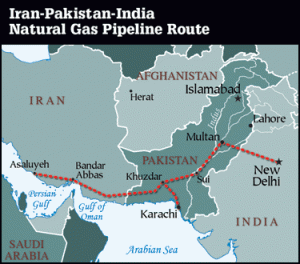
The anticipated Iran-Pakistan-India (IPI/”Peace Pipeline”) pipeline may end up running only through Iran/Pakistan as India backed out from the project last week says Muhammad Abbasi, Pakistani Ambassador to Iran. Delhi’s withdrawal comes simultaneously as the US pressures Islamabad to disengage from the multibillion dollar project set for completion in 2013. This adds to the list of obstacles IPI faced since it was conceptualized in the 1990’s. From international pressures, prolonged funding negotiations, to domestic insecurities and reservations, the pipeline has yet to begin construction. However, Pakistan stresses urgency in moving forward with construction in the face of alarming energy shortages :
Only 60% of households have electricity and 18% access to pipeline gas for heating. Energy demand is expected to increase 250% over the next 20 years. To meet expected demand, electrical generating capacity must grow by 50% from 20.4 gigawatts to 30.6 gigawatts by 2010
As a result, Islamabad works diligently to address the issue. President Zardari is dealing closely with the Chinese on hydel projects in underdeveloped areas of the north and this May, the 7.5 billion dollar deal allowing Iranian oil supplies to Pakistan was officially signed. It initially permits 30 million cubic meters of gas per day and later to 60 million whichgreatly begins to alleviate the energy crisis:
Pakistan’s domestic gas production is falling and import dependence growing tremendously. By connecting itself with the world’s 2nd largest gas reserve, Pakistan guarantees a reliable supply for decades. If the pipeline were to be extended to India it could also be an instrument for stability in often tense Pakistan-India relations. Under any scenario of pipeline expansion which makes Pakistan a transit state, Islamabad stands to gain from transit fees hundreds of millions of dollars every year.
Given such potential, it’s not surprising Pakistan is intent on moving forward with IPI regardless of pressure from D.C. Despite Special Envoy Holbrooke’s diplomatic suggestions that the United States might “link funds committed by the Democratic Friends of Pakistan” to their cooperation with Iran on IPI, foreign minister Shah Mahmood Qureshi maintained Pakistan’s urgency:
“The gas pipeline construction agreement with Iran and Pakistan will by no means go under the U.S. pressures,”
But some experts insist that without American support to release funding and loan guarantees, financing of IPI will make the 2013 deadline unfeasible. This poses problems for Pakistan, and on the American front, there are differing concerns. Hoping to maintain US authority and secure interests in the region, President Obama shifts starkly from the previous administration using more engagement and soft power with Iran. So American moves to work with the international community in economically choking Iran and ultimately eliciting behavior from Tehran are diminished as Iranian influence increases through international projects such as IPI. Hardline Bush Administration and more diplomatic Obama led policies are interesting yielding similar ends as Iran continues to expand trade and relations with the international community. This flouts hard, soft, all stances the United States takes in attempting to contain Tehran.
For instance, a vastly constructed pipeline running over 2,775 kilometers (1,725 miles)from the Persian Gulf in Iran, through Baluchistan to a port in Karachi and then north to New Delhi creates “an unbreakable long term political and economic dependence” of billions of people from Pakistan, to India and potentially extending to China.
The prospect of the entire subcontinent being “dependent” on Iran actually sounds alarming, but if we look at certain realities it’s perhaps far fetched. Firstly, any semblance of an actual dependence is most likely only applied to Pakistan given their current energy crisis, the cost effectiveness and efficiency of natural gas as opposed to developing LNG sources: India on the other hand has “two LNG terminals and will complete a third terminal by this year. Two additional terminals have also been proposed, and several companies are examining viability of constructing additional LNG import sites”. So Delih is far less likely to be entirely reliant on Tehran for natural gas because developments in LNG and civilian nuclear projects. Plus, India’s long, strong alliance with Russia allows for a convenient energy supplier to the north if need be. In fact, for Moscow IPI is an opportunity to quell thoughts that Tehran will compete in supplying natural gas to EU markets. Russia’s deputy energy minister explains:
“It is therefore in Russia’s interest to derail the Nabucco project by diverting Iran’s gas away from Europe and locking it to the Asian market. We are ready to join the project as soon as we receive an offer”
Thus a point of contention for Moscow and Washington. DC’s fears are further exacerbated by a potential of IPI eventually ensuring energy supplies to long standing Pakistani ally, China with shipments along the Karakoram Highway through future pipelines . The argument made is that hopes of modifying Iranian behavior with economic pressures plus our mutual hedging with China suffers if IPI is constructed. Again, this relies on the assumption that billions of Indians and Chinese become “dependent” on Iranian gas supplies, which I find unlikely. Pakistan if anyone, is likely to become heavily reliant on those supplies in the next couple decades should IPI be executed as planned. Thus suggested solutions point to alternative pipelines that bypass Iran:
“A rival gas-pipeline project — the Turkmenistan-Afghanistan-Pakistan-India (TAPI) carrying gas from Daulatabad in Turkmenistan via Herat and Kandahar in Afghanistan to Multan in central Pakistan is one such alternative”
But this concept is contingent to a stable Afghanistan, which most experts indicate is not in the near future. Without stabilizing Afghanistan and given chilly relations with India, TAPI is not likely to move forward without overcoming numerous diplomatic and security obstacles. And Pakistan’s energy crisis doesn’t afford Islamabad time to wait for the international community to stabilize Afghanistan or warming relations with India.
Critics of IPI also insist it is conducive to US interests for Pakistan to develop LNG supplies rather than natural gas. This probably entails cooperation with Europe and the United States as opposed to Iran, which is an unviable suggestion. Firstly, LNG development is more expensive than natural gas supplies through a pipeline. Plus, it’s more probable that Pakistan receive lower cost, soft term loans in dealing with Iran as opposed to the EU or US. IPI also presents a possibility of improved trade opening import markets for Pakistan where Iranians can purchase food items. Pakistan has a strong agricultural base and produces wheat, sugar and rice that can be exported efficiently to its neighbors. So for Pakistan, IPI is a viable solution to the energy crisis in addition to creating future revenue generation.
Finally, US critics warn that the security situation in Afghanistan-Pakistan at the moment bodes badly for practicable pipeline construction:
Should the worst happen and a Taliban style regime take over Pakistan, the economies of the world’s most radical Shiite state and that of what could be the world’s most radical Sunni state would be connected to each other for decades to come like conjoined twins.
This is an outrageous misgiving. Al Qaeda and the Taliban spilled over into Pakistan since our War on Terror began in 2001, meaning the Taliban are nowhere near rampant in number or have many sympathizers amongst the mostly moderate population. The Pakistani army made strides in efficiently securing the Swat valley and continue to make progress in eradicating militants. Assuming the entire Pakistani military and heads of state can not obliterate 20-40K (at maximum) Taliban is unreasonable. Many experts have indicated, it’s not that it can’t be done, it’s working to ensure the job gets done efficiently and to secure the long term which is taking time. I think the suspicion of Taliban influence in Pakistan is used perhaps to sensationalize the consequences of IPI construction.
Still, critics maintain that IPI is against our interests and hope lies in it never being constructed given diminutive chances of getting the needed 7.5 billion in funding and because of the volatile location of construction. IPI would run through the province of Baluchistan where resentment and instability with the federal government is historical, underprivileged masses prevail and prior instances of attacks on water pipelines ensued. These facts might impede construction of IPI but it’s important to note that even the most critical voices against the pipeline maintain we not intervene in aiding any subversion of federal government projects in Baluchistan:
US open support for opposition groups who might be willing to undermine the project is unthinkable as any collaboration – overt or covert – would severely cripple our relations with Islamabad
Pakistan’s deep cooperation and commitment to fighting the War on Terror trump other priorities. Plus, in the long run, economic interdependence at the cost of our diminishing influence is maybe preferred to a possibility that this region become increasingly rife with groups well armed and trained at subverting national governments. The Soviet Afghan War was our best teacher of that lesson.
Finally, critics argue how it’s against US interests for Iranian influence to expand in South Asia through IPI because it would add regional instability should Tehran become nuclear and support terrorism. However, this relies on the assumption that heads of state are engaging in bilateral trade with Pakistan on this project for an ultimate goal of international terrorism and that heads of state are irrationally going to create instability in a region that they are increasingly economically interdependent with.
Certainly, a successful natural gas pipeline that spurs economic growth for Iran and helps solve South Asia’s energy crisis might increase Tehran’s influence to some extent, but overall instability and supporting terrorism runs counter to basic arguments of liberal theories of capitalism. With increased trade and interdependence, might increased peace and less interest and instability ensue?
Thus in accepting the reality of what Fareed Zakaria calls, “The Rise of the Rest” wherein increasingly interdependent and economically stable states using minimum or zero US intervention are growing into regional powers President Obama is beckoned to reassess foreign policy. Iran won’t likely rival American hegemony through IPI, but increasingly such situations require we evolve policies to effectively deal with long standing allies like Pakistan who are inevitably drawn into relations that could diminish our influence.
ORIGINALLY POSTED @


 Zainab B. Jeewanjee
 Zainab Jeewanjee