Posts Tagged ‘Pakistan international affairs’
 September 16, 2009
CNN refreshingly shifts the context of current discourse on Pakistan by reporting on female recruitment to the Pakistani Air Force. A story published this week highlights Ms. Ambreen Gul’s experience with the Pakistani air force as “one of seven women trained to fly Pakistan’s F-7 supersonic fighter jets”. Gul describes her experience as both positive and productive. Air Force cadet Ms. Sharista Beg also explains:
“To tell you the truth I’ve been given equal opportunity or I suppose more than men have been given,”
I refer to the story as refreshing because given that news is largely focused on macro level, security issues dealing with the war in Afghanistan and how it relates and spills over into Pakistan, the image we have of Pakistan is imprecisely bleak.
Of course macro level security issues in which our troops are directly engaged rightfully take priority over other news stories on Pakistan, but the unintended consequences of viewing this country as such and simply in terms of the “War on Terror”, “Taliban”, “fundamentalism” or “militancy” is a reduced understanding of what we are dealing with in our engagement there.
So I applaud CNN for balancing information with their story on Fighter Pilot Gul. Hopefully news outlets will continue to publish reports that allow a more accurate picture of what is a largely moderate Pakistan. Because a more accurate picture can only help us understand our situation there. In fact, the article concludes well, citing specifics of how the Pakistani air force works in line with our objectives:
“They’re training in counterinsurgency, collecting aerial intelligence and targeting militant strongholds in the treacherous mountains of Pakistan’s tribal region along the Afghan border”
The nebulous Afghan-Pakistan border has become the front lines in our War on Terror making it easy to forget that Pakistan, just like us fights diligently against fundamentalism and militancy with their resources, troops and morale. We want to uproot terror to bring our troops home and secure interests in the long run, likewise Pakistan shares this long term goal and in addition, has an immediate interest in obliterating militancy for actual day-to-day security. The CNN article does a fine job of reporting in this instance and prompts us to realize that cooperation is key.
Posted in Current Affairs, International Affairs, Pakistan, US Pakistan relations | Tagged afghan pakistan border, afghan-pak, afghan-pak border, afghanistan pakistan relations, air force in pakistan, air force of pakistan, air force pakistan, ambreen gul, ambreen gul air force, ambreen gul pakistani air force, balancing news on pakistan, cnn pakistan, cnn pakistan news, cnn report on pakistan, cnn report pakistan, cnn reports on pakistan, defeating terrorism pakistan, female jet fighters, fighter jets in pakistan, fighting terrorism in pakistan, jet fighters pakistan, jet pilot in pakistan, jet pilots in pakistan, jet pilots of pakistan, jets in pakistan, moderate pakistan, moderation in pakistan, news on pakistan, news on pakistan cnn, Pakistan, pakistan afghan border, pakistan air force, pakistan air force war on terror, pakistan counterinsurgency, pakistan fight terrorism, pakistan fighting terrorism, pakistan fights terrorism, Pakistan international affairs, pakistan news, pakistan report on cnn, pakistan sexism, pakistan taliban, Pakistan US relations, Pakistan war on terror, pakistani air force, pakistani female fighter jets, pakistani female pilot, pakistani fighter jets, pakistani jet pilot, pakistani jet pilots, pakistani news, pakistans air force, pakistans fight against terrorism, sexism in pakistan, Taliban, taliban in pakistan, taliban pakistan, terrorism pakistan, US Pakistan relations, us war on terror, war on terror, war on terror pakistan, zainab jeewanjee, Zainab jeewanjee politics | 2 Comments »
September 15, 2009
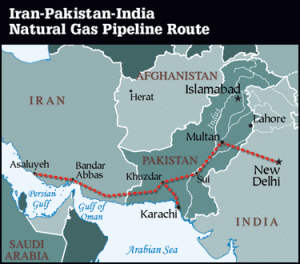
The anticipated Iran-Pakistan-India (IPI/”Peace Pipeline”) pipeline may end up running only through Iran/Pakistan as India backed out from the project last week says Muhammad Abbasi, Pakistani Ambassador to Iran. Delhi’s withdrawal comes simultaneously as the US pressures Islamabad to disengage from the multibillion dollar project set for completion in 2013. This adds to the list of obstacles IPI faced since it was conceptualized in the 1990’s. From international pressures, prolonged funding negotiations, to domestic insecurities and reservations, the pipeline has yet to begin construction. However, Pakistan stresses urgency in moving forward with construction in the face of alarming energy shortages :
Only 60% of households have electricity and 18% access to pipeline gas for heating. Energy demand is expected to increase 250% over the next 20 years. To meet expected demand, electrical generating capacity must grow by 50% from 20.4 gigawatts to 30.6 gigawatts by 2010
As a result, Islamabad works diligently to address the issue. President Zardari is dealing closely with the Chinese on hydel projects in underdeveloped areas of the north and this May, the 7.5 billion dollar deal allowing Iranian oil supplies to Pakistan was officially signed. It initially permits 30 million cubic meters of gas per day and later to 60 million whichgreatly begins to alleviate the energy crisis:
Pakistan’s domestic gas production is falling and import dependence growing tremendously. By connecting itself with the world’s 2nd largest gas reserve, Pakistan guarantees a reliable supply for decades. If the pipeline were to be extended to India it could also be an instrument for stability in often tense Pakistan-India relations. Under any scenario of pipeline expansion which makes Pakistan a transit state, Islamabad stands to gain from transit fees hundreds of millions of dollars every year.
Given such potential, it’s not surprising Pakistan is intent on moving forward with IPI regardless of pressure from D.C. Despite Special Envoy Holbrooke’s diplomatic suggestions that the United States might “link funds committed by the Democratic Friends of Pakistan” to their cooperation with Iran on IPI, foreign minister Shah Mahmood Qureshi maintained Pakistan’s urgency:
“The gas pipeline construction agreement with Iran and Pakistan will by no means go under the U.S. pressures,”
But some experts insist that without American support to release funding and loan guarantees, financing of IPI will make the 2013 deadline unfeasible. This poses problems for Pakistan, and on the American front, there are differing concerns. Hoping to maintain US authority and secure interests in the region, President Obama shifts starkly from the previous administration using more engagement and soft power with Iran. So American moves to work with the international community in economically choking Iran and ultimately eliciting behavior from Tehran are diminished as Iranian influence increases through international projects such as IPI. Hardline Bush Administration and more diplomatic Obama led policies are interesting yielding similar ends as Iran continues to expand trade and relations with the international community. This flouts hard, soft, all stances the United States takes in attempting to contain Tehran.
For instance, a vastly constructed pipeline running over 2,775 kilometers (1,725 miles)from the Persian Gulf in Iran, through Baluchistan to a port in Karachi and then north to New Delhi creates “an unbreakable long term political and economic dependence” of billions of people from Pakistan, to India and potentially extending to China.
The prospect of the entire subcontinent being “dependent” on Iran actually sounds alarming, but if we look at certain realities it’s perhaps far fetched. Firstly, any semblance of an actual dependence is most likely only applied to Pakistan given their current energy crisis, the cost effectiveness and efficiency of natural gas as opposed to developing LNG sources: India on the other hand has “two LNG terminals and will complete a third terminal by this year. Two additional terminals have also been proposed, and several companies are examining viability of constructing additional LNG import sites”. So Delih is far less likely to be entirely reliant on Tehran for natural gas because developments in LNG and civilian nuclear projects. Plus, India’s long, strong alliance with Russia allows for a convenient energy supplier to the north if need be. In fact, for Moscow IPI is an opportunity to quell thoughts that Tehran will compete in supplying natural gas to EU markets. Russia’s deputy energy minister explains:
“It is therefore in Russia’s interest to derail the Nabucco project by diverting Iran’s gas away from Europe and locking it to the Asian market. We are ready to join the project as soon as we receive an offer”
Thus a point of contention for Moscow and Washington. DC’s fears are further exacerbated by a potential of IPI eventually ensuring energy supplies to long standing Pakistani ally, China with shipments along the Karakoram Highway through future pipelines . The argument made is that hopes of modifying Iranian behavior with economic pressures plus our mutual hedging with China suffers if IPI is constructed. Again, this relies on the assumption that billions of Indians and Chinese become “dependent” on Iranian gas supplies, which I find unlikely. Pakistan if anyone, is likely to become heavily reliant on those supplies in the next couple decades should IPI be executed as planned. Thus suggested solutions point to alternative pipelines that bypass Iran:
“A rival gas-pipeline project — the Turkmenistan-Afghanistan-Pakistan-India (TAPI) carrying gas from Daulatabad in Turkmenistan via Herat and Kandahar in Afghanistan to Multan in central Pakistan is one such alternative”
But this concept is contingent to a stable Afghanistan, which most experts indicate is not in the near future. Without stabilizing Afghanistan and given chilly relations with India, TAPI is not likely to move forward without overcoming numerous diplomatic and security obstacles. And Pakistan’s energy crisis doesn’t afford Islamabad time to wait for the international community to stabilize Afghanistan or warming relations with India.
Critics of IPI also insist it is conducive to US interests for Pakistan to develop LNG supplies rather than natural gas. This probably entails cooperation with Europe and the United States as opposed to Iran, which is an unviable suggestion. Firstly, LNG development is more expensive than natural gas supplies through a pipeline. Plus, it’s more probable that Pakistan receive lower cost, soft term loans in dealing with Iran as opposed to the EU or US. IPI also presents a possibility of improved trade opening import markets for Pakistan where Iranians can purchase food items. Pakistan has a strong agricultural base and produces wheat, sugar and rice that can be exported efficiently to its neighbors. So for Pakistan, IPI is a viable solution to the energy crisis in addition to creating future revenue generation.
Finally, US critics warn that the security situation in Afghanistan-Pakistan at the moment bodes badly for practicable pipeline construction:
Should the worst happen and a Taliban style regime take over Pakistan, the economies of the world’s most radical Shiite state and that of what could be the world’s most radical Sunni state would be connected to each other for decades to come like conjoined twins.
This is an outrageous misgiving. Al Qaeda and the Taliban spilled over into Pakistan since our War on Terror began in 2001, meaning the Taliban are nowhere near rampant in number or have many sympathizers amongst the mostly moderate population. The Pakistani army made strides in efficiently securing the Swat valley and continue to make progress in eradicating militants. Assuming the entire Pakistani military and heads of state can not obliterate 20-40K (at maximum) Taliban is unreasonable. Many experts have indicated, it’s not that it can’t be done, it’s working to ensure the job gets done efficiently and to secure the long term which is taking time. I think the suspicion of Taliban influence in Pakistan is used perhaps to sensationalize the consequences of IPI construction.
Still, critics maintain that IPI is against our interests and hope lies in it never being constructed given diminutive chances of getting the needed 7.5 billion in funding and because of the volatile location of construction. IPI would run through the province of Baluchistan where resentment and instability with the federal government is historical, underprivileged masses prevail and prior instances of attacks on water pipelines ensued. These facts might impede construction of IPI but it’s important to note that even the most critical voices against the pipeline maintain we not intervene in aiding any subversion of federal government projects in Baluchistan:
US open support for opposition groups who might be willing to undermine the project is unthinkable as any collaboration – overt or covert – would severely cripple our relations with Islamabad
Pakistan’s deep cooperation and commitment to fighting the War on Terror trump other priorities. Plus, in the long run, economic interdependence at the cost of our diminishing influence is maybe preferred to a possibility that this region become increasingly rife with groups well armed and trained at subverting national governments. The Soviet Afghan War was our best teacher of that lesson.
Finally, critics argue how it’s against US interests for Iranian influence to expand in South Asia through IPI because it would add regional instability should Tehran become nuclear and support terrorism. However, this relies on the assumption that heads of state are engaging in bilateral trade with Pakistan on this project for an ultimate goal of international terrorism and that heads of state are irrationally going to create instability in a region that they are increasingly economically interdependent with.
Certainly, a successful natural gas pipeline that spurs economic growth for Iran and helps solve South Asia’s energy crisis might increase Tehran’s influence to some extent, but overall instability and supporting terrorism runs counter to basic arguments of liberal theories of capitalism. With increased trade and interdependence, might increased peace and less interest and instability ensue?
Thus in accepting the reality of what Fareed Zakaria calls, “The Rise of the Rest” wherein increasingly interdependent and economically stable states using minimum or zero US intervention are growing into regional powers President Obama is beckoned to reassess foreign policy. Iran won’t likely rival American hegemony through IPI, but increasingly such situations require we evolve policies to effectively deal with long standing allies like Pakistan who are inevitably drawn into relations that could diminish our influence.
ORIGINALLY POSTED @
Posted in Current Affairs, Foreign Policy, International Affairs, International Relations, Pakistan, South Asia, US Foreign Polciy, US Pakistan relations | Tagged balochistan, balochistan energy, balochistan gas, balochistan pipeline, baluchistan, baluchistan iran, baluchistan pakistan, construction in pakistan, electricity shortage pakistan, Energy, energy crisis in pakistan, energy crisis pakistan, energy pakistan, energy shortage in pakistan, energy shortage pakistan, energy supplies to Pakistan, Fareed Zakaria, fareed zakaria rise of the rest, foreign policy to pakistan, Gas pipeline Iran Pakistan, Gas pipeline pakistan, globalization, hydropower, ido pak gas, India Iran Pakistan gas, India Pakistan, india pakistan development, india pakistan gas pipeline, India Pakistan Iran Pipeline, India Pakistan relations, indo pak pipeline, International Affairs, international affairs in iran, international affairs in pakistan, international affairs iran, international affairs of pakistan, International Affairs Pakistan, international politics, international politics in pakistan, international relations pakistan, IPI natural gas, iran and pakistan, iran in pakistan, iran india pakistan pipeline, Iran Pakistan, iran pakistan affairs, iran pakistan assistance, iran pakistan cooperation, iran pakistan development, Iran Pakistan India pipeline, iran pakistan international affairs, iran pakistan pipeline, iran pakistan policies, Iran Pakistan relations, iran pakistani economic development, iran policies with pakistan, irani international affairs, irani international relations, irani pakistani relations, irani political affairs, irani politics, iranian pakistani relations, iranian political affairs, iranian political affairs pakistan, iranian politics, iranian politics in pakistan, iranian politics pakistan, LNG india, LNG pakistan, natural gas, natural gas pipeline IPI, natural gas pipeline pakistan, pakistan affairs., pakistan and iran politics, pakistan economic development, pakistan foreign minister, pakistan foreign policy, pakistan gas pipeline, Pakistan international affairs, pakistan international relations, pakistan iran economic, pakistan iran relations, pakistan pipeline iran, pakistan policies with iran, pakistan political affairs, pakistan politics, pakistani affairs, pakistani economic assistance, pakistani foreign policy, pakistani international politics, pakistani iran affairs, pakistani iranian relations, pakistani political affairs, pakistani politics, pakistans foreign policy, pipeline construction pakistan, pipeline iran, pipeline pakistan, political affairs of pakistan, politics in pakistan, politics of iran, politics of iran pakistan, politics of pakistan, politics pakistan, Rise of the rest fareed zakaria, Tehran gas pipeline, US foreign policy pakistan, US foreign policy to pakistan, US IPI, US Pakistan relations, zainab jeewanjee, zainab jeewanjee political affairs, Zainab jeewanjee politics, zardari | Leave a Comment »
August 27, 2009
Muhammad Ali Jinnah, better known as the founder of Pakistan when India was divided in 1947 is making headlines today with controversy surrounding ex-Indian Parliamentarian Jaswant Singh’s recent book: India – Partition – Independence. Immediately following the books release, Singh was expelled from his position in the Bhartiya Janata (BJP) party, protests wherein the book was burned and a prompt ban on the work in Gujarat ensued. But why the uproar?
In a recent interview, Singh reveals the following views on Jinnah that are now apparently too controversial in India, but receiving mostly praise across Pakistan:
- Jinnah was an Indian nationalist
- He joined the Indian Congress party before the Muslim League implying an original loyalty to a United India and eventual shift to non secularism as a result of Congress party politics later
- Jinnah fought the British for an Independent India, in tandem with fighting “resolutely and relentlessly” for Muslim rights in India
- Jinnah is admirable for being a self made man, having created a position in politics for himself without the luxury of prior wealth or status
- Jinnah was not anti-Hindu
- Jinnah failed insofar as he received a “moth eaten” piece of divided India in the form of Pakistan and left Muslims who stayed back in India without sufficient guidance
- Gandhi himself referred to Jinnah as a great Indian, so there should be no controversy in recognizing him as such today
- Muslims in India today are downtrodden, live in pain and are “robbed of the essence of psychological security”
- Both Indian Muslims and Pakistani’s have paid a price for Partition since both would have been stronger under a united India
To those who have not grown up or spent much time in South Asia, it may be difficult to understand why such ideas can be controversial and strike such polar chords in the hearts and minds of people divided by a man made border only 60 years ago. But the division of India, into two states resulting in an independent Pakistan saw extreme violence, mass refugee migration and that carnage left a lasting scar on South Asian mindsets. Put in a most blunt form: India suffered the bitter taste of a fractured state that is rooted among the great civilizations in history. And Pakistan suffered the bitter reality of as Singh put it, “a moth eaten”, post colonial state with perhaps an inevitably fractured and frail territory from inception. From the bizarre geopolitical landscape of Bangladesh not contingent to, yet officially part of Pakistan to the conflict over Kashmir at the very onset of partition, Singh makes a fair point in explaining partition caused profound suffering on both ends. The subsequent bitterness is manifest in perpetual hostility between both states in the form of conflicts, and in India, even on a communal level where according to Singh, Muslims are still downtrodden.
So praising Jinnah as a “great man” in India may be akin to condoning the very fracturing of India. In Pakistan, it’s lauded as an admission that their founder heroically created a homeland where Muslims would no longer be downtrodden. Singh’s work also might acknowledge that partition dealt an unfair hand to Pakistani’s, an idea that can come across as unpalatable on the Indian side. But relying on interviews from Jaswant Singh on the book so far, I think the controversy is a tired insinuation of hostility from the state. Banning the book on the grounds that:
“the text in it is misleading for the public and against interest of the state, and therefore, the book must be forfeited and prohibited”
only fuels a hostile polarization of India and Pakistan. Mind you, India and Pakistan as states are increasingly polarized, which in turn results in a division of peoples. Because my guess is that had government kept its hands out of censoring Singh’s book it might have spoken to the hearts and minds of South Asian’s disseminating novel ideas that are not divisive. Noam Chomsky once said that “states are violent institutions”, in South Asia, at the very least they are bitter, but people inherently are not. Singh’s work might have tapped into that sentiment and in the banning of it, states tighten their grip on citizens by perpetuating division and hostility in South Asia. Against a backdrop of a desire for economic growth, stability and globalization, that kind of bitterness is stale 60 odd years later. So I’m looking forward to reading the book and am lucky that my copy was reserved before the ban, in safe hands far from from protests and government intervention.
Posted in Current Affairs, India Pakistan, International Affairs, International Relations, South Asia | Tagged 1947, banning jaswant singh, banning jaswants book, book controversy india, book on jinnah ban, book on jinnah banned, chomsky, divided India, gandhi, gandhi jinnah, globalization, globalization india, globalization india pakistan, globalization pakistan, India, india independence, india jinnah, India Pakistan, india pakistan 1947, india pakistan independence, india pakistan partition, India Pakistan relations, india partition independence, indo pak relations, jaswant singh, jaswant singh BJP book, jaswant singh BJP expel, jaswant singh book, jaswant singh book ban, jaswant singh book jinnah, jaswant singh book pakistan, jaswant singh controversy, jaswant singh controversy india, jaswant singh expelled, jaswant singh interview, jaswant singh jinnah, jaswant singh pakistan, Jinnah, jinnah a great man jaswant singh, jinnah book ban, jinnah book banned, jinnah book banned in india, jinnah fought british, jinnah founder of pakistan, jinnah gandhi, jinnah india, jinnah indian nationalist, jinnah nationalist, jinnah pakistan jaswant singh, jinnah partition, jinnah partition india, kashmir partition, muslim league jinnah, noam chomsky, Pakistan, pakistan independence, pakistan india, pakistan india partition, Pakistan international affairs, pakistan international relations, Partition, partition 1947, partition jinnah india, zainab jeewanjee | 3 Comments »
August 26, 2009
Former leaders from Ayub Khan, Benazir Bhutto, and General Musharraf tried to address the issue of growing energy consumption and diminishing supplies which is now legitimately deemed a “crisis” in Pakistan. President Zardari had his hand in addressing the crisis last week during the quarterly visit to Beijing where he discussed China’s assistance on energy projects. The result is a signed Memorandum of Understanding between both states for the construction of the Bunji dam in the Astore district of Pakistan. Pakistani Ambassador to China, Masood Khan confirmed this dam is one of 8 slotted for priority construction and will have a capacity of generating 7,000 megawatts of electricity. Additionally, Presdient Zardari visited the ambitious Three Gorges Dam and met with Solar Power companies in China this year and enthusiastically invited them to carry out feasibility studies and expertise:
“We need solar power for individual housing units and I want the Chinese to carry out a study in Pakistan,”
As a result, Chinese owned Solar Energy Science and Technology Company expressed a readiness to construct solar power generation projects. Many dams and solar projects targeting the northern areas that are relatively underdeveloped and fairly detached from national infrastructure. But despite being underdeveloped, the region is prime location for generating hydro power and NGO’s have in the past introduced small, community based hydro power stations where usage is limited to basic lighting for residences and had little capacity to produce energy required for income generation. Last weeks deal with China on the other hand might be a more viable route to progress. A case study from India in 2001 demonstrates how an entrepreneur in Chitral installed a “one megawatt hydel power project that changed the socio-economic conditions of the area by providing electricity to run machinery for the manufacturing and processing of local goods. Locally-generated energy then created skilled job opportunities in the power supply system and in workshops for making electric appliances and fixing electric installations.
Applying such construction to the northern areas of Pakistan as per recent deals with China have the potential to spur similar growth. Localized hydel projects with Chinese expertise can bypass a need for more macro transmission and distribution costs involved with creating larger infrastructure. Time and money are saved if large scale distribution channels to transmit power are not needed. And because the energy produced would be confined to the area of consumption more expensive centralized power generation and large scale load issues may be avoided.
Plus, Hydropower is cost effective and solar power has fair potential in Pakistan because of the warm climate.
And with Chinese companies already having begun work on various hydel projects, including the Neelum Jhelum, Gomal Zam and Mangla Rising constructions, President Zardari said he was:
“personally monitoring all ongoing projects being carried out by Chinese engineers and experts in Pakistan, adding that he was holding regular meetings with Chinese ambassador in Islamabad”
So colorful history aside, President Zardari is one of the few, if not first true businessmen turned leaders of Pakistan and it will be great to see the success of his recent bilateral negotiations with China translate to a lasting alleviation of the energy crisis.
ORIGINALLY POSTED @
Posted in Current Affairs, International Affairs, International Relations, Pakistan | Tagged Asif Zardari, asif zardari business man, Bunji dam, china energy assistance, china funding energy, china pakistan cooperation, chinese dams, Chinese Pakistani relations, energy assistance to pakistan, energy crisis pakistan, energy pakistan, hydel, hydel pakistan, hydel power in pakistan, hydel project, hydropower, hydropower in pakistan, hydropower pakistan, massod khan, Pakistan, pakistan ambassador, Pakistan China, pakistan china cooperation, pakistan china relations, Pakistan Chinese relations, Pakistan dam, Pakistan dams, Pakistan energy, Pakistan energy crisis, pakistan foreign minister, Pakistan hydel, Pakistan hydel China, Pakistan hydel construction, Pakistan hydel project, Pakistan hydropower, Pakistan hydropower construction, pakistan hydropower energy, Pakistan international affairs, pakistan international relations, Pakistans energy crisis, President Asif Zardari, Sino Pak relations, zainab jeewanjee, zardari business, zardari business dealings, zardari businesses, Zardari China, Zardari dam, Zardari hydel, Zardari hydropower | 29 Comments »
August 21, 2009
Polls opened today in Afghanistan with Washington watching closely in hopes that elections are peaceful and leave a lasting mark of democracy for future state building. Pakistan has the same interest on perhaps an even more immediate level. Successful elections in Afghanistan are an integral ingredient to Pakistan’s domestic offensive in uprooting dangerous factions, expanding the economy, nurturing their democracy and stabilizing relations with neighbors. But if a candidate does not receive at least 50% of votes in this first round, “elections are pushed into a second, more unpredictable round of voting“. And second round elections might agitate an already rickety political climate amidst apprehensions of violence, which is entirely detrimental for Pakistan given domestic and regional circumstances right now.
On the domestic front, Pakistan’s military continues to make progress against dangerous groups. Weakened by the death (and or disappearance) of leader Baitullah Mehsud, the Taliban in Pakistan “seems to be in disarray”. Meaning Islamabad’s offensive against factions this year are bearing fruits for the War on Terror and shifting toward more stability, hopefully for the long term. But if elections in Afghanistan are pushed to a second round, weeks of political irresolution can allow terrorist groups a climate of uncertainty within which to recuperate from losses and cause turmoil. Which since 2001 has shown that a dangerous spillover effect exists wherein Afghani militant groups shift in to Pakistan harboring themselves into the nebulous, virtually imperturbable border.
Broader regional considerations also factor into Pakistan’s hopes for stable elections. The spillover of militant groups since 9/11 intensifies Pakistan’s long desired interest in seeing a democratic, stable Afghanistan where refugees may repatriate. In fact,Pakistan hosts one of the largest refugee populations in the world, an underreported story that actually helps explain why dangerous factions were able to develop in Pakistan. Millions of devastated Afghans, some armed and many destitute from fighting Soviets in the 1980’s found refuge from their war ravaged country in Pakistan. A mostly destitute population seeking refuge in a developing country with highly volatile political circumstances allowed violent sectarian and religiously extremist factions to exploit and recruit refugees to their cause. In addition, there are heavy economic costs for Pakistan in maintaining such a large number of refugees. Since last years military escalation in Afghanistan, the UN High Commissioner for Refugees explains that there is around 2 to 2.1 million Afghani Refugees now living in Pakistan. He said the United Nations planned to launch an emergency appeal for hundreds of millions of dollars needed to sustain refugees that have come in just this past year. So peaceful elections in a first round that move Afghanistan in a direction of democratic stability is integral to Pakistan’s security: they relieve Islamabad of a very costly responsibility to a long-standing refugee challenge.
Although some minority, yet raucous opinions say elections ushering democratic authority are not in Islamabad’s interest because they “diminish Pakistan’s influence in Afghanistan”. Thus suggesting policymakers are strategically motivated to prevent losing an allegedly malleable buffer zone that Afghanistan serves against India. It’s an unlikely, poorly reasoned notion. It attempts to be qualified by citing Islamabad’s insistence on uprooting domestic militant/fundamentalist groups, so as to avoid confrontation with a supposed malleable buffer forces. But expecting policy makers to divert efforts from turmoil at home to external threats is a laughable assertion. Before taking care of neighboring militant groups whose primary focus is not on fighting Pakistanis, Islamabad legitimately devotes resources to uprooting domestic factions who pose an immediate threat. Suicide bombings have become an almost weekly recurrence in Pakistan and with that level of instability, faulting Pakistan for not doing enough to uproot neighboring terror is outrageous. Plus, NATO forces and amplified American presence in Afghanistan furthers the absurdity of such calls for Pakistan to ignore turmoil at home and focus on Afghanistan. And neither of these allegations logically indicate a Pakistani motivation for instability so as to use Afghanistan as a buffer zone.
But perhaps the most unreasonable way of supporting a notion that Pakistan lacks interest in successful elections refers to relations with India. Specifically, that Islamabad’s refusal to remove forces from the Indian border despite current spillover from Afghanistan indicates an excessive concern with an Indian threat. A few reasons why this is incorrect: firstly, referring again to amplified U.S. and current NATO presence and given an abundance of domestic threats that require Islamabad’s attention, removing troops from the Indian border to the Afghan border does little to help Pakistan now, (especially weighted against the risks of doing so). Secondly, even if troops from were redeployed, those forces are squarely trained/equipped to face a potential Indian threat, not in counterterrorism. Which became well known much to Washington’s dismay with the military’s many unsuccessful attempts at uprooting militants from the northern regions along the Afghan border.
Finally, a refusal to redeploy forces is not because of an excessive concern given the reality of current Indian-Pakistani relations. The Mumbai atrocities occurred less than a year ago and the aftermath saw a speedy, vehement escalation of tensions. Some Indian media and politicians fanned the flames, and when tensions rise between India and Pakistan, the world gets nervous. By way of a counterfactual, we can tie how these tensions relate to justifying Islamabad’s decision to maintain troops on the border: If, God Forbid, another atrocity took place on Indian soil since 11/26/08 and Pakistan had redeployed troops away from the border. The result could be an even further escalation of tensions. A terrifying potential for confrontation ensues and Pakistan’s capacity to defend against an already far more immense Indian force is drastically diminished. Which itself has a potential to cause hasty, over offensive beahvior from either side. Basic lessons in Realism thus teach us that redeployment away from the Indian border is out of the question. Given history, and sensitive circumstances since 11/26 I think military strategy might advise the same. Thus from a Pakistani policymakers point of view, troops on the Indian border is a legitimate priority. If anything, one might even argue they deter confrontation.
So, allegations that Islamabad is not sufficiently committed to stable election processes in Afghanistan are just not reasonable. If anything, successful elections relieve Pakistan of deep social and economic costs through refugee repatriation. And from the Mumbai atrocities to countless civilians who suffer daily from terror and a climate of instability that allows violent factions to operate, a peaceful, prosperous Afghanistan beginning with successful elections is very much in Pakistan’s interest.
ORIGINALLY PUBLISHED @
Posted in International Affairs, International Relations | Tagged 2009 election afghanistan, 2009 elections for afghanistan, 2009 elections in afghanistan, af-pak cooperation, af-pak region, af-pak relations, af-pak strategy, af-pak taliban, af-pak terrorism, af-pak war, af-pak war on terror, afghan buffer zone, afghan election, afghan election 2009, Afghan elections, afghan pakistan relations, Afghan refugees, afghan refugees in pakistan, afghan refugees united nations, afghani election 2009, afghani refugees, afghani refugees in pakistan, afghanistan buffer zone, afghanistan election abdullah, afghanistan election karzai, afghanistan elections, afghanistan elections 2009, afghanistan elections pakistan, afghanistan militants, afghanistan pakistan relations, afghanistan refugee, afghanistan refugee issue pakistan, Afghanistan refugees, afghanistan refugees in pakistan, afghanistan refugees united nations, afghanistani elections, afghanistani elections 2009, Al Qaeda, al qaeda in pakistan, Al Qaeda Pakistan, democracy in afghanistan, democracy war on terror, deterrence, elections in Afghanistan, India, India Pakistan, india pakistan deterrence, India Pakistan relations, indian media, indian politicians, international affairs in pakistan, intricacies of the afghan election, karzai islamabad, karzai pakistan, Mumbai attacks, NATO, Pakistan, pakistan abdullah abdullah, pakistan afghan election, pakistan afghan relations, pakistan afghanistan, pakistan afghanistan refugees, pakistan interests in afghanistan, Pakistan international affairs, pakistan international relations, pakistan karzai, Pakistan militant, pakistan military, Pakistan refugees, pakistan terrorism, Pakistan war, Pakistan war on terror, pakistani military, pakistans interest in afghan elections, pakistans interest in afghanistan, pakistans military, refugees, soviet afghan war, Taliban, taliban in pakistan, taliban pakistan, terrorism pakistan, terrorist group afghanistan, terrorist groups afghanistan, terrorist groups in pakistan, terrorist groups pakistan, UN pakistan, UN refugee, UNHCR, United Nations, united nations pakistan, united nations refugees pakistan, US Pakistan relations, us war on terror, voting in afghanistan, war in afghanistan, war on terror, war on terror in afghanistan, war on terror pakistan, zainab jeewanjee, Zainab jeewanjee politics | Leave a Comment »
August 18, 2009
U.S. Envoy Holbrooke issued a public statement this week acknowledging Pakistan’s “deep rooted” energy problem. He explained that the United States “wanted to send the message that it was concerned about people’s genuine problems”. And the energy problem is in fact among the major problems faced by everyday Pakistanis. In the sweltering summertime, rural areas are faced with prolonged hours of outages, also known as “load shedding” with main cities including the Federal capital suffering 6 to 8 hours daily. This is not only physically unbearable for everyday citizens, but has a profound stalling effect on businesses as it further cripples the already anguished economy. Holbrooke is right then, a genuine attempt to begin resolving the energy crisis would be much welcomed and could in fact help to win the “hearts and minds” of Pakistanis.
This is among the first diplomatic statements issued regarding a funding to help upgrade Pakistan’s power sector and a timeline, or specific details on how such assistance would actually come about were not yet offered. But Pakistani finance minister Shaukat Tarin described in detail how the government could “rent electricity-generating plants over the next three to five years to fill the gap until large-scale energy projects come online and Washington could help by providing financial guarantees to encourage private investment in the sector”. Given the billions of dollars in defense spending Washington has provided Islamabad since 2001, I think Finance Minister Tarin is asking for very, very little here. It would be wise long term strategy for Holbrooke and the Obama Administration to seriously considering delving into this kind of cooperation as it can yield true long term security for the masses of citizens and ultimately, the state.
In addition, Holbrooke announced he would discuss a range of other issues that directly affect the everyday lives of Pakistanis during visit to Karachi on Wednesday. In unison with most diplomatic statements from the United States pertinent to Pakistan these days, Holbrooke’s remarks were overall positive as he expressed confidence in the current democratic regime completing its term and cited a “visible improvement in the political atmosphere” when compared to his past visit.
Amplified cooperation between Washington and Islamabad in combating terrorists is painting a rosy picture of relations these days. News of possible cooperation on funding energy projects is hopeful and on the Pakistani side, Prime Minister Gilani “sought to assuage concerns among western countries about governance and mismanagement issues in Pakistan saying that accountability had been institutionalized”. Many countries are hesitant to allocate funding in fear of a lack of transparency and corruption. But Pakistan has finally addressed this through the first ever independent oversight body: a parliamentary watchdog – Public Accounts Committee of the National Assembly who is appointed from the opposition party. This truly is unprecedented and viable move toward democratic processes. It should actually assuage fears to invest in helping Pakistan at this time. An interesting side note here is that this institutionalized, unprecedented oversight comes as a result of the judiciary and media being independent, which is a policy enacted by former General Musharraff as head of state during his tenure.
Finally, the drone attacks continue to be a point of discussion between the U.S. and Pakistan with Gilani reitering that Washington directly provide Islamabad with the technology so not as to further instigate Anti-Americanism in the region through the widespread collateral/civilian damage that the unmanned predator aircrafts inflict.
So it will be interesting to see statements from Washington in the coming weeks on Pakistan. Funding to help resolve the profoundly distressing energy crisis could be a wonderful opportunity for us to offer real aid to Pakistan. Military aid given since 2001 has been real, and can help for security, but if the Obama administration wants to shift from the previous administrations policies and engage in more meaningful solutions, I think winning the hearts and minds through funding projects that directly affect people is in our long term interest of securing the region rather than only focusing on aid to state level institutions for which trickle down can be painfully slow.
Posted in International Affairs, Pakistan, U.S. Politics | Tagged Barack Obama Pakistan, CIA drones pakistan, development in pakistan, drone, drones, drones in Pakistan, education in Pakistan, Energy, energy crisis in pakistan, energy crisis pakistan, energy pakistan, from energy to education pakistan, from energy to education pakistan has a few number one priorities, Holbrooke, holbrooke pakistan, load shedding, load shedding in pakistan, load shedding pakistan, loadshedding, loadshedding in pakistan, loadshedding pakistan, Musharraf, Obama Pakistan, Pakistan, Pakistan Barack Obama, pakistan corruption, pakistan defense spending, pakistan drone attacks, Pakistan energy, Pakistan energy crisis, pakistan energy issues, Pakistan international affairs, pakistan international relations, Pakistan obama, Pakistan US discussions, Pakistan war on terror, special envoy pakistan, special envoy to afghanistan, special envoy to pakistan, US Pakistan discussions, US Pakistan relations, zainab jeewanjee, zainab jeewanjee Pakistan, Zainab jeewanjee politics | 4 Comments »


 Zainab B. Jeewanjee
 Zainab Jeewanjee