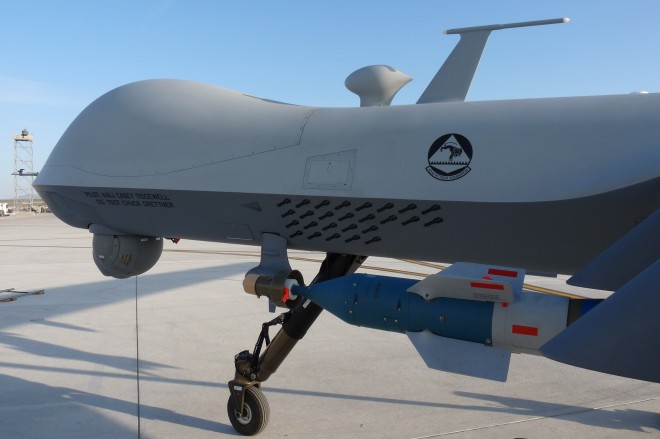
Defense Secretary Robert Gates met with officials in Islamabad to reiterate the importance of drone attacks, despite escalating reservations of their use amongst Pakistani’s. It’s been a polarizing issue from the onset because while it’s convenient to fly unmanned CIA predator aircraft over potential terrorist havens, they result in significant civilian casualties, and displaced persons. So it’s no surprise that over a year later, reconciling their use in Pakistan is still on the agenda.
For this reason, Secretary Gates announced a possibility of America providing “Pakistan with 12 unarmed Shadow aircraft”. Meaning the planes would not have a capacity to strike, but offer enhanced “surveillance capabilities under U.S. supervision”. It’s a fair decision and something I’ve suggested previously.
Gates also stressed the importance of militarily addressing all extremist groups because:
“It’s dangerous to single out any one of these groups and say, ‘If we could beat that group that would solve the problem,’ because they are in effect a syndicate of terrorist operators”
And almost simultaneously, Secretary Clinton unveiled The Afghanistan and Pakistan Regional Stabilization Strategy which sends an increase of 20-30% in civilian experts to both countries and “outlines plans to rebuild the Afghan farm sector, improve governance, and reintegrate extremists into society”. But this strategy of “reintegrating extremists” runs in contradiction to Secretary Gates’ aforementioned remarks.
Gates ruled out any possibility of reintegration calling for a consolidated attack on extremists suggesting that they work in “syndication”, while Cinton’s plan attempts to bring extremists back into the fold of moderate society.
It’s a stark inconsistency in our foreign policy. Because while I think Secretary Clinton’s idea notion of reintegration is more in tune with ground realities, and therefore viable, I figure Secretary Gates was being staunch in talks because finally relinguishing partial drone technology provided him with that margin of hawkishness. Either way though, one thing is certain, despite skepticism on both ends of the U.S. Pakistan relationship, cooperation is ever deepening.
At the heels of 26/11, Pakistan charged seven people involved in the Mumbai atrocities today. The Virginia Quarterly Review has a four part article revealing the ordeal in harrowing detail and after reading it, I’m still stunned. On 26/11 last year I got a call from a friend born and raised in Mumbai who was flying out there that afternoon, he said his parents were fine but his voice was wrought by a despair I hadn’t heard from him before. He didn’t specifically say he was distraught or describe how he felt in detail, but i recognized the frustration instantly because I’d heard that voice before: from friends in Karachi who witness countless threats and acts of terrorism since 9/11. I identified immediately with my friends frustration and despair on a humanitarian level, and even further because although the perpetrators in Mumbai were allegedly trained in Pakistan, I knew they’d ultimately hurt Pakistani’s the most.
As India forges ahead economically and internationally, Pakistan is deteriorating. Terrorism has brought vanishing security that has perpetually halted foreign investment, stagnating the economy leaving no trickle down for the lower and middle class majority population who simultaneously realize a widening gap in their position vis a vis the wealthy. Terrorism has rendered governance in survival mode since 9/11 making leeway for decreased oversight and increased corruption, which was rampant to begin with.
A year after the Mumbai atrocities, we see Manmohan Singh hosted at the White House in elaborate fanfare with progressive talks on bilateral trade rooted in liberalism that is fitting for a country with roughly 8% growth in GDP and a middle class that’s now larger than our entire population in the United States.
Conversely, relations with Pakistani South Asia in light of that progress are a valid point of comparison because we have a strategic interest in both countries. More than ever, it’s apparent we have economically strategic interests with India, and security based interests in Pakistan. And like previous presidencies the Obama administration quickly realized the delicate art of balancing both interests given that either country feels progressive relations with the United States inherently comes as a direct expense of one another. Engaging India as it expands economically and Pakistan geopolitically for security’s sake (i.e. in the War on Terror and in the face of an ascending China) pose an opportunity for us to strike a creative balance in South Asia.
It’s not about who wears the crown, (“Taj”) in South Asian U.S. relations, it’s about engaging both sides for the long haul.
In Pakistan that means cooperating today for security’s sake and uprooting terrorism and fundamentalism for tomorrow. Key from there is not abandoning ship, but remaining engaged so that Pakistan too has a route to economic expansion in the future. Without security, viable development won’t take place. And so long as we are engaged in an Af-Pak war, our policymakers have a responsibility to establish a roadmap that is rooted in long term success. This is our chance to get it right in South Asia, and that begins with an intention for a permanent solution. Assisting Pakistan to navigate the rising tide of development in our globalized world could be the key to ensuring they remain a strategic, long standing ally.
Speaking to my grandmother whose in Karachi yesterday morning, she explained my cousins stayed home from elementary school as most schools had shut down this week. Karachi is the the largest, most bustling city in Pakistan, and despite being situated in the south, far removed from the hotbed of militants in northern Waziristan, terrorism has gradually spilled over from Afghanistan, crept into Pakistan and paralyzed the country. My grandmother described a city laden with tension where people live in a constant climate of uncertainty and increasing fear.
It was pressing to hear her tired voice describe the situation with a kind of detachment. Her tone was passive: an indication of hopelessness. And that hopelessness is not in reference to obliterating terrorists, because there’s little speculation on a military capacity to wipe out at most, 10 thousand terrorists. Rather, her passive tone is a worn out sound echoing 62 years of statehood rooted in insecurity. She’s seen Pakistan through three wars fought with India, including a civil war in the 70’s resulting in a cession of East Pakistan, one of the worlds largest refugee problems in the 1980’s and now the War on Terror fought on home soil. Her passivity is an exhausted acceptance of perpetual political insecurity.
The aforementioned video shows a younger generation, not yet exhausted. They’re shocked, frustrated by what’s happening in their country as they passionately raise their voices in protest against extremist Islamic groups who oppress the country.
Most ironic is that extremist groups bombed the Islamic University in Islamabad where these young men study. Testimony to how grossly extremists propagate an inaccurate view of Islam that terrorizes Muslims everyday.
Which brings me back to how imperative it is that Pakistani and US forces focus on uprooting and not just obliterating terrorists. Pakistan is home to the worlds 6th largest population, and the second largest Muslim country. That’s a strategic demographic in the War on Terror and for future international security. Ensuring terrorism is uprooted in the long term will require a sustained, multifaceted, military and non military approach. Few will argue against the necessity of economic development, the question really is how to pay for it. I’ve mentioned before that the Kerry Lugar bill is a fair, but insufficient attempt at doing this, and ultimately, Pakistan itself must uproot terrorism.
This critical time is an opportunity for Pakistani politicians to take responsibility and bring forth a detailed agenda that rallies current masses. A specific, well publicized plan of action, accepting but not relying on outside assistance is Pakistan’s best hope at engaging its citizens to wipe out terrorism for the long haul. Hopelessness, frustration and desire for Pakistani’s to develop economically and free themselves from terror poses a widespread opportunity to supplement the military offensive with civil support. That support is the capital with which to begin an agenda to uproot terrorism.
Grassroots organizations, women’s and educational groups whose ideologies run counter to extremist groups should be actively highlighted by the media and politicians.
A more proactive approach that is clearly visible works on two levels. One, it aggregates support in the country against extremism setting a future stage for more moderate masses. Secondly, it alleviates international fears of Pakistan becoming a failed state. Because not only do citizens like my grandma need hope, but the international community also watches in concern for Pakistan to define itself in unity and diametrically against extremism.
What happens when a majority of one country’s citizens opt for martial law but the democratically elected government in power including judicial, executive and legislative branches are against a military takeover? It’s quite the political conundrum because either side offers legitimate democratic authority, but they’re diametrically opposed. A rational answer is to let the democratically elected government fulfill it’s term and allow citizens to elect politicians to office who will support martial law in the next term. That might work in a fully functional democracy backed by institutions that can uphold legitimacy and granted the state is sufficiently secure. However, in light of decreasing security, severe economic downturns and age old skepticism of U.S. actions in Pakistan, ever so gradually the country shifts it’s gaze toward the military.
Decreasing Security :: To offer partial explanation in a nutshell: Since 2001, terrorists fleeing Operation Enduring Freedom in Afghanistan, spilled over into Pakistan at the nebulous northern border areas which are historically autonomous from federal regulation. The fact that Pakistan already housed one of the worlds largest refugee populations allowed this spillover a massive and destitute demographic from which to exploit support. As a result, we now see unprecedented terrorism in Pakistan where Al Qaeda and the Taliban had no significant presence prior to 9/11.
Skepticism of U.S.’s Role in Pakistan:: Since the inception of Pakistan in 1947, bilateral realations with the United States have been defined by cooperation wherein Pakistan served as a proxy for U.S. Containment throughout the Cold War (i.e. security pacts like SEATO, CENTCOM, then aiding our Afghan led defense against Soviet incursions in the 1980’s). In exchange, Pakistan’s military with U.S. support, bolstered itself as the strongest, most efficient and stable institution in Pakistan. Some argue civilian governments and democratic institutions were thus never given an opportunity to compete with such a well funded, strongly backed military. And therein we find multifaceted dimensions that help explain the controversy over current U.S. support of Pakistan. Former Pakistan to U.S. ambassador Maleeha Lodhi describes the Kerry Lugar bill:
“the offending part of the legislation sets up the country as hired help and puts the military in the dock, presumed guilty on many counts and having to prove its innocence to Washington”
Pakistan is “hired help”, that’s the crux of skepticism on the Kerry-Lugar bill. Concern is rooted in a long history of cooperation with the United States that some argue created a behemoth military institution costing them a fair chance at democracy. In attempt to address that very concern, the Kerry Lugar bill mentions no military aid in exchange for cooperation on the War on Terror, unlike previous assistance packages from the Cold War. Ironically, bleak affairs in Pakistan now which are partially a result of pervious cooperation, particularly during the Soviet Afhgan war, prompt arguments that the military is exactly what needs support right now. Thus, the Lugar Bill receives not only skepticism from Pakistan’s strongest institution, but increasingly the public.
Although Secretary Clinton and Senators Kerry and Lugar have made no indication of altering the bill, to avoid future skepticism and potential resentment of U.S. involvement in Pakistan it could be wise to make changes so as to not sideline the military at this critical period in our War on Terror. Unlike previous Republican presidencies, the Obama administration is committed to dealing with civilian governments in Pakistan. It’s a noble idea and even though i don’t suspect that as the military gains legitimacy the civilian government will collapse soon, we should think twice before riling such concern over a bill that has just a 5 year life span. Central and South Asia are critical regions for our interests and we may need to engage strategically positioned Pakistan in more years to come. So a backlash by the most powerful institution in that country is something we should anticipate, and work actively against.
Pakistani forces are in full offensive mode today, bombing northern areas of South Waziristan. Although planned months in advance, this comes immediately following a siege at military headquarters, and a number of suicide attacks for which Taliban have claimed responsibility. Simultaneously, the Kerry-Lugar Bill elicits concern that contingencies on funding potentially violate sovereignty, US controlled drone attacks continue and the economy has yet to pick up. Needless to say, the War on Terror have been tough times for Pakistan, and I hope the military succeeds in securing northern areas swiftly.
But an interesting perspective that is perhaps overshadowed by statistics, strategies, and tangible costs/benefits of our engagement in Operation Enduring Freedom, are the multifaceted issues of Pakistan’s agenda, which should describe handling security breaches at the forefront of their interests.
The Christian Science Monitor has a piece entitled “Pakistan Taliban Bombing Spree Could spur Backlash” reporting on today’s military offensive, but the thrust is that the Taliban siege at military headquarters “spurs” Pakistani forces to fight harder, and stronger against the Taliban. By attributing an increased fight to the “backlash” of this weekends attacks, the article rests on an implied assumption that Pakistan would otherwise have made suboptimal efforts at obliterating terrorists. At the end of the article an alternative view is offered by a security analyst at the INternational Institute for Strategic Studies in London explaining:
“I don’t think any serious military is baited in that way. It will certainly annoy the military intensely and strengthen resolve, but the South Waziristan operation – which will inevitably occur at some point – isn’t going to be accelerated just because of this.”
“By launching these attacks on the very citadel and symbol of the Pakistani Army they have just crossed a red line, and there is no turning back as far as the Pakistani Army is concerned. I think they will be made to pay for it.”
Certainly, a brazen attack on military headquarters will rile a staunch response. But the articles title still suggests that the siege fuels the military offensive rather than an inherent interest in combatting terrorism.
This idea is an extension of what is now a widespread misperception that Pakistan is not entirely interested in combating terrorism, when on the contrary, this weeks offensive reaffirms Pakistan’s struggle for security. And I wonder if the skeptical lens with which reports question Pakistan’s effort stem from a stage set for discourse back in 2001 when former President George Bush decided countries were simply “either with us, or against us”.
The effectiveness of that strategy is debatable, but 8 years later it doesn’t offer sufficient explanations for allies like Pakistan who work “with us”, yet face persistent accusations of not doing enough. Because this weekend’s siege on military headquarters indicates Pakistan’s inherent interest in uprooting terrorism, but without a comprehensive reading into the situation it’s easy to have only a “with or against us” understanding. The northern areas where Afghani militants have spilled over is an autonomous region, historically beyond the realm of federal authority. Yet its inhabitants share with greater Pakistan a similar culture, ascribe to the same religion (although interpretations vary), and even share a physical resemblance making it a very sensitive area where any state would use force only as a final resort. Militarily obliterating such an area is unpalatable to the general Pakistani public and therefore a difficult issue to deal with for policymakers. In addition, Pakistan’s forces are only 60+ years old and trained predominantly in conventional warfare to face a potential Indian threat.
Thus, there are extremely sensitive considerations and multiple dimensions in the Pakistani approach to dealing with terrorism that since 2001, is an increasingly domestic battle. Just militarily obliterating this kind of demographic is not only potentially destabilizing for Pakistan, but is impractical without additional funding, training, and intelligence sharing with our forces. So Pakistan’s cooperation with the United States is not a black or white, “with us or against us” situation. The Obama administration understands this as if applies General McChrystal’s recommendations to differentiate Taliban from Al Qaeda as targets in the War on Terror. Such practicality takes into considerations long term realities and sensitivities of the region as cooperation in our War on Terror looks increasingly domestic for Pakistan.
No explanation can adequately address the horrors carried out in Gojra Pakistan. But these horrors are newsworthy and have potential to serve as a lesson in uprooting such inhumanity. Rather than focusing squarely and vaguely on vast historical causation that might allow factions to commit these horrors, a closer look at multifaceted ways in which to uproot that causation by drawing on recent history is valuable.
Because in some ways recent events are repetitive of the country’s history of cyclical, civilian to military governance. Just over half of 62 years of Pakistani statehood have been spent under martial law (which is bizarre, though not entirely as alarming as it sounds). Civilian regimes have been notoriously corrupt and did little to bring about democracy when scrutinized beyond the cover of a “civlian” title. Given this backdrop and our long engagement with Islamabad, Washington’s lenses should be discerning when dealing with Pakistan. But events like Gojra, the Mumbai atrocities and relentless, daily plight Pakistan’s military and civilians face in uprooting terror from in and around their borders, consistently begs the question: what is still going wrong?
If we draw on recent events for explanation, there is one consistency: Since the War on Terror began, Pakistan was most stable under Musharraf with respect to security and international standing and since his departure, the economy is deteriorating.
Correlating these successes to Msuharraf’s tenure might come across as reductive, but it is tangible. Thus, to better formulate our strategy in Pakistan given the luxury of hindsight, it could be useful to revisit Musharraf’s policies by way of dispelling vociferous censures that follow him until now:
As a military leader Musharraf’s governance deepened the cycle of martial law ultimately not allowing a democracy to take shape in Pakistan:
Not necessarily: South Asian policy expert Anatol Lieven explains “All civilian governments have been guilty of corruption, election rigging and the imprisonment or murder of political opponents, in some cases to a worse degree than the military administrations that followed.” And the pool from which to select leaders post Musharraf offered little hope for anything different. Alternative options were extensions of the very leadership Lieven explains. They offered dynastic governance (Benazir Bhutto as daughter of Zulfiqar Bhutto) or perpetual subversion of democracy through maintaining a feudal system (Asif Zardari). In fact, the feudal system wherein masses of uneducated Pakistani’s are bound to a servile existence is what causes this kind of aristocracy to reign. This rampant subversion of Pakistani citizenry is a far cry from democracy.
Musharraf indirectly addressed this by privatizing news media. This profoundly affected everyday Pakistani’s by spurring, fresh news, views, ideas, occupations and attention independent of state censorship and interest. Something I took for granted until spending time in Karachi before Musharraf’s tenure (especially under Sharif’s government). If anti- Americanism was a problem in Pakistan, Sharif’s rigid and religious driven censorship of television, and print media certainly did not help while Musharraf’s policies, did.
On a side note: although media privatization is eclipsed by other news out of Pakistan in the past few years, I cite this as Musharraf’s crowning achievement. I maintain that its effects will have lasting impact on ultimately allowing a viable democracy to take shape in Pakistan by way of a meaningful dissemination of independent and increasingly globalized information.
Musharraf should not be credited with the economic growth because it was driven by foreign support funds from the War on Terror which would have been collected from cooperation by any Pakistani government in power at the time:
Also while investments were “paternalistic” during martial law, economic growth actually did, “trickle down” as was seen in major cities. A more modernized standard of living through increased consumption and access to products reflected this economic expansion amongst all levels in society. For the first time in Karachi, I saw hired help, including chauffeurs who are part of the working class carrying cell phones and purchasing American DVD’s. Women were increasingly seen occupying positions in the financial sector and politics. So military paternalism, is sadly more productive than the civilian corruption that takes place because it means funds are at least circulated domestically, rather than driven out of the country entirely.
Now I’m not equating these specific instances of consumption and progress necessarily to full-fledged support of Musharraf, nor am I making a case for permanent military rule in Pakistan or condoning military corruption. However, such tangible developments amidst unfounded criticism and the reality of Pakistan’s history should inform Washington. A senior fellow on South Asia at the Council on Foreign Relations perhaps prescribed this best in 2007:
Musharraf offers Washington continuity in the face of uncertain political transition. He is a familiar face, a leader with whom the Bush administration has established a sustained working relationship. Under even the smoothest possible transition scenarios, Musharraf’s departure would interrupt bilateral cooperation on military, counterterrorism, and intelligence matters for days or weeks—with uncertain consequences for U.S. security
In hindsight, this assessment is quite apt. Musharraf was an ally who provided results and continued to successfully expand our efforts in the War on Terror. Not just for U.S. interests, but for Pakistani interests in security and development. Had Musharraf not fired the Supreme Court judges and declared the state of emergency that wound up dismissing further justices, he might have maintained his leadership that is needed in Pakistan at this time. And I hope the Obama Administration takes this recent history into close consideration when formulating our ongoing cooperation with leaders in Islamabad.
Polls opened today in Afghanistan with Washington watching closely in hopes that elections are peaceful and leave a lasting mark of democracy for future state building. Pakistan has the same interest on perhaps an even more immediate level. Successful elections in Afghanistan are an integral ingredient to Pakistan’s domestic offensive in uprooting dangerous factions, expanding the economy, nurturing their democracy and stabilizing relations with neighbors. But if a candidate does not receive at least 50% of votes in this first round, “elections are pushed into a second, more unpredictable round of voting“. And second round elections might agitate an already rickety political climate amidst apprehensions of violence, which is entirely detrimental for Pakistan given domestic and regional circumstances right now.
On the domestic front, Pakistan’s military continues to make progress against dangerous groups. Weakened by the death (and or disappearance) of leader Baitullah Mehsud, the Taliban in Pakistan “seems to be in disarray”. Meaning Islamabad’s offensive against factions this year are bearing fruits for the War on Terror and shifting toward more stability, hopefully for the long term. But if elections in Afghanistan are pushed to a second round, weeks of political irresolution can allow terrorist groups a climate of uncertainty within which to recuperate from losses and cause turmoil. Which since 2001 has shown that a dangerous spillover effect exists wherein Afghani militant groups shift in to Pakistan harboring themselves into the nebulous, virtually imperturbable border.
Broader regional considerations also factor into Pakistan’s hopes for stable elections. The spillover of militant groups since 9/11 intensifies Pakistan’s long desired interest in seeing a democratic, stable Afghanistan where refugees may repatriate. In fact,Pakistan hosts one of the largest refugee populations in the world, an underreported story that actually helps explain why dangerous factions were able to develop in Pakistan. Millions of devastated Afghans, some armed and many destitute from fighting Soviets in the 1980’s found refuge from their war ravaged country in Pakistan. A mostly destitute population seeking refuge in a developing country with highly volatile political circumstances allowed violent sectarian and religiously extremist factions to exploit and recruit refugees to their cause. In addition, there are heavy economic costs for Pakistan in maintaining such a large number of refugees. Since last years military escalation in Afghanistan, the UN High Commissioner for Refugees explains that there is around 2 to 2.1 million Afghani Refugees now living in Pakistan. He said the United Nations planned to launch an emergency appeal for hundreds of millions of dollars needed to sustain refugees that have come in just this past year. So peaceful elections in a first round that move Afghanistan in a direction of democratic stability is integral to Pakistan’s security: they relieve Islamabad of a very costly responsibility to a long-standing refugee challenge.
Although some minority, yet raucous opinions say elections ushering democratic authority are not in Islamabad’s interest because they “diminish Pakistan’s influence in Afghanistan”. Thus suggesting policymakers are strategically motivated to prevent losing an allegedly malleable buffer zone that Afghanistan serves against India. It’s an unlikely, poorly reasoned notion. It attempts to be qualified by citing Islamabad’s insistence on uprooting domestic militant/fundamentalist groups, so as to avoid confrontation with a supposed malleable buffer forces. But expecting policy makers to divert efforts from turmoil at home to external threats is a laughable assertion. Before taking care of neighboring militant groups whose primary focus is not on fighting Pakistanis, Islamabad legitimately devotes resources to uprooting domestic factions who pose an immediate threat. Suicide bombings have become an almost weekly recurrence in Pakistan and with that level of instability, faulting Pakistan for not doing enough to uproot neighboring terror is outrageous. Plus, NATO forces and amplified American presence in Afghanistan furthers the absurdity of such calls for Pakistan to ignore turmoil at home and focus on Afghanistan. And neither of these allegations logically indicate a Pakistani motivation for instability so as to use Afghanistan as a buffer zone.
But perhaps the most unreasonable way of supporting a notion that Pakistan lacks interest in successful elections refers to relations with India. Specifically, that Islamabad’s refusal to remove forces from the Indian border despite current spillover from Afghanistan indicates an excessive concern with an Indian threat. A few reasons why this is incorrect: firstly, referring again to amplified U.S. and current NATO presence and given an abundance of domestic threats that require Islamabad’s attention, removing troops from the Indian border to the Afghan border does little to help Pakistan now, (especially weighted against the risks of doing so). Secondly, even if troops from were redeployed, those forces are squarely trained/equipped to face a potential Indian threat, not in counterterrorism. Which became well known much to Washington’s dismay with the military’s many unsuccessful attempts at uprooting militants from the northern regions along the Afghan border.
Finally, a refusal to redeploy forces is not because of an excessive concern given the reality of current Indian-Pakistani relations. The Mumbai atrocities occurred less than a year ago and the aftermath saw a speedy, vehement escalation of tensions. Some Indian mediaand politicians fanned the flames, and when tensions rise between India and Pakistan, the world gets nervous. By way of a counterfactual, we can tie how these tensions relate to justifying Islamabad’s decision to maintain troops on the border: If, God Forbid, another atrocity took place on Indian soil since 11/26/08 and Pakistan had redeployed troops away from the border. The result could be an even further escalation of tensions. A terrifying potential for confrontation ensues and Pakistan’s capacity to defend against an already far more immense Indian force is drastically diminished. Which itself has a potential to cause hasty, over offensive beahvior from either side. Basic lessons in Realism thus teach us that redeployment away from the Indian border is out of the question. Given history, and sensitive circumstances since 11/26 I think military strategy might advise the same. Thus from a Pakistani policymakers point of view, troops on the Indian border is a legitimate priority. If anything, one might even argue they deter confrontation.
So, allegations that Islamabad is not sufficiently committed to stable election processes in Afghanistan are just not reasonable. If anything, successful elections relieve Pakistan of deep social and economic costs through refugee repatriation. And from the Mumbai atrocities to countless civilians who suffer daily from terror and a climate of instability that allows violent factions to operate, a peaceful, prosperous Afghanistan beginning with successful elections is very much in Pakistan’s interest.




 Zainab B. Jeewanjee
 Zainab Jeewanjee