Posts Tagged ‘pakistan policy’
 February 11, 2010
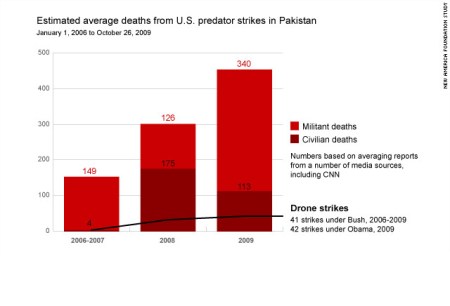
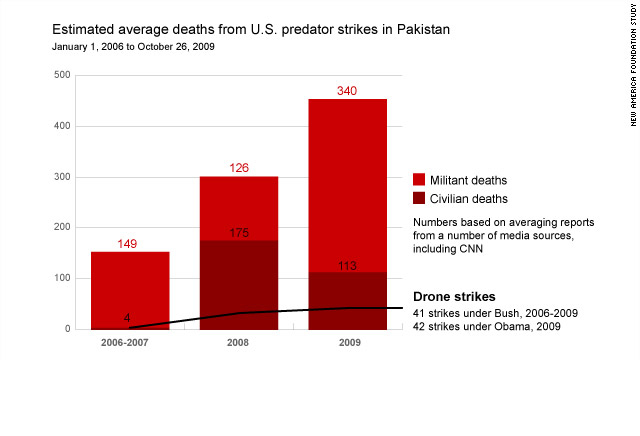
Are the Drones Worth the Cost of Cooperation ?
Read Part 1 – Reconciling CIA Drones In Pakistan
Read Part 2 – Concessions & Collateral Damage
The most provocative piece I’ve seen on drones in Pakistan was published last week. Not the most detailed, well researched article (the New Yorker takes the cake so far) but certainly the most confrontational. Farhat Taj writes in the Daily Times that International media, including American and Pakistani reports critical of drone use are totally unfounded. Vehemently, Taj writes:
” The people of Waziristan are suffering a brutal kind of occupation under the Taliban and al Qaeda. It is in this context that they would welcome anyone, Americans, Israelis, Indians or even the devil, to rid them of the Taliban and al Qaeda”
It’s a grand, almost inconceivable statement given that Anti Americanism is on a rapid rise and India / Pakistan are widely considered notorious Arch Nemesis in international relations today. Taj says inhabitants of Waziristan actually “welcome” drone attacks and dismisses all accusations of civilian casualties as Taliban propaganda. Basing this on the idea that almost no media are allowed in the area, she concludes there is no verifiable evidence, and therefore no reason for concern of civilian casualties. But mere logic would indicate otherwise. Although surgical, drones are not so precise to as to obliterate one individual at a time. When they strike, the range of damage inflicted by any drone is bound to cause peripheral damage, destroying more than just a singular terrorist.
Taj also too vehemently dismisses the concern that drones infringe on Pakistan’s sovereignty. She says greater Pakistan is oblivious to the more pressing priority of wiping out Taliban. And while I agree the Taliban is inflicting profound, perpetual and grave damage on Waziristan, greater Pakistan’s perceptions are important and not to be overlooked so easily.
Waziristan is but a fraction of Pakistan. If the majority of Pakistani’s see drones as an infringement of sovereignty, future cooperation with strategically poised Pakistan can become difficult. The alliance is already waning and one of politics’ golden rules is: perceptions matter. Whether or not there are exact numbers of civilian casualties, Pakistani’s are strongly against unmanned aircraft dropping bombs in their territory. Regardless of circumstances, the perception of an alliance with America, and our War on Terror is endangered by the drones. Hence arguments that drones are counter productive.
At what cost are we using drones to wipe out a few key leaders from militant and extremist groups? Might we accomplish the same success in hunting down terrorists by employing Pakistani forces to take these guys out themeslves using close cooperation with our counter terrorism, intelligence and military operations?
Some already argue that Islamabad tacitly works with the United States on drones in the north, however, the official and public stance of the Pakistani government is of staunch disapproval of drones. It’s a fair argument because without Islamabad’s approval, the United States would be in violation of international law, and protocol in using drones in Waziristan minus Pakistsan’s approval. So I buy the argument that Islamabad works closely in using drones in the north. But the fact that the government goes to the extent of constantly assuring its public that they disapprove of drones on record, is testimony to how offensive the use of unmanned aircrafts are in Pakistan.
So while our heightened use of drones might be effective in obliterating key leaders from the Taliban ranks for success in the immediate term, the consequences of drones entail potentially riling further anti Americanism which could compromise our interests in the future.
Cooperation is key, and I’m not convinced increased use of drones will help us engage Pakistan in the future.
ORIGINALLY PUBLISHED @
Posted in Current Affairs, Foreign Policy, International Affairs, International Relations, Pakistan, US Foreign Polciy, US Pakistan relations | Tagged 2010 pakistan politics, International Affairs, international affairs in pakistan, International Affairs international affairs in pakistan International Affairs Pakistan international politics pakistan International Relations international relations pakistan jeewanjee Pakistan Pakis, International Affairs Pakistan, international politics pakistan, International Relations, international relations pakistan, jeewanjee, jeewanjee politics, pakistan international, Pakistan international affairs, pakistan policy, pakistan politiacal affairs, pakistan political, pakistan political affairs, pakistan politics, pakistan united states afghanistan, Pakistan US cooperation, Pakistan war on terror, pakistani affairs, pakistani policies, pakistani political affairs, pakistani politics, pakistani poltics, pakistani poltiis, pakistani us relations, politics in pakistan, politics of pakistan, terrorism of pakistan, united states assistance pakistan, United states foreign policy pakistan, united states pakistan cooperation, united states pakistan policies, united states pakistan relations, united states zia ul haq, us assistance to pakistan, US foreign policy, US foreign policy to pakistan, us led war on terror, us led war on terror pakistan, us neutrality pakistan, US Pakistan relations, us winning hearts and minds, war on terror in pakistan, war on terror united states pakistan, zainab, zainab jeewanjee, zainab jeewanjee foreign policy, zainab jeewanjee internation, zainab jeewanjee international affairs, zainab jeewanjee international relations, zainab jeewanjee Pakistan, Zainab jeewanjee politics, zainab politics, zainyjee | 6 Comments »
January 26, 2010
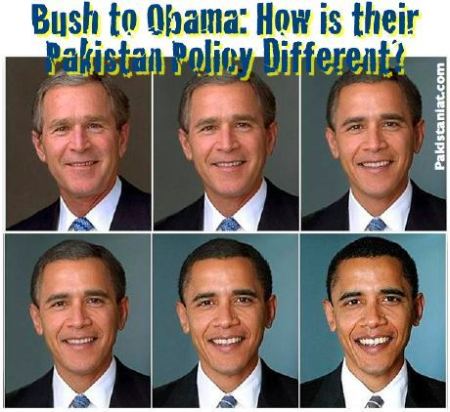
Bush & Obama : Identical Policies to Pakistan?
Similar to his ratings drop at home, abroad President Obama is being accused of not living up to expectations. In DAWN news this week there’s an article entitled: “Obama’s Changing Tone” suggesting our President is reverting to foreign policy reminiscent of the Bush administration on Pakistan, and to an extent, the greater Muslim World. The idea is that Obama’s planned troop surge in tandem with ever toughening rhetoric post the Fort Hood Massacre and the Christmas Bomber, reflects leadership that’s not much different than former President Bush’s.
But on the contrary, our escalating presence in Pakistan is exactly what Obama promised. During the campaign trail, he made clear that his main focus was Al Qaeda and destroying terrorists in Pakistan (militants having spilled over from Afghanistan into Pakistan). The rhetoric was so hawkish, it actually became a sticking point before the primaries that Republicans and Democrats like Hillary criticized. Also, the media publicized his staunch rhetoric at length, so
Obama really has not changed tone on Pakistan: an intensified war matches his rhetoric from the start.
Plus is it fair to expect something radically different than the previous administration in the first place? Let’s not forget that it is often the political system and circumstances that drive leadership, and not vice versa. The fact is, America was already deeply engaged in two very problematic wars at the inception of Obama’s Presidency. He inherited an intensely worsening situation in Afghanistan that rapidly spilled across the border into Pakistan. President Obama anticipated this and is thus living up to campaign promises: a more hawkish foreign policy to Pakistan.
Which of course then raises the question: is hawkishness the right approach to Pakistan at this time? Pakistani’s certainly don’t think so. CIA drones have the entire country in an uproar, while Islamabad isn’t taking well to DC’s tacit encouragement of rapidly increasing Indian influence in Afghanistan, and even billions in aid from America is frowned upon with unprecedented magnitude. And it’s not that the Obama administration isn’t aware of skepticism. Rather, toughening policies are a matter of practicality.
My guess is that the President is thinking: we’re already in Afghanistan, the war is deteriorating into Pakistan, what’s the best way to mitigate the situation, secure the region just enough to exit in the next couple years while leaving behind more cooperative players in the region so as to ensure our energy and geopolitical interests in South/Central Asia.
Phew. Now there’s a dilemma. And when looked at from his possible perspective, the Pakistan quagmire is revealed as tremendously complex. It’s such a multifaceted, sweeping, consequential and changing situation that involves so many players who work within the confines of political systems that only history should be the best judge of whether Obama’s stance on Pakistan is constructive or progressive. And that itself is relative. So let’s not be surprised at his hawkishness. It was naive of anyone to expect otherwise in the case of Pakistan.
ORIGINALLY PUBLISHED @
Posted in Current Affairs, Foreign Policy, International Affairs, International Relations, Pakistan, US Foreign Polciy, US Pakistan relations | Tagged af-pak, af-pak region, af-pak strategic, af-pak war, af-pak war on terror, america and pakistan cooperation, america and pakistan politics, american foreign policy and pakistan, american foreign policy pakistan, american pakistani politics, International Affairs, International Affairs Pakistan, international politics pakistan, International Relations, international relations pakistan, military aid, obama and pakistan, obama foreign policy, Obama Pakistan, obama pakistan policy, obamas foreign policy, obamas pakistan policy, pakistan international, pakistan policy, pakistan politiacal affairs, pakistan political, pakistan political affairs, pakistan politics, pakistan united states afghanistan, Pakistan US cooperation, Pakistan US relations, pakistan us relationship, Pakistan war on terror, pakistan washington dc, pakistani affairs, pakistani corruption, pakistani military, pakistani policies, pakistani political affairs, pakistani politics, pakistani poltics, pakistani poltiis, pakistani taliban, pakistani us relations, pakistans military, pakistans war on terror, pervez musharraf pakistan, policy to pakistan, political affairs of pakistan, politics in pakistan, politics of pakistan, politics pakistan, president obama and pakistan, president obama foreign policy, president obama pakistan, president obama pakistan strategy, prime minister sharif, relations between united states and pakistan, senator kerry, senator kerry pakistan, senator lugar pakistan, south waziristan pakistan, Taliban, taliban afghanistan, taliban in pakistan, taliban pakistan, the af-pak region, the af-pak war, troop surge afghanistan, troop surge in afghanistan, troop surge in pakistan, troop surge pakistan, u.s. pakistan cooperation, united states assistance pakistan, united states democracy pakistan, United states foreign policy pakistan, united states pakistan cooperation, united states pakistan policies, united states pakistan relations, us aid to pakistan, us assistance to pakistan, US foreign policy, US foreign policy pakistan, us foreign policy south asia, US foreign policy to pakistan, us led war on terror, us led war on terror pakistan, us neutrality pakistan, US pakistan cooperation, us pakistan politics, US Pakistan relations, us pakistan relationship, us war on terror, us war on terror pakistan, war on terror in afghanistan, war on terror in pakistan, war on terror pakistan, war on terror united states pakistan, zainab blog, zainab jeewanjee, zainab jeewanjee foreign policy, zainab jeewanjee internation, zainab jeewanjee international affairs, zainab jeewanjee international relations, zainab jeewanjee Pakistan, Zainab jeewanjee politics, zainab politics, zainyjee | 1 Comment »
December 21, 2009
American Neutrality is Boston Globe’s recommendation for U.S. policymakers as political uncertainty looms over Pakistan with last weeks repeal of the National Reconciliation Ordinance, effectively revoking Amnesty from corruption charges on thousands of government officials. Although political transition appears imminent in 2010 and comes as President Obama commits to an Af-Pak troop surge, effectively stepping up our engagement with Islamabad, the Boston Globe’s call for neutrality is wise given the current pool of potential leaders to choose from:
- Nawaaz Sharif:
- Reason We Should Remain Neutral – Quite simply: “After two terms as prime minister, he’s remembered for rampant corruption, nuclear proliferation, and his penchant for cozying up to Islamist militants“
- Pervez Musharraf or Asif Zardari:
- Reason We Should Remain Neutral – Well: “at the behest of Washington, General Pervez Musharraf, who was president at the time, arranged the amnesty that allowed Zardari and his wife, Benazir Bhutto, to return from exile so she could lead her Pakistan Peoples Party in elections. Bhutto was assassinated, and her husband became prime minister. Not without reason, many Pakistanis who are angry about Zardari’s corruption and ineffectiveness hold the United States responsible for imposing him on their country”
- Pakistan Military:
- Reason We Should Remain Neutral – Perpetuating rampant blame that one too many American backed military dictators have prevented democracy from ever taking root in Pakistan can’t help growing weariness of cooperation with our government.
- Noteworthy example – Backing General Zia-ul-Haq in the 1980’s with his leadership key to training the Mujahideen (now known as Al Qaeda) to oust the Soviets from Afghanistan. Not coincidentally, Zia’s regime is remembered as the time Pakistan shifted from being a socially progressive, and moderate Islamic state, to imposing severe, fundamentalist religious policy reforms.
- Chief Justice Iftekhar Chaudhry:
- Reason We Should Remain Neutral: Under a sugar-coated banner of “democracy”, the Chief Justice is too blatantly partisan for us to support. His recent decision to repeal the National Reconciliation Ordinance, which set wheels in motion for regime change is widely understood as nothing short of a ploy for power and done in the politics of retribution.
This leaves neutrality as not only our most wise option, but also perhaps our most ethical route. Restraint in supporting any particular regime could mean history points one less finger in our direction should anything go less than perfect as we deepen involvement in Af-Pak. Simultaneously, neutrality assures Pakistani masses who are increasingly skeptical of cooperation with the United States that they have 100% autonomy in political processes.
Well publicized neutrality on a looming regime change could be a valuable opportunity to demonstrate a genuine interest in Pakistan as they transform politically and we require their support in the War on Terror.
ORIGINALLY PUBLISHED @
Posted in Current Affairs, Foreign Policy, International Affairs, International Relations, Pakistan, U.S. Politics, US Foreign Polciy, US Pakistan relations | Tagged 2010 pakistan, 2010 pakistan politics, af-pak, af-pak region, af-pak strategic, af-pak war, af-pak war on terror, american neutrality pakistan, american pakistan relations, asif ali zardari, Asif Zardari, asif zardari pakistan NRO, asif zardari supreme court, chaudhry chief justice, chief justice chaudry, chief justice in pakistan, chief justice nro pakistan, chief justice of pakistan, chief justice pakistan, current affairs pakistan, genearal zia united states, General Musharraf, general zia pakistan, general zia united states, iftekhar chaudry, iftikhar chaudhry, international affairs in pakistan, International Affairs Pakistan, international politics pakistan, international relations pakistan, jeewanjee, jeewanjee politics, justice chaudhry, justice chaudry, kerry lugar bill, kerry lugar bill pakistan, mujahideen zia, musharraf pakistan, musharraf zardari, muslim world, muslims pakistan, national reconciliation ordinance, national reconciliation ordinance pakistan, nawaaz sharif, nawaaz sharif corruption, nawaz sharif corruption, nawaz sharif corruption prime minister, neutrality pakistan, news on pakistan, NRO court zardari, NRO pakistan, NRO pakistan court, NRO ruling, NRO supreme court, NRO supreme court pakistan, NRO unconstitutional, NRO unconstitutional pakistan, NRO zardari, NRO zardari pakistan, organization of islamic conference pakistan, pakistan 2010 prediction, pakistan 2010 recommendation, pakistan affairs., pakistan foreign policy, pakistan foreign policy association united states, pakistan international, Pakistan international affairs, pakistan international politics, pakistan musharraf, pakistan needs economic development, pakistan news, pakistan next year, pakistan policy, pakistan politiacal affairs, pakistan political, pakistan political affairs, pakistan politics, pakistan politics asif zardari, pakistan united states afghanistan, Pakistan US cooperation, Pakistan war on terror, pakistani affairs, pakistani policies, pakistani political affairs, pakistani politics, pakistani poltiis, pakistani us relations, pervez musharraf pakistan, politics in pakistan, politics of pakistan, president obama pakistan strategy, prime minister jaswant singh, prime minister nawaz sharif, prime minister sharif, supreme court pakistan zardari, terrorism afghanistan pakistan, terrorism of pakistan, the af-pak region, the af-pak war, united states assistance pakistan, United states foreign policy pakistan, united states pakistan cooperation, united states pakistan policies, united states pakistan relations, united states zia ul haq, us assistance to pakistan, US foreign policy, US foreign policy to pakistan, us led war on terror, us led war on terror pakistan, us neutrality pakistan, US Pakistan relations, us winning hearts and minds, war on terror in pakistan, war on terror united states pakistan, zainab jeewanjee, zainab jeewanjee foreign policy, zainab jeewanjee internation, zainab jeewanjee international affairs, zainab jeewanjee international relations, zainab jeewanjee Pakistan, Zainab jeewanjee politics, zainab politics, zainyjee, zardari corruption, zardari nro, zia pakistan islamization, zia pakistan radical islam, zia ul haq pakistan | 2 Comments »
December 18, 2009
Overview: Pakistan has been the ultimate quagmire. Suicide bombings, Taliban aggressions and violence plagued Pakistani civilians throughout the year while the Obama administration grappled with crafting an effective strategy in what is now referred to as the Af-Pak War. Collectively, foreign policymaking heavyweights attempted at a solution. Special Envoy Holbrooke spent months in the region, Secretary Clinton made multiple visits and media rounds this year, and the Senate Foreign Relations Committee heard from General McChrystal on a troop surge which itself was hotly debated at length before ultimately being brought forth by President Obama. Despite the necessity of bilateral cooperation in obliterating terrorists, Pakistan and the United States grow weary of their alliance. Drones, intensifying U.S. relations with India namely the civilian nuclear deal, and deep hesitations on the Kerry Lugar Bill marred relations on the Pakistani side. And for the United States, the lingering concern that Pakistan should be doing more in the War on Terror and appreciate our patience with their efforts have made both states cynical partners.
Person of the Year: Unfortunately, the Terrorist. Al Qaeda militants who spilled over from the nebulous Afghan-Pakistan border have gripped the country and sadly had major impact on the lives of innocent civilians. Brazen, unprecedented violence in the form of suicide attacks on public shopping areas, children’s schools and even Mosques demonstrate how the terrorist paralyzed Pakistan in 2009.
Most Unexpected Event: Terrorists turning domestic. Pakistan has suffered the brunt of terrorist activity in 2009. The stereotype we have of terrorists today entails violent attacks on supposed “infidels”, or western international targets. But 2009 saw Al Qaeda gradually in cooperation with the Taliban, extend violent attacks on Pakistan’s predominantly Muslim population. Attacks on and around Islamic houses of worship even became a reality this year.
What to Watch for in 2010: Increasing democratization of Pakistan, despite a very likely change in regime. Former military General Musharraf may return in some capacity, and democratization should continue to progress by way of an expanding private media. As per Musharraff’s reform in 2002, privatized Television channels have made extraordinary strides in disseminating information that is increasingly reflective of the masses, giving Pakistani’s a voice, and vehicle for change. Many consider the reinstatement of Chief Justice Iftikhar Chaudhry in March 2009 a direct result of privatized media who vociferously helped mobilize demonstrations such as the Long March. So, although security issues will continue to dominate until Af-Pak is stabilized, expect expanding television media that can help pave the way for a more moderate, democratic Pakistan.
ORIGINALLY PUBLISHED @
Posted in Pakistan, US Pakistan relations | Tagged 2010 pakistan, 2010 pakistan politics, af-pak, af-pak region, af-pak strategic, af-pak war, af-pak war on terror, international affairs in pakistan, International Affairs Pakistan, international politics pakistan, international relations pakistan, jeewanjee, jeewanjee politics, pakistan 2010 prediction, pakistan 2010 recommendation, pakistan international, Pakistan international affairs, pakistan next year, pakistan policy, pakistan politiacal affairs, pakistan political, pakistan political affairs, pakistan politics, pakistani politics, pakistani poltiis, politics in pakistan, politics of pakistan, the af-pak region, the af-pak war, zainab jeewanjee, zainab jeewanjee international relations, Zainab jeewanjee politics, zainab politics | 19 Comments »


 Zainab B. Jeewanjee
 Zainab Jeewanjee