After months of consideration on how to deal with our escalating engagement in the AF-Pak region, Obama’s administration has decided:
“the Taliban cannot be eliminated as a political or military movement”
An article in the Washington Post today cites the administrations re-vamped goal of mitigating a Taliban capacity to interfere in the establishment of a stable Afghan government while assuring us that Al Qaeda is the primary threat, and our strategy will focus squarely on eradicating them.
It seemed news on Pakistan in the past year revolved around Islamabad not doing enough to eradicate the Taliban; equating the group to Al Qaeda in terms of importance in the War on Terror. But today marks a clear departure from such criticism. Distinguishing Al Qaeda from the Taliban is a huge step forward for the United States. Because connecting our goals to eliminate both immediate security threats and major elements of Afghan society that are unpalatable to our values, has proven counter productive. Having lived in Pakistan to experience the ill effects of hyper conservative religious factions, I know we mean well in trying to uproot extremism, but it just hasn’t worked in tandem with our military offensive. And I’ve mentioned the importance of a distinction between these groups previously:
The Taliban is historically distinct from militant groups like Al Qaeda. Unlike the Taliban, Al Qaeda is directly responsible for 9/11. Simply put, the Taliban was an ideologically fundamental group, while Al Qaeda is a militant, terrorist group. Both are dangerous as such, but the Taliban has national interests in controlling Afghanistan under strict ideological rules while Al Qaeda is a militant organization with international ambitions.
It’s not a novel contention, but only just being reflected in policy, and I think it has potential for success. As an ideological force, the Taliban foster an ultra conservative brand of Islam, but are not necessarily a threat to our security interests. Plus, if General McChrystal’s goal is defined as establishing a sustainable, democratic Afghan government, in order for it to be considered legitimate, it must be rooted in Afghan values and according to Afghan preferences. Such preferences might seem backward, or entirely unpleasant to us, but so long as our interests are being protected, impressing our brand of democratic values should take a back seat for the time being. I think the Obama administration has taken a wise step in revamping the Af-Pak strategy and hope it yields lasting success.
Riaz Mohammad Khan is being considered for the position of Pakistan’s Special Envoy to India says Foreign Minister Shah Mahmood Qureshi. Attempting to resume talks that are stalled since the Mumbai atrocities, Minister Qureshi suggests using “backchannel diplomacy” through informal talks and in parallel with a formal peace process to achieve a warming of relations and overall progress in relations. In a recent statement to Indian TV networks, Qureshi clearly states he is “instructed by the President to move on. We want to normalize with India”. Such top level recommendations reflect Islamabad’s growing desire for more progressive relations with their neighbor, as consistently pursued by the Zardari administration.
Attributing initial moves toward back channel diplomacy to Musharraf era policies in resolving the Kashmir issue with India, Qureshi stresses that progress can only be made if both “front and back channel (diplomacy) move in tandem”. It’s a reasonable assessment given relations have been held up despite three high level meetings between leaders at the sidelines of international summits since June. Back Channel diplomacy, being secret and inherently less formal can eliminate domestic political concerns policymakers face that might stifle open, progressive discussion.
With a climate of mistrust exacerbated by the Mumbai atrocities and on the Pakistan side, claims that India is constantly funding militant separatists in Baluchistan, back channel diplomacy can mitigate both states political need to formally construct ever toughening stances against one another.
The Baluchistan and Mumbai issues are highly sensitive to citizens in both countries and assuaging those concerns is rightfully a priority for politicians on all ends. As a result, official talks between India and Pakistan wind up inherently staunch as they are subject to international media portrayals and reactionary sensitivities of masses in either country. This has done little to advance peace talks in any tangible way. And because the United States has a stake in ensuring stability in Pakistan given increased investment in the form of the Kerry Lugar bill and additional troops to Afghanistan, perhaps special envoy Holbrooke, or another appointed official on behalf of Washington might serve to mediate initial attempts at back channel diplomacy.
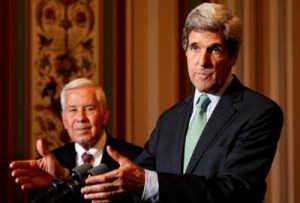
Senate unanimously passed a bill authorizing “appropriations to promote an enhanced strategic partnership with Pakistan”. The legislation is likely to receive similar support in the House later this week before being sent to President Obama for final approval. Initial versions of legislation were presented as the Biden-Lugar bill last year led by democrats Joe Biden and Senator Kerry, and supported by Hillary Clinton and Barack Obama. Currently, the bill is coauthored by Republican Senator Dick Lugar making it widely bipartisan which reflects our growing desire to engage Pakistan ensuring stability and ultimately our interests in the region.
The Legislation triples foreign aid to our major non NATO ally” allowing up to $1,500,000,000 for their cooperation in “counterterrorism/counterinsurgencydescribing Pakistan’s ongoing struggles and successes against the Taliban and Al Qaeda. It cites assassination of Benazir Bhutto, the Islamabad and Mumbai hotel attacks last fall among other suicide bombings in Pakistan and Afghanistan, some of which involved deaths of US citizens to underscore an immediate need to assist Pakistan at this critical time. As we face mounting deaths in the War on Terror, send additional troops to Afghanistan and President Obama works closely with generals to revamp our strategy there, the bill is meant to forge a new relationship with Pakistan.
It extends diplomatic rhetoric directly to the people of Pakistan by describing the daily plight of citizens who are “especially hard hit by rising food and commodity prices and severe energy shortages” with 2/3rds of the population living on less than 2.25 and 1/5 of the population living below the poverty line”. It further mentions “Compatible goals of combating terrorism, radicalism and promoting economic development through building of infrastructure and promoting social and material well being for Pakistani citizens through development of public services”. And most interestingly, the bill cites Pew opinion polls finding:
“Pakistan has historically viewed the relationship between the United States and Pakistan as a transactional one characterized by a heavy emphasis on security issues with little attention to other matters of great interest to citizens of Pakistan”.
Then referring to the current civilian government as an “opportunity to place relations on a new and more stable foundation”. The bill’s ‘statement of policy‘ identifies the following objectives:
Support the consolidation of democracy, good governance & rule of law in Pakistan
Support economic growth & development to promote stability/security
To build a sustained, long term, multifaceted relationship with Pakistan
Expanding bilateral engagement with Pakistan
To work with Pakistan and bordering countries to facilitate peace (a possible reference to mediating the Kashmir issue. President Obama mentioned doing so during his campaign run for President)
Expand people to people engagement between US and Pakistan through increased educational, technical and cultural exchanges (possibly in the form of more student/professional visas. Envoy Holbrooke mentioned this in visits to Karachi in July)
Work with government of Pakistan to:
prevent Pakistani territory from being used as a base/conduit for terrorism in Pakistan, Afghanistan, India or elsewhere
Coordinate military, paramilitary & police action against terrorist terrorism
Help bring peace, stability and development
(this might entail counterinsurgency/counterterrorism assistance and cooperation through intelligence sharing, arms development/trade and training of Pakistani forces)
Pakistan is aptly described as a major non-NATO, long-standing ally. But cooperation has been dominated by security issues generally in the form of military dictators supported by the States in exchange for Pakistan’s military assistance throughout the Cold War and current War on Terror resulting in the Pakistani mindset of solely “transactional” relations. This bill is a fair attempt to shift that context to a more positive tone with the aforementioned objectives and diplomatic rhetoric.
However, certain specificities such as timetables and solid oversight must be transparently accessible to the Pakistani and American public to ensure more positive relations are achieved. Already experts are weighing in with concerns. Despite the commitment to development in addressing the plight of daily Pakistani’s, Foreign Policy Magazine mentions that the bill doesn’t say exactly how much of these funds are to be allocated toward military assistances. And although senator Kerry insists “Clear, tough minded accountability standards and metrics” are contained in the bill, Dawn News cites Rand Corporation expert Dr. Christine Fair raising the issue of “greater transparency” and wanting to ensure international accounting standards are applied in allocating these funds. Such concerns are equally felt in Pakistan, where past commitments of economic development have not always found their way to alleviating the plight of daily citizens for whom funding is supposedly intended.
For this reason a concerted conviction to improving the daily lives of Pakistani’s is required by Pakistani politicians who have ultimate control over how these funds are applied. I hope that President Asif Zardari along with Parliament works closely to ensure monies are responsibly allocated to a “sustainable” development the bill calls for.
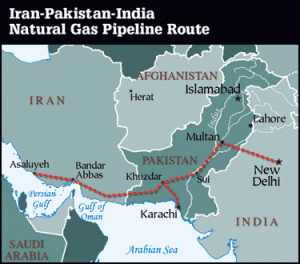
The anticipated Iran-Pakistan-India (IPI/”Peace Pipeline”) pipeline may end up running only through Iran/Pakistan as India backed out from the project last week says Muhammad Abbasi, Pakistani Ambassador to Iran. Delhi’s withdrawal comes simultaneously as the US pressures Islamabad to disengage from the multibillion dollar project set for completion in 2013. This adds to the list of obstacles IPI faced since it was conceptualized in the 1990’s. From international pressures, prolonged funding negotiations, to domestic insecurities and reservations, the pipeline has yet to begin construction. However, Pakistan stresses urgency in moving forward with construction in the face of alarming energy shortages :
Only 60% of households have electricity and 18% access to pipeline gas for heating. Energy demand is expected to increase 250% over the next 20 years. To meet expected demand, electrical generating capacity must grow by 50% from 20.4 gigawatts to 30.6 gigawatts by 2010
Pakistan’s domestic gas production is falling and import dependence growing tremendously. By connecting itself with the world’s 2nd largest gas reserve, Pakistan guarantees a reliable supply for decades. If the pipeline were to be extended to India it could also be an instrument for stability in often tense Pakistan-India relations. Under any scenario of pipeline expansion which makes Pakistan a transit state, Islamabad stands to gain from transit fees hundreds of millions of dollars every year.
Given such potential, it’s not surprising Pakistan is intent on moving forward with IPI regardless of pressure from D.C. Despite Special Envoy Holbrooke’s diplomatic suggestions that the United States might “link funds committed by the Democratic Friends of Pakistan” to their cooperation with Iran on IPI, foreign minister Shah Mahmood Qureshi maintained Pakistan’s urgency:
“The gas pipeline construction agreement with Iran and Pakistan will by no means go under the U.S. pressures,”
But some experts insist that without American support to release funding and loan guarantees, financing of IPI will make the 2013 deadline unfeasible. This poses problems for Pakistan, and on the American front, there are differing concerns. Hoping to maintain US authority and secure interests in the region, President Obama shifts starkly from the previous administration using more engagement and soft power with Iran. So American moves to work with the international community in economically choking Iran and ultimately eliciting behavior from Tehran are diminished as Iranian influence increases through international projects such as IPI. Hardline Bush Administration and more diplomatic Obama led policies are interesting yielding similar ends as Iran continues to expand trade and relations with the international community. This flouts hard, soft, all stances the United States takes in attempting to contain Tehran.
For instance, a vastly constructed pipeline running over 2,775 kilometers (1,725 miles)from the Persian Gulf in Iran, through Baluchistan to a port in Karachi and then north to New Delhi creates “an unbreakable long term political and economic dependence” of billions of people from Pakistan, to India and potentially extending to China.
The prospect of the entire subcontinent being “dependent” on Iran actually sounds alarming, but if we look at certain realities it’s perhaps far fetched. Firstly, any semblance of an actual dependence is most likely only applied to Pakistan given their current energy crisis, the cost effectiveness and efficiency of natural gas as opposed to developing LNG sources: India on the other hand has “two LNG terminals and will complete a third terminal by this year. Two additional terminals have also been proposed, and several companies are examining viability of constructing additional LNG import sites”. So Delih is far less likely to be entirely reliant on Tehran for natural gas because developments in LNG and civilian nuclear projects. Plus, India’s long, strong alliance with Russia allows for a convenient energy supplier to the north if need be. In fact, for Moscow IPI is an opportunity to quell thoughts that Tehran will compete in supplying natural gas to EU markets. Russia’s deputy energy minister explains:
“It is therefore in Russia’s interest to derail the Nabucco project by diverting Iran’s gas away from Europe and locking it to the Asian market. We are ready to join the project as soon as we receive an offer”
Thus a point of contention for Moscow and Washington. DC’s fears are further exacerbated by a potential of IPI eventually ensuring energy supplies to long standing Pakistani ally, China with shipments along the Karakoram Highway through future pipelines . The argument made is that hopes of modifying Iranian behavior with economic pressures plus our mutual hedging with China suffers if IPI is constructed. Again, this relies on the assumption that billions of Indians and Chinese become “dependent” on Iranian gas supplies, which I find unlikely. Pakistan if anyone, is likely to become heavily reliant on those supplies in the next couple decades should IPI be executed as planned. Thus suggested solutions point to alternative pipelines that bypass Iran:
“A rival gas-pipeline project — the Turkmenistan-Afghanistan-Pakistan-India (TAPI) carrying gas from Daulatabad in Turkmenistan via Herat and Kandahar in Afghanistan to Multan in central Pakistan is one such alternative”
But this concept is contingent to a stable Afghanistan, which most experts indicate is not in the near future. Without stabilizing Afghanistan and given chilly relations with India, TAPI is not likely to move forward without overcoming numerous diplomatic and security obstacles. And Pakistan’s energy crisis doesn’t afford Islamabad time to wait for the international community to stabilize Afghanistan or warming relations with India.
Critics of IPI also insist it is conducive to US interests for Pakistan to develop LNG supplies rather than natural gas. This probably entails cooperation with Europe and the United States as opposed to Iran, which is an unviable suggestion. Firstly, LNG development is more expensive than natural gas supplies through a pipeline. Plus, it’s more probable that Pakistan receive lower cost, soft term loans in dealing with Iran as opposed to the EU or US. IPI also presents a possibility of improved trade opening import markets for Pakistan where Iranians can purchase food items. Pakistan has a strong agricultural base and produces wheat, sugar and rice that can be exported efficiently to its neighbors. So for Pakistan, IPI is a viable solution to the energy crisis in addition to creating future revenue generation.
Should the worst happen and a Taliban style regime take over Pakistan, the economies of the world’s most radical Shiite state and that of what could be the world’s most radical Sunni state would be connected to each other for decades to come like conjoined twins.
This is an outrageous misgiving. Al Qaeda and the Taliban spilled over into Pakistan since our War on Terror began in 2001, meaning the Taliban are nowhere near rampant in number or have many sympathizers amongst the mostly moderate population. The Pakistani army made strides in efficiently securing the Swat valley and continue to make progress in eradicating militants. Assuming the entire Pakistani military and heads of state can not obliterate 20-40K (at maximum) Taliban is unreasonable. Many experts have indicated, it’s not that it can’t be done, it’s working to ensure the job gets done efficiently and to secure the long term which is taking time. I think the suspicion of Taliban influence in Pakistan is used perhaps to sensationalize the consequences of IPI construction.
Still, critics maintain that IPI is against our interests and hope lies in it never being constructed given diminutive chances of getting the needed 7.5 billion in funding and because of the volatile location of construction. IPI would run through the province of Baluchistan where resentment and instability with the federal government is historical, underprivileged masses prevail and prior instances of attacks on water pipelines ensued. These facts might impede construction of IPI but it’s important to note that even the most critical voices against the pipeline maintain we not intervene in aiding any subversion of federal government projects in Baluchistan:
US open support for opposition groups who might be willing to undermine the project is unthinkable as any collaboration – overt or covert – would severely cripple our relations with Islamabad
Pakistan’s deep cooperation and commitment to fighting the War on Terror trump other priorities. Plus, in the long run, economic interdependence at the cost of our diminishing influence is maybe preferred to a possibility that this region become increasingly rife with groups well armed and trained at subverting national governments. The Soviet Afghan War was our best teacher of that lesson.
Finally, critics argue how it’s against US interests for Iranian influence to expand in South Asia through IPI because it would add regional instability should Tehran become nuclear and support terrorism. However, this relies on the assumption that heads of state are engaging in bilateral trade with Pakistan on this project for an ultimate goal of international terrorism and that heads of state are irrationally going to create instability in a region that they are increasingly economically interdependent with.
Certainly, a successful natural gas pipeline that spurs economic growth for Iran and helps solve South Asia’s energy crisis might increase Tehran’s influence to some extent, but overall instability and supporting terrorism runs counter to basic arguments of liberal theories of capitalism. With increased trade and interdependence, might increased peace and less interest and instability ensue?
Thus in accepting the reality of what Fareed Zakaria calls, “The Rise of the Rest” wherein increasingly interdependent and economically stable states using minimum or zero US intervention are growing into regional powers President Obama is beckoned to reassess foreign policy. Iran won’t likely rival American hegemony through IPI, but increasingly such situations require we evolve policies to effectively deal with long standing allies like Pakistan who are inevitably drawn into relations that could diminish our influence.



 Zainab B. Jeewanjee
 Zainab Jeewanjee