Posts Tagged ‘pervez musharraf pakistan’
 January 26, 2010
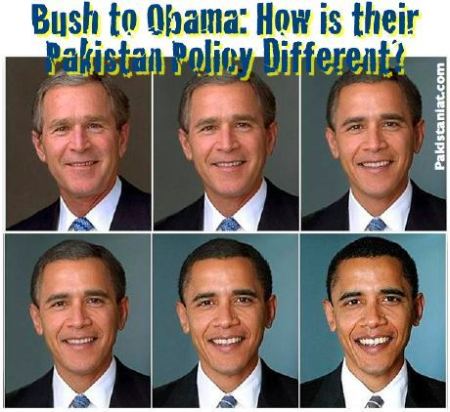
Bush & Obama : Identical Policies to Pakistan?
Similar to his ratings drop at home, abroad President Obama is being accused of not living up to expectations. In DAWN news this week there’s an article entitled: “Obama’s Changing Tone” suggesting our President is reverting to foreign policy reminiscent of the Bush administration on Pakistan, and to an extent, the greater Muslim World. The idea is that Obama’s planned troop surge in tandem with ever toughening rhetoric post the Fort Hood Massacre and the Christmas Bomber, reflects leadership that’s not much different than former President Bush’s.
But on the contrary, our escalating presence in Pakistan is exactly what Obama promised. During the campaign trail, he made clear that his main focus was Al Qaeda and destroying terrorists in Pakistan (militants having spilled over from Afghanistan into Pakistan). The rhetoric was so hawkish, it actually became a sticking point before the primaries that Republicans and Democrats like Hillary criticized. Also, the media publicized his staunch rhetoric at length, so
Obama really has not changed tone on Pakistan: an intensified war matches his rhetoric from the start.
Plus is it fair to expect something radically different than the previous administration in the first place? Let’s not forget that it is often the political system and circumstances that drive leadership, and not vice versa. The fact is, America was already deeply engaged in two very problematic wars at the inception of Obama’s Presidency. He inherited an intensely worsening situation in Afghanistan that rapidly spilled across the border into Pakistan. President Obama anticipated this and is thus living up to campaign promises: a more hawkish foreign policy to Pakistan.
Which of course then raises the question: is hawkishness the right approach to Pakistan at this time? Pakistani’s certainly don’t think so. CIA drones have the entire country in an uproar, while Islamabad isn’t taking well to DC’s tacit encouragement of rapidly increasing Indian influence in Afghanistan, and even billions in aid from America is frowned upon with unprecedented magnitude. And it’s not that the Obama administration isn’t aware of skepticism. Rather, toughening policies are a matter of practicality.
My guess is that the President is thinking: we’re already in Afghanistan, the war is deteriorating into Pakistan, what’s the best way to mitigate the situation, secure the region just enough to exit in the next couple years while leaving behind more cooperative players in the region so as to ensure our energy and geopolitical interests in South/Central Asia.
Phew. Now there’s a dilemma. And when looked at from his possible perspective, the Pakistan quagmire is revealed as tremendously complex. It’s such a multifaceted, sweeping, consequential and changing situation that involves so many players who work within the confines of political systems that only history should be the best judge of whether Obama’s stance on Pakistan is constructive or progressive. And that itself is relative. So let’s not be surprised at his hawkishness. It was naive of anyone to expect otherwise in the case of Pakistan.
ORIGINALLY PUBLISHED @
Posted in Current Affairs, Foreign Policy, International Affairs, International Relations, Pakistan, US Foreign Polciy, US Pakistan relations | Tagged af-pak, af-pak region, af-pak strategic, af-pak war, af-pak war on terror, america and pakistan cooperation, america and pakistan politics, american foreign policy and pakistan, american foreign policy pakistan, american pakistani politics, International Affairs, International Affairs Pakistan, international politics pakistan, International Relations, international relations pakistan, military aid, obama and pakistan, obama foreign policy, Obama Pakistan, obama pakistan policy, obamas foreign policy, obamas pakistan policy, pakistan international, pakistan policy, pakistan politiacal affairs, pakistan political, pakistan political affairs, pakistan politics, pakistan united states afghanistan, Pakistan US cooperation, Pakistan US relations, pakistan us relationship, Pakistan war on terror, pakistan washington dc, pakistani affairs, pakistani corruption, pakistani military, pakistani policies, pakistani political affairs, pakistani politics, pakistani poltics, pakistani poltiis, pakistani taliban, pakistani us relations, pakistans military, pakistans war on terror, pervez musharraf pakistan, policy to pakistan, political affairs of pakistan, politics in pakistan, politics of pakistan, politics pakistan, president obama and pakistan, president obama foreign policy, president obama pakistan, president obama pakistan strategy, prime minister sharif, relations between united states and pakistan, senator kerry, senator kerry pakistan, senator lugar pakistan, south waziristan pakistan, Taliban, taliban afghanistan, taliban in pakistan, taliban pakistan, the af-pak region, the af-pak war, troop surge afghanistan, troop surge in afghanistan, troop surge in pakistan, troop surge pakistan, u.s. pakistan cooperation, united states assistance pakistan, united states democracy pakistan, United states foreign policy pakistan, united states pakistan cooperation, united states pakistan policies, united states pakistan relations, us aid to pakistan, us assistance to pakistan, US foreign policy, US foreign policy pakistan, us foreign policy south asia, US foreign policy to pakistan, us led war on terror, us led war on terror pakistan, us neutrality pakistan, US pakistan cooperation, us pakistan politics, US Pakistan relations, us pakistan relationship, us war on terror, us war on terror pakistan, war on terror in afghanistan, war on terror in pakistan, war on terror pakistan, war on terror united states pakistan, zainab blog, zainab jeewanjee, zainab jeewanjee foreign policy, zainab jeewanjee internation, zainab jeewanjee international affairs, zainab jeewanjee international relations, zainab jeewanjee Pakistan, Zainab jeewanjee politics, zainab politics, zainyjee | 1 Comment »
December 21, 2009
American Neutrality is Boston Globe’s recommendation for U.S. policymakers as political uncertainty looms over Pakistan with last weeks repeal of the National Reconciliation Ordinance, effectively revoking Amnesty from corruption charges on thousands of government officials. Although political transition appears imminent in 2010 and comes as President Obama commits to an Af-Pak troop surge, effectively stepping up our engagement with Islamabad, the Boston Globe’s call for neutrality is wise given the current pool of potential leaders to choose from:
- Nawaaz Sharif:
- Reason We Should Remain Neutral – Quite simply: “After two terms as prime minister, he’s remembered for rampant corruption, nuclear proliferation, and his penchant for cozying up to Islamist militants“
- Pervez Musharraf or Asif Zardari:
- Reason We Should Remain Neutral – Well: “at the behest of Washington, General Pervez Musharraf, who was president at the time, arranged the amnesty that allowed Zardari and his wife, Benazir Bhutto, to return from exile so she could lead her Pakistan Peoples Party in elections. Bhutto was assassinated, and her husband became prime minister. Not without reason, many Pakistanis who are angry about Zardari’s corruption and ineffectiveness hold the United States responsible for imposing him on their country”
- Pakistan Military:
- Reason We Should Remain Neutral – Perpetuating rampant blame that one too many American backed military dictators have prevented democracy from ever taking root in Pakistan can’t help growing weariness of cooperation with our government.
- Noteworthy example – Backing General Zia-ul-Haq in the 1980’s with his leadership key to training the Mujahideen (now known as Al Qaeda) to oust the Soviets from Afghanistan. Not coincidentally, Zia’s regime is remembered as the time Pakistan shifted from being a socially progressive, and moderate Islamic state, to imposing severe, fundamentalist religious policy reforms.
- Chief Justice Iftekhar Chaudhry:
- Reason We Should Remain Neutral: Under a sugar-coated banner of “democracy”, the Chief Justice is too blatantly partisan for us to support. His recent decision to repeal the National Reconciliation Ordinance, which set wheels in motion for regime change is widely understood as nothing short of a ploy for power and done in the politics of retribution.
This leaves neutrality as not only our most wise option, but also perhaps our most ethical route. Restraint in supporting any particular regime could mean history points one less finger in our direction should anything go less than perfect as we deepen involvement in Af-Pak. Simultaneously, neutrality assures Pakistani masses who are increasingly skeptical of cooperation with the United States that they have 100% autonomy in political processes.
Well publicized neutrality on a looming regime change could be a valuable opportunity to demonstrate a genuine interest in Pakistan as they transform politically and we require their support in the War on Terror.
ORIGINALLY PUBLISHED @
Posted in Current Affairs, Foreign Policy, International Affairs, International Relations, Pakistan, U.S. Politics, US Foreign Polciy, US Pakistan relations | Tagged 2010 pakistan, 2010 pakistan politics, af-pak, af-pak region, af-pak strategic, af-pak war, af-pak war on terror, american neutrality pakistan, american pakistan relations, asif ali zardari, Asif Zardari, asif zardari pakistan NRO, asif zardari supreme court, chaudhry chief justice, chief justice chaudry, chief justice in pakistan, chief justice nro pakistan, chief justice of pakistan, chief justice pakistan, current affairs pakistan, genearal zia united states, General Musharraf, general zia pakistan, general zia united states, iftekhar chaudry, iftikhar chaudhry, international affairs in pakistan, International Affairs Pakistan, international politics pakistan, international relations pakistan, jeewanjee, jeewanjee politics, justice chaudhry, justice chaudry, kerry lugar bill, kerry lugar bill pakistan, mujahideen zia, musharraf pakistan, musharraf zardari, muslim world, muslims pakistan, national reconciliation ordinance, national reconciliation ordinance pakistan, nawaaz sharif, nawaaz sharif corruption, nawaz sharif corruption, nawaz sharif corruption prime minister, neutrality pakistan, news on pakistan, NRO court zardari, NRO pakistan, NRO pakistan court, NRO ruling, NRO supreme court, NRO supreme court pakistan, NRO unconstitutional, NRO unconstitutional pakistan, NRO zardari, NRO zardari pakistan, organization of islamic conference pakistan, pakistan 2010 prediction, pakistan 2010 recommendation, pakistan affairs., pakistan foreign policy, pakistan foreign policy association united states, pakistan international, Pakistan international affairs, pakistan international politics, pakistan musharraf, pakistan needs economic development, pakistan news, pakistan next year, pakistan policy, pakistan politiacal affairs, pakistan political, pakistan political affairs, pakistan politics, pakistan politics asif zardari, pakistan united states afghanistan, Pakistan US cooperation, Pakistan war on terror, pakistani affairs, pakistani policies, pakistani political affairs, pakistani politics, pakistani poltiis, pakistani us relations, pervez musharraf pakistan, politics in pakistan, politics of pakistan, president obama pakistan strategy, prime minister jaswant singh, prime minister nawaz sharif, prime minister sharif, supreme court pakistan zardari, terrorism afghanistan pakistan, terrorism of pakistan, the af-pak region, the af-pak war, united states assistance pakistan, United states foreign policy pakistan, united states pakistan cooperation, united states pakistan policies, united states pakistan relations, united states zia ul haq, us assistance to pakistan, US foreign policy, US foreign policy to pakistan, us led war on terror, us led war on terror pakistan, us neutrality pakistan, US Pakistan relations, us winning hearts and minds, war on terror in pakistan, war on terror united states pakistan, zainab jeewanjee, zainab jeewanjee foreign policy, zainab jeewanjee internation, zainab jeewanjee international affairs, zainab jeewanjee international relations, zainab jeewanjee Pakistan, Zainab jeewanjee politics, zainab politics, zainyjee, zardari corruption, zardari nro, zia pakistan islamization, zia pakistan radical islam, zia ul haq pakistan | 2 Comments »
November 1, 2009
Zainab Interviews the Honorary Sharifuddin Pirzada
Q & A BREAKDOWN
PAST LEADERS: Jinnah
- 2:39 – 3:17 – Former BJP Parliamentarian Jaswant Singh authored a book on Jinnah that is receiving a lot of controversy, having actually worked with Jinnah, can you share your thoughts on the book ?
- 3:20 – 4:42 – In recent interviews, Singh has said Muslims in India are “robbed of their psychological security” and basically downtrodden. He says what Jinnah should have done is left some advice for Indian Muslims who stayed back and didn’t migrate to Pakistan after partition, what do you think Jinnah might have said?
- 4:44-6:01 – He also refers to Jinnah as a “nationalist” not at all Anti-Indian, please expand
- 6:01-7:34 – Referring to politics, when Jinnah split from the Congress party eventually formulating a two state idea later in his career, were there any politics referring to Nehru or Gandhi that had an impact on decision making? Jaswant Singh makes a mention to some, what does your experience tell us?
- 7:35: – 8:15 – You’ve mentioned previously that Jinnah was a self made man, more details?
- 8:15 – 8:55 : Tell us about your experience with Jinnah, its a rare treat for us to have your insight
- 8: 55 – 9:22 – Further details, conclusion on Jinnah.
“Jinnah had the Charm of Churchill, Dignity of de Gaulle, Magnetism of Mandela, and Objectivity of Obama”
CURRENT LEADERS : Musharraf
- 9:23 – 10:47 – Shifting to current leaders now, lets talk about Musharraf. You’ve got great experience, tell us about your work with the former General and Leader of Pakistan.
- 10:48 – 11:55 – How did your work with Musharraf expand during his tenure?
- 12:56 – 13:45 – You served on the national security council & as senior advisor to Gen. Musharraf, tell us howthe context of national security in Pakistan changed after 9/11. Specifically what came on the agenda, what were the immediate concerns and interests and what drove the decision to behave the way Pakistan did at the time?
- 13:45 – 15:48 – Recent polls indicate a majority of pakistanis think Musharraf should be punished for treason as per laws under article 6 of the Constitution, how do you feel about that?
- 15:48 – 14:55 – Do you think it’s a valid case that Musharraf be tried for treason?
- 14:54 – 15:38 – Regarding an increasingly free media in Pakistan, please offer further insight
- 15:38 – 16:16 – There’s a contention that the currently free media be attributed to Benazir Bhutto’s regime wherein sateilite technology allowing expanded media was put in place, while others assign credit to Musharraf. Can you clarify this?
- 16:16 – 18:39 – Do you think it was the state of emergency and sacking of the judiciary that caused Musharraf to lose elections?
- 18:42 – 19:35 – Final question on Musharraf, what do you think his legacy would be?
“The Media is very free in Pakistan, and Musharraf is to be given a great deal of credit for that”
CURRENT LEADERS : Zardari
- 19:48 – 20:55 – Recent military achievements in SWAT and international trade deals penned by Zardari paint a somewhat rosy picture for the future, what are your thoughts on him so far?
US – PAKISTAN RELATIONS:
- 20:57 – 23:14 – There’s a US special envoy in the region, drone attacks continue, the west is pushing for rapid democratization and are heavily investing in counterterrorism through cooperation with Pakistan while Islamabad hopes to secure itself and expand economically in this engagement. But there’s a long history of cooperation but still a lot of skepticism on both sides, do you think current engagement with a new administration who promises more diplomacy will yield different results than we’ve seen in this alliance?
- 23:14 – 24:52 – What advice might you offer President Obama or the State department in terms of engaging Pakistan?
“Pakistan was member of SEATO and CENTO but certain conditions were not fulfilled and there is a strong section of Pakistan who has reservations with a cordial relationship with the United States”
PAKISTAN & THE MUSLIM WORLD
- 24:55 – 25:11 – Your position at the Organization of Islamic Conference?
- 25:13 – 25:57 – On the Israeli Palestinian issue, how do you assess the current two state solution that Obama has put forward? How viable is it?
- 25:57 – 26:25 – What is Pakistan’s diplomatic/official stance on the Israeli Palestinian Issue?e Islamic Conference
- 12:25 – 26:35 – What are the main priorities of the Organization of the Islamic Conference?
“The Palestinian Issue followed by Kashmir are of top priority to the Organization of Islamic Conference”
PAKISTAN BORDER RELATIONS : INDIA & AFGHANISTAN:
- 26:35 – 27:42 – Manmohan Singh & Prime Minister Gilani at the NAAM summit this summer agreed to bracket issues of Terrorism and move forward on peace talks and trade issues. Such rhetoric is not new, and might not reach fruition, so do you see anything being resolved in Kashmir anytime soon, without the help of the US?
- 27:44 – 28:44 – Elections in Afghanistan are being contested between Abdullah Abdullah and incumbent Karzai. Pakistan doesn’t seem keen on either because both signal a warming of relations between Kabul & New Delhi which is believed to come at a direct expense to Islamabad. How do you feel about that?
America can facilitate peace talks between India and Pakistan on Kashmir, but on the whole, people of Kashmir are still suffering and struggling. The approach of prime ministers has been positive, but an extremist element in India exists which doesn’t want this. To stop suffering in Kashmir, a solution must be reached.
PAKISTAN’S INTERNATIONAL FUTURE:
- 28:44 – How do you see geopolitics playing out in the next decade for Pakistan, given amplified US presence, including super embassies being constructed in Pakistan/Afghanistan, perpetually stalled relations with India, a very likely nuclear neighbor in Iran, and increasingly influential China and polarized Russia, what does Pakistan look like ten years from now?
“Pakistan in the next ten years must concentrate on democratic set up, economic development & maintaining cordial relatoins with Islamic countries. There are two great friends of Pakistan: Saudi Arabia, the other is China. That’s a good starting point”
Posted in Current Affairs, Foreign Policy, India Pakistan, International Affairs, International Relations, Pakistan, South Asia, US Pakistan relations | Tagged af-pak war, afghanistan pakistan war on terror, akistan, american pakistan relations, current affairs pakistan, democracy pakistan, gandhi jinnah, gandhi partition jinnah, General Musharraf, International Affairs, International Affairs Pakistan, jijnnah partition, jinnah democracy, jinnah democratic, jinnah freedom, jinnah gandhi, jinnah pakistan, jinnah pakistan democracy, jinnah pakistan freedom, jinnah politician, jinnah politics, kerry lugar bill, kerry lugar bill pakistan, latest news pakistan, minnah democratic pakistan, mohammad ali jinnah, musharraf pakistan, muslim world, muslims pakistan, news on pakistan, organization of islamic conference pakistan, pakistan afghanistan, pakistan current affairs, Pakistan economy, Pakistan international affairs, pakistan international politics, pakistan musharraf, pakistan news, pakistan politics, pakistan terrorism, Pakistan terrorists, pakistan us assistance, Pakistan US cooperation, Pakistan war on terror, pakistani affairs, pakistani politics, pakistani us relations, partition pakistan, pervez musharraf pakistan, politician pakistan, politics in pakistan, Sharefuddin Pirzada, united states assistance pakistan, united states pakistan cooperation, us assistance to pakistan, US foreign policy, US foreign policy to pakistan, US Pakistan relations, war on terror, war on terror pakistan, zainab jeewanjee, zainab politics, zainyjee.wordpress.com | 7 Comments »


 Zainab B. Jeewanjee
 Zainab Jeewanjee