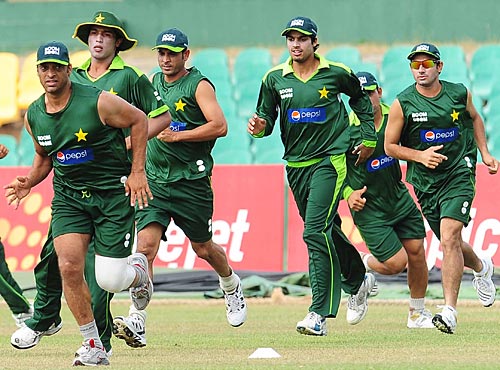
Pakistan Warms up for the Asia Cup India Match - June 2010
Well, it’s that time again. An India vs. Pakistan ODI match will be underway in a few moments. And there’s nothing like India-Pakistan cricket. For better or worse, it’s THE epic rivalry; it get’s catty, intense, fans are insanely polarized. It’s basically crickets equivalent to the NHL’s Crosby / Ovechkin rivalry. For my non-sports readers, it’s akin to team Aniston vs team Angelina. (for the record: I’m team Ovechkin and Angelina respectively)
But whether you’re a Pakistan or India fan, both teams are somewhat evenly matched at this time with Pakistan having more depth and raw talent, and India with firm composure, more consistent experience and better record in recent history. So it’s likely going to be a nail biter, winding down to the final over to determine a winner.
So, what’s it going to take for the men in green? Here’s what’s swimming around my head before the game:
Afridi: Stay the same. Awesome performance in the last game as skipper. In typical Afridi character he lived up to the “boom boom” title and strong character we expect from him. With 110 off of 75 it was his natural game catapulted to great heights with leadership and consistency. Good news is he has a tendency to excel against India. Let’s hope that form is maintained.
Salman Butt: Hold your wicket yo. He usually does, but it’s not always certain, yet crucial that he does so today. The Indian bowling attack looks mediocre, but don’t underestimate their pace bowling. Zaheer Khan is in the attack and Nehra could do harm too.
Abdur Razzaq: My favorite All rounder must be the Danger Man today. What does that mean? It means if we need it, you make 14 runs an over. No questions asked. Oh, and when we need those key maiden overs in the last hour of their lineup, keep up the bowling defense.
Kamran Akmal: Please no butterfingers. This is a world class game and an epic rivalry, no room for drop catches. Also, be quicker on the stumpings. Be a solid bat; a clutch hitter picking up the run rate consistently as a lower order batsman and even more so if you’re pushed up the order.
Mohammad Aamer: Come in strong and shut down Sehwag. Perhaps cut him some slack early on, get him into a slogging mindset then throw on pressure with an ultra slow ball. Sehwag’s bat is so fast that this is bound to be confusing to his game.
Shahzaib Hasan: Damn rookie stop playing like it’s a test match.
Shoaib Akhtar: Watch the extras, nuff said. If The Rawalpindi express does this, there’s no stopping him.
Shoaib Malik: Be at the top of your game, back form a honeymoon we need to see classic Malik in your best form. Picking off Harbhajan smashing off a couple sixes, fielding like a beast, and with accurate off spin.
Umar Akmal: Run with raw talent. You’ve got the youth, energy and can hold your wicket with a solid strike rate. Pick up the occasional boundary and stay consistent.
Prediction :::: the game changer will be either Shoaib Malik or Shoab Akhtar. They’re comback kids and can steal matches for Pakistan. They’ve done it in classic form in the past, and i want to see them do it again tonight.
And I’m not going to lie. After your loss to the Aussies last month, I was tempted to leave you, perhaps for the Kiwi’s, maybe even see Sri Lanka for awhile. But I didn’t stray; I was a good girlfriend. Then came today’s PCB decision, reminding me that you are subject to an absurdly inefficient authority so seeped in politics that I can’t deal with your baggage anymore. The drama has been progressively agonizing.
It’s like dating a teenager. Which is why it was so easy to love you when I was one. But I’m not a teenager anymore. I’m in my 20’s now and am seriously thinking about settling down. I need a cricket team who can reciprocate my love, show consistency and keep me amused. After a long day of work, yoga and blogging, I stay up till midnight and beyond (California time) to watch your ODI’s, even Tests and you leave me dissatisfied, night after night. It’s been 14 years, of ups and downs, which have been a sad series of “downs” in the past few years. When Shahid Afridi first joined the team and scored the Worlds Fastest Century in the nineties, I was captivated; you had me at hello. So I put up with the 1999 World Cup Debacle, the next world Cup Debacle, and have no idea what you’re going to pull in this next one.
So why do I still love you? I suppose because deep down I still believe in you. It’s irrational, impractical and against my immediate interests to stay, but I won’t leave. And after all you’ve put me through: if I still don’t walk away…..that’s gotta be love.
Test matches will disappear from cricket by the year 2020, and ironically, because of 20Twenty. After Pakistan’s frustrating loss against Australia today, batsman Mohammad Yousuf warns that Twenty20 cricket will ruin Pakistan’s game. He says:
“Because of Twenty20 cricket no player knows how to stay at the wicket anymore. Until players do not play with discipline and play ball to ball and leave balls they are supposed to we will struggle in ODIs, let alone Tests. If you are going to slog all the time what is the point? It is necessary that Pakistanis, the media, the board, the fans realise that we play as little Twenty20 as possible.”
Mohammad Yousuf is asking everyone to limit Twenty20 cricket at a time when it’s popularity is on the rise, Pakistan is the reigning World Champion and undoubtedly has the best players the game has seen (Afridi, Razzaq, Ajmal, Gul). He’s basically making a case for conservative cricket: or getting back to the basics of Test.
In Test’s even if you’re pitched a full toss at above average speed and there’s no one at long on or square leg, the skilled batsman refrains from smashing it out of the park.
Reason being the risk of getting out supersedes the worth of a six. However, that kind of discipline is the exact antithesis of 20Twenty cricket where you are required to play each ball as if it’s a potential six. But having the sense to resist potential sixers is but one part of the batting discipline needed in traditional cricket. It’s an overall psychological discipline where batsman must with extreme patience and consistency just hold one’s wicket. To do that, over after over for 5 days, knowing that the match could wind up in just a draw requires an extreme endurance that few batsman posses. In fact some of the best batsmen in the game who have mastered this don’t even play ODI’s anymore, like Rahul Dravid. Case in point, most teams don’t have players who specialize in Test, Dravid is actually a rare case. Mohammad Yousuf could then be on the right track: are players losing an edge in Test, and perhaps even skill by playing 20Twenty cricket?
20Twenty is the American equivalent of Home Run Derby: the game simply requires batsman to smash anything and everything out of the park. 8th man down must carry at least a 100% strike rate to give a team the depth required to be competitive in the game.
It’s less about psychological discipline, discerning batting or even batting skills for that matter. Because if the aim is to slog, you can take a whack at just about anything pitched your way. It requires a lot of power and little else. Anyone with training and enough arm strength to smack the ball around can be fairly successful. There aren’t rewards for consistency, patience or discipline. In fact, those qualities are counter productive in 20Twenty. In Tests you score runs by first discerning which balls are safe, whether that be after 5 or 50 overs, and then you nudge, or direct the ball into anticipated gaps.
It’s a whole different ball game, as they say in the States. So is Mohammad Yousuf correct in calling for a limit to 20Twenty? The conventional part of me who tends to resist change says yes. But the more spontaneous, forward thinking side of me says, hey, if that’s the natural progression of the game and Tests are inevitably obsolete, bring on a few more Shahid Afridi’s !
Shahid Afridi is the most exciting cricketer in ODI’s. He’ll either smash the fastest century in history, or maintain a strike rate of 300 off just a couple balls before being caught out. So for Pakistan his presence could mean massive game winning runs, or for the opposition, a quick, key wicket early on. Either way, it’s extremely suspenseful excitement for both teams and all fans watching that no other player offers.
What’s even more exciting is that Afiridi’s no longer a novice. He’s been around 10+ years but hasn’t received the kind of acclaim his potential commands. He’s overlooked as merely an inexperienced slogger because no one really expects him to last more than a couple overs. But in this years 20/20 World Cup and today’s ODI, Afridi asserted himself as the quintessential all rounder.
One shouldn’t underestimate tight fielding, very effective bowling, and competitive spirit Afridi harnessed over the years . Because even when he’s inconsistent at bat, his wealth of periphery contributions have led to victory, proving he’s so much more than just a slogger.
In today’s match versus New Zeland he demonstrated maturity by chalking up roughly just 50% percent of runs off boundaries when Pakistan was 70 for 4, and taking key wickets, almost getting a hat trick. Doubters take note: Afridi is entirely capable of playing a solid, consistent, and well rounded game.
His volatile career can partially be attributed to laughable PCB selection processes and mediocre coaching. Because the past decade of Pakistani cricket has been defined by arbitrary player selections and coaches irrationally shuffling the lineup.
Counter productive, yo-yo operations assigned Afridi everywhere from opener, middle order and tail end batsman without giving him sufficient time to play where he is most effective. His natural game is aggressive and valuable at the mid to lower end for two reasons. Firstly, although he’s had trouble with spinners, he’s deadly when attacking a worn down ball from a medium paced bowler. Secondly, Afridi’s style isn’t conducive to requirements of an opener. Opening bat imposes a pressure for a deep concentration and patience.
Because Pakistan is often inconsistent and has yet to decide on solid openers, this leaves middle and lower end batsman required to chalk up significant runs when openers don’t hack it. And that kind of pressure requires rapid, hard hitting runs on a grand scale from severely limited balls that only Afridi can produce. He thrives on such conditions, rising to the occasion and leading Pakistan to victories like today’s.
Not to mention his consistent bowling. He always maintains a good economy and although he’s not a strike bowler, he quite often strikes wickets. In today’s match he patiently maintained line and length despite going without a wicket for a few overs, eventually taking out Daniel Vettori who looked dangerous with a 90+ strike rate.
Key to such effective bowling is Afridi’s deadly variation in speed. He has the unique ability to throw batsmen off their game by changing up bowling pace buttressed by an equally menacing competitive spirit. He’ll bowl 3 slow balls, and the next one faster than even Razzaq’s fastest. Some fast bowlers change up’s aren’t even as fast as his.
Plus he disguises the changeup very well: batsmen don’t know if he’s going to throw a googly, leg spin, or just throw a fast one with no turn at all. Afridi doesn’t allow batsmen liberty to anticipate a ball, hence his consistently good economy. Side note: Tendulkar is also good at this.
There’s no doubt Afridi’s a talented cricketer. But the past year we’ve seen a mature Afridi harness his game and emerge as a strong leader against world class teams. With the Pakistan team in what seems like a constant transitional phase, Afridi has risen to all occasions maintaing a powerful game and vivid energy that is key to supporting youngsters like Umar Gul and Kamran Akmal as we saw in today’s match.
So kudos to Ramiz Raja for finally addressing skipper Younus Khan about his lacking performance after today’s match. It’s high time Pakistan found a new captain, and i think Afridi has earned a shot at the position.
Even if peace talks are stalled between India and Pakistan, warming relations are on the cards for South Asian’s this week. With India’s chances of surviving the ICC Champions Trophy contingent to a Pakistan win on Wednesday against Australia, Dhoni and company will be watching closely in hopes for a victory for the men in green. So what’s it going to take:
Strong Opening:
Imran Nazir can’t be hasty. He has a tendency to get carried away after an early four, or six. Overconfidence can be a hinderance. And he can’t rely on hopes of weak fielding as he might have done in previous matches. He should play his natural game, hit a few boundaries overt time, but keep on guard.
Kamran Akmal has fair potential, even if he’s not my top choice for opener because of a lacking consistency. Key for him is simply: “don’t get out”. Allow Nazir to handle hiking up a solid run rate and understand that if his partner does get out, skilled batsman such as Malik and Afridi are behind him. Plus it’s well known that Pakistan can generate 100+ runs with middle/tail end batsman if need be. So Akmal should refrain from taking leadership, hold his wicket and play big shots if given safe opportunities to do so.
Discipline:
Umar Gul must be more careful. With a 9.16 economy in the India match, and zero wickets, he needs to step it up. Gul has to take charge as Pakistan’s most experienced opening bowler with this squad. There’s no such thing as negligible extras when playing against the Aussies, it’s just too costly.
Wicket Taking:
When Australia loses a wicket, they face opposition with equal or even greater confidence than before. Their batting doesn’t falter, it goes up a notch. So what Pakistan needs to do is ensure a constant aggressiveness in bowling. Keeping an Aussie run rate down in the first five overs is critical. If you give the Aussies a chance to consistently gain confidence from the onset, they’ll run with it and it’ll be hard to chase/contain from there.
Fielding:
Shahid Afirdi & Shoaib Malik are the top fieldsmen. But it’s going to take aconcerted effort on the entire Pakistan side to avoid weak fielding that can wind up expensive in the end. The Australian concept seems to be that when a fielder drops a catch off their hit, they punish bowlers by hitting one out of the park, as if to consider the misfielding an opportunity for a bonus hit, or a free wicket of sorts. It’s an aggressive strategy underscoring the importance of fielding against this team.
The game plan for Pakistan ultimately is: Cautious Intensity. No extras, keep the Aussie run rate down, maintain wickets and the runs will come. Besides, Pakistan’s already secured their seat in the Semi Finals. A safe victory is really all we ask for. Well, in the case of the Indian squad, given that their survival is reliant on both a Pakistan win and an astronomical run rate against the West Indies in their next match, they might be hoping Pakistan get a little more than just a “safe” victory 😉





 Zainab B. Jeewanjee
 Zainab Jeewanjee