At the heels of 26/11, Pakistan charged seven people involved in the Mumbai atrocities today. The Virginia Quarterly Review has a four part article revealing the ordeal in harrowing detail and after reading it, I’m still stunned. On 26/11 last year I got a call from a friend born and raised in Mumbai who was flying out there that afternoon, he said his parents were fine but his voice was wrought by a despair I hadn’t heard from him before. He didn’t specifically say he was distraught or describe how he felt in detail, but i recognized the frustration instantly because I’d heard that voice before: from friends in Karachi who witness countless threats and acts of terrorism since 9/11. I identified immediately with my friends frustration and despair on a humanitarian level, and even further because although the perpetrators in Mumbai were allegedly trained in Pakistan, I knew they’d ultimately hurt Pakistani’s the most.
As India forges ahead economically and internationally, Pakistan is deteriorating. Terrorism has brought vanishing security that has perpetually halted foreign investment, stagnating the economy leaving no trickle down for the lower and middle class majority population who simultaneously realize a widening gap in their position vis a vis the wealthy. Terrorism has rendered governance in survival mode since 9/11 making leeway for decreased oversight and increased corruption, which was rampant to begin with.
A year after the Mumbai atrocities, we see Manmohan Singh hosted at the White House in elaborate fanfare with progressive talks on bilateral trade rooted in liberalism that is fitting for a country with roughly 8% growth in GDP and a middle class that’s now larger than our entire population in the United States.
Conversely, relations with Pakistani South Asia in light of that progress are a valid point of comparison because we have a strategic interest in both countries. More than ever, it’s apparent we have economically strategic interests with India, and security based interests in Pakistan. And like previous presidencies the Obama administration quickly realized the delicate art of balancing both interests given that either country feels progressive relations with the United States inherently comes as a direct expense of one another. Engaging India as it expands economically and Pakistan geopolitically for security’s sake (i.e. in the War on Terror and in the face of an ascending China) pose an opportunity for us to strike a creative balance in South Asia.
It’s not about who wears the crown, (“Taj”) in South Asian U.S. relations, it’s about engaging both sides for the long haul.
In Pakistan that means cooperating today for security’s sake and uprooting terrorism and fundamentalism for tomorrow. Key from there is not abandoning ship, but remaining engaged so that Pakistan too has a route to economic expansion in the future. Without security, viable development won’t take place. And so long as we are engaged in an Af-Pak war, our policymakers have a responsibility to establish a roadmap that is rooted in long term success. This is our chance to get it right in South Asia, and that begins with an intention for a permanent solution. Assisting Pakistan to navigate the rising tide of development in our globalized world could be the key to ensuring they remain a strategic, long standing ally.
Amidst drastic worsening of the Af-Pak situation with US forces suffering our deadliest months and Pakistani civilians and military bearing the brunt of terrorist assaults, Secretary Clinton arrived in full diplomatic force last week. She made media rounds sitting down for Q&A sessions with everyone from major news outlets to universities. But even the Clinton charm and expertise was met with vociferous skepticism. Before concerns on the Kerry Lugar bill could be adequately addressed, Clinton’s statements seem to have only riled increased trepidation in Pakistan:
Hamid Mir of GEO News peppered her with questions regarding illegally armed US diplomats roaming the streets of the capital and continued drone attacks. His questions reflect macro concerns that sovereignty is inherently undermined in cooperating with the United States. And at the Government college in Lahore, Secretary Clinton faced what I thought were even tougher questions:
Students identified a worsening War on Terror is akin to the Vietnam quagmire and suggested it’s time we focused on winning hearts and minds.
Another student echoed widespread skepticism of US/Pakistan cooperation citing failures of previous engagement during the Soviet Afghan War and how again “forcing Pakistan to take action that we might not want to take” is a legitimate concern among masses. Another said bilateral relations are marred by a subsequent “trust deficit” with Secretary Clinton responding that American’s have a similar lacking faith in Pakistan.
“Al Qaeda has had safe haven in Pakistan since 2002….I find it hard to believe that nobody in your government knows where they are and couldn’t get them if they really wanted to”
And that was just on security. On society and development she criticized “At the risk of sounding undiplomatic, Pakistan has to have internal investment in your public services and your business opportunities”
Ouch, thinks Pakistan. If Hillary’s mission was to rally support of cooperation with the United States amidst rapidly increasing skepticism of D.C.’s policies, the rhetoric has fallen short. In fact both Pakistani and American media are growing weary of the alliance:
Chris Matthews, in trademark rambunctiousness goes to town on Pakistan’s efforts in the War on Terror. But simplistic, irrelevant comments from his guests subtract from any substantive debate on the issue.
No offense Mr. Matthews, but just a brief look at a history book, closer reading of ground realities, or even quoting Hillary in context of the entire situation would have made for a more substantial segment. The panelists actually likened U.S engagement of Pakistan to a Sigfreid and Roy Act. It’s laughable and renders the aforementioned student questions more articulate and informative than this discussion.
Nonetheless, it seems former Pakistani President Ayub Khan’s book suggesting cooperation based on the idea of each being “Friends not Masters” is now a shared sentiment in this alliance . So the dilemma remains: increasing skepticism polarizes Islamabad and D.C. I just hope it will spur realization that winning hearts and minds on both ends is imperative.
Zainab Interviews the Honorary Sharifuddin Pirzada
Q & A BREAKDOWN
PAST LEADERS: Jinnah
2:39 – 3:17 – Former BJP Parliamentarian Jaswant Singh authored a book on Jinnah that is receiving a lot of controversy, having actually worked with Jinnah, can you share your thoughts on the book ?
3:20 – 4:42 – In recent interviews, Singh has said Muslims in India are “robbed of their psychological security” and basically downtrodden. He says what Jinnah should have done is left some advice for Indian Muslims who stayed back and didn’t migrate to Pakistan after partition, what do you think Jinnah might have said?
4:44-6:01 – He also refers to Jinnah as a “nationalist” not at all Anti-Indian, please expand
6:01-7:34 – Referring to politics, when Jinnah split from the Congress party eventually formulating a two state idea later in his career, were there any politics referring to Nehru or Gandhi that had an impact on decision making? Jaswant Singh makes a mention to some, what does your experience tell us?
7:35: – 8:15 – You’ve mentioned previously that Jinnah was a self made man, more details?
8:15 – 8:55 : Tell us about your experience with Jinnah, its a rare treat for us to have your insight
8: 55 – 9:22 – Further details, conclusion on Jinnah.
“Jinnah had the Charm of Churchill, Dignity of de Gaulle, Magnetism of Mandela, and Objectivity of Obama”
CURRENT LEADERS : Musharraf
9:23 – 10:47 – Shifting to current leaders now, lets talk about Musharraf. You’ve got great experience, tell us about your work with the former General and Leader of Pakistan.
10:48 – 11:55 – How did your work with Musharraf expand during his tenure?
12:56 – 13:45 – You served on the national security council & as senior advisor to Gen. Musharraf, tell us howthe context of national security in Pakistan changed after 9/11. Specifically what came on the agenda, what were the immediate concerns and interests and what drove the decision to behave the way Pakistan did at the time?
13:45 – 15:48 – Recent polls indicate a majority of pakistanis think Musharraf should be punished for treason as per laws under article 6 of the Constitution, how do you feel about that?
15:48 – 14:55 – Do you think it’s a valid case that Musharraf be tried for treason?
14:54 – 15:38 – Regarding an increasingly free media in Pakistan, please offer further insight
15:38 – 16:16 – There’s a contention that the currently free media be attributed to Benazir Bhutto’s regime wherein sateilite technology allowing expanded media was put in place, while others assign credit to Musharraf. Can you clarify this?
16:16 – 18:39 – Do you think it was the state of emergency and sacking of the judiciary that caused Musharraf to lose elections?
18:42 – 19:35 – Final question on Musharraf, what do you think his legacy would be?
“The Media is very free in Pakistan, and Musharraf is to be given a great deal of credit for that”
CURRENT LEADERS : Zardari
19:48 – 20:55 – Recent military achievements in SWAT and international trade deals penned by Zardari paint a somewhat rosy picture for the future, what are your thoughts on him so far?
US – PAKISTAN RELATIONS:
20:57 – 23:14 – There’s a US special envoy in the region, drone attacks continue, the west is pushing for rapid democratization and are heavily investing in counterterrorism through cooperation with Pakistan while Islamabad hopes to secure itself and expand economically in this engagement. But there’s a long history of cooperation but still a lot of skepticism on both sides, do you think current engagement with a new administration who promises more diplomacy will yield different results than we’ve seen in this alliance?
23:14 – 24:52 – What advice might you offer President Obama or the State department in terms of engaging Pakistan?
“Pakistan was member of SEATO and CENTO but certain conditions were not fulfilled and there is a strong section of Pakistan who has reservations with a cordial relationship with the United States”
PAKISTAN & THE MUSLIM WORLD
24:55 – 25:11 – Your position at the Organization of Islamic Conference?
25:13 – 25:57 – On the Israeli Palestinian issue, how do you assess the current two state solution that Obama has put forward? How viable is it?
25:57 – 26:25 – What is Pakistan’s diplomatic/official stance on the Israeli Palestinian Issue?e Islamic Conference
12:25 – 26:35 – What are the main priorities of the Organization of the Islamic Conference?
“The Palestinian Issue followed by Kashmir are of top priority to the Organization of Islamic Conference”
PAKISTAN BORDER RELATIONS : INDIA & AFGHANISTAN:
26:35 – 27:42 – Manmohan Singh & Prime Minister Gilani at the NAAM summit this summer agreed to bracket issues of Terrorism and move forward on peace talks and trade issues. Such rhetoric is not new, and might not reach fruition, so do you see anything being resolved in Kashmir anytime soon, without the help of the US?
27:44 – 28:44 – Elections in Afghanistan are being contested between Abdullah Abdullah and incumbent Karzai. Pakistan doesn’t seem keen on either because both signal a warming of relations between Kabul & New Delhi which is believed to come at a direct expense to Islamabad. How do you feel about that?
America can facilitate peace talks between India and Pakistan on Kashmir, but on the whole, people of Kashmir are still suffering and struggling. The approach of prime ministers has been positive, but an extremist element in India exists which doesn’t want this. To stop suffering in Kashmir, a solution must be reached.
PAKISTAN’S INTERNATIONAL FUTURE:
28:44 – How do you see geopolitics playing out in the next decade for Pakistan, given amplified US presence, including super embassies being constructed in Pakistan/Afghanistan, perpetually stalled relations with India, a very likely nuclear neighbor in Iran, and increasingly influential China and polarized Russia, what does Pakistan look like ten years from now?
“Pakistan in the next ten years must concentrate on democratic set up, economic development & maintaining cordial relatoins with Islamic countries. There are two great friends of Pakistan: Saudi Arabia, the other is China. That’s a good starting point”
What happens when a majority of one country’s citizens opt for martial law but the democratically elected government in power including judicial, executive and legislative branches are against a military takeover? It’s quite the political conundrum because either side offers legitimate democratic authority, but they’re diametrically opposed. A rational answer is to let the democratically elected government fulfill it’s term and allow citizens to elect politicians to office who will support martial law in the next term. That might work in a fully functional democracy backed by institutions that can uphold legitimacy and granted the state is sufficiently secure. However, in light of decreasing security, severe economic downturns and age old skepticism of U.S. actions in Pakistan, ever so gradually the country shifts it’s gaze toward the military.
Decreasing Security :: To offer partial explanation in a nutshell: Since 2001, terrorists fleeing Operation Enduring Freedom in Afghanistan, spilled over into Pakistan at the nebulous northern border areas which are historically autonomous from federal regulation. The fact that Pakistan already housed one of the worlds largest refugee populations allowed this spillover a massive and destitute demographic from which to exploit support. As a result, we now see unprecedented terrorism in Pakistan where Al Qaeda and the Taliban had no significant presence prior to 9/11.
Skepticism of U.S.’s Role in Pakistan:: Since the inception of Pakistan in 1947, bilateral realations with the United States have been defined by cooperation wherein Pakistan served as a proxy for U.S. Containment throughout the Cold War (i.e. security pacts like SEATO, CENTCOM, then aiding our Afghan led defense against Soviet incursions in the 1980’s). In exchange, Pakistan’s military with U.S. support, bolstered itself as the strongest, most efficient and stable institution in Pakistan. Some argue civilian governments and democratic institutions were thus never given an opportunity to compete with such a well funded, strongly backed military. And therein we find multifaceted dimensions that help explain the controversy over current U.S. support of Pakistan. Former Pakistan to U.S. ambassador Maleeha Lodhi describes the Kerry Lugar bill:
“the offending part of the legislation sets up the country as hired help and puts the military in the dock, presumed guilty on many counts and having to prove its innocence to Washington”
Pakistan is “hired help”, that’s the crux of skepticism on the Kerry-Lugar bill. Concern is rooted in a long history of cooperation with the United States that some argue created a behemoth military institution costing them a fair chance at democracy. In attempt to address that very concern, the Kerry Lugar bill mentions no military aid in exchange for cooperation on the War on Terror, unlike previous assistance packages from the Cold War. Ironically, bleak affairs in Pakistan now which are partially a result of pervious cooperation, particularly during the Soviet Afhgan war, prompt arguments that the military is exactly what needs support right now. Thus, the Lugar Bill receives not only skepticism from Pakistan’s strongest institution, but increasingly the public.
Although Secretary Clinton and Senators Kerry and Lugar have made no indication of altering the bill, to avoid future skepticism and potential resentment of U.S. involvement in Pakistan it could be wise to make changes so as to not sideline the military at this critical period in our War on Terror. Unlike previous Republican presidencies, the Obama administration is committed to dealing with civilian governments in Pakistan. It’s a noble idea and even though i don’t suspect that as the military gains legitimacy the civilian government will collapse soon, we should think twice before riling such concern over a bill that has just a 5 year life span. Central and South Asia are critical regions for our interests and we may need to engage strategically positioned Pakistan in more years to come. So a backlash by the most powerful institution in that country is something we should anticipate, and work actively against.
At the heels of Pakistan’s offensive against militants in South Waziristan, terrorists brazenly staged an attack on military headquarters this weekend. Commandos responded swiftly, taking out 9 of the militants, capturing their ring leader and freeing 39 hostages. Despite success in ending the siege, the incident demonstrates a worsening Af-Pak situation and beseeches a new strategy.
Our administrations new strategy is defined by an increase in troops to Afghanistan, focusing military efforts squarely on Al Qaeda (less focus on Taliban) and expanded funding to Pakistan by way of the Kerry Lugar bill. And while the troop surge and emphasis on Al Qaeda are debated at length in D.C., the Pakistani media is abuzz on the Kerry Lugar bill. There are calls by The Awami League Party (representing the NWFP regions & a predominantly Pashtun population) that the bill allow for an “uninterrupted flow of non military assistance” while other politicians vouch against the legislation altogether. Tehrik-e-Insaaf chairman Imran Khan said the bill “enslaves” Pakistan and can only benefit the top echelons of government referring to past corruption allegations on senior government officials. Similarly, pundits were all over Pakistani television in the past week, echoing concerns about corruption, lack of support to the military, too many strings attached to funding, and how the bill threatens sovereignty. This morning Foreign Minister Shah Mahmood Qureshi flew to D.C. to discuss theseconcerns just as rumours that Pakistan’s Ambassador to the United States is losing his post becayse of not entirely positive comments regarding the Kerry-Lugar legislation. Suffice to say, the Enhanced Partnership with Pakistan Actmeant to extend a new strategic hand of cooperation to Islamabad is not off to the positive start intend
In fact, Senator Kerry’s office directly responded to popular skepticism in a recent report.
Addressing concerns that the bill would invade state soveriegnty: Senator Kerry explains the bill funds “schools, roads, energy infrastructure and medical clinics” and that “those seeking to undermine” a US/Pakistan in that endeavor are doing so to “advance narrow partisan or institutional agendas“.
Regarding the idea that the legislation comes with too many strings attached, Kerry emphasizes that the $7.5 billion annual pledge is for “unconditioned non military aid” and comes with “strict measures of financial accountability” referring specifically to Executive Branch oversight on the use of these funds.
This is contentious to Pakistan because it’s maybe the first time external oversight is imposed on assistance from the United States. And while the bill does a great job of outlining funds for social infrastructure intended to find it’s way to everyday citizens, on the issue of sovereigty, the real sticking point is regarding a potential subversion of the Pakistani military. Senator Kerry insists that the bill’s:
“focus is on nonmilitary assistance to the people of Pakistan” and military aid is contingent to “cooperation on nonproliferation“. However, the bills funding is rooted in “significant efforts towards combating terrorist groups” and the “Pakistani military not subverting the political or judicial process” to ensure “common goals” of “security and democracy“.
This irks Pakistani’s for a number of reasons. Firstly, there’s ambiguous wording. “Cooperation on nonproliferation” is vague enough to translate as potentially linking funds to Pakistan giving up their right to maintain armaments comparable to neighboring India. Similarly, “significant efforts toward combating terrorism” gives no reference for how this will be measured.
On the Pakistan side, the worry is that “significant efforts”, according to their definition might not match a U.S. definition of success. Plus there might continue to be a disagreement on the idea of “combating terrorism”. It’s a contention we’ve seen play out as D.C. repeatedly called for heightened efforts on combating the Taliban, quitely but surely opposing Pakistan’s attempts at negotiating with those groups rather than employing just a military offensive, (a policy we’re now reverting).
Also, delinking assistance from the military is unprecedented and freightening to some because while it is necessary to develop schools, and social, democratic infrastructure for long term development, in the immediate term there are widespread security breaches with weekly suicide attacks, an ever growing incursion from Afghan militants on the northern border and drone attacks that result in collateral damage.
So Pakistans concerns echo a need for both immediate security and long term development, but not at the expense of one another.
Keep in mind, the widely held, and all but true notion that Pakistan is perhaps the only place where the military controls a country, and not vice versa. That idea is rooted in that their military is historically the strongest, most stable and legitimately accepted institution. Let me emphasize that last part: it’s historically the most legitimately accepted institution in Pakistan in an absence of stable democratic institutions never having developed. Meaning, in times of economic, social and political uncertainty, the military has historically responded most efficiently in alleviating situations since 1947. Whether one accepts the idea that the military creates a perpetual cycle of uncertainty within which to assume power periodically, or the military responds to the shortcomings of civilian governments in the absence of democratic instiuttions (chicken & egg argument), either way, the military’s been relatively effective in handling crises in Pakistan in comparison to civlian regimes. So given the current enviornment of insecurity, people are weary of a hopeful promise for “long term” moves toward “democracy” that might comes at the expense of insufficient assistance to their military who has a capacity to alleviate immediate security concerns.
I think democracy is the ultimate route to security for Pakistan, but despite Executive branch oversight and our “long term” commitment defined by only 5 years of funding, Pakistan’s concerns are understandable. Given a long history of cooperation, Pakistan is more used to US assistance through bilateral relations with a Republican government in DC (think General Zia/Raegan, General Musharraf/Bush, Ayub Khan/Eisenhower, Yahya/Nixon) and the Kerry Lugar bill is a staunch reverasal of our foreign policy with Islamabad. Perhaps finding value in previously crafted policies to Pakistan in combination with our current legislative proposals is an optimal solution to quelling the enahanced concern of our enhanced cooperation.
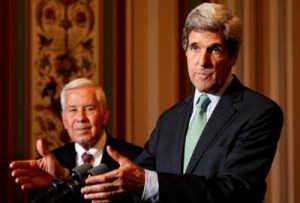
Senate unanimously passed a bill authorizing “appropriations to promote an enhanced strategic partnership with Pakistan”. The legislation is likely to receive similar support in the House later this week before being sent to President Obama for final approval. Initial versions of legislation were presented as the Biden-Lugar bill last year led by democrats Joe Biden and Senator Kerry, and supported by Hillary Clinton and Barack Obama. Currently, the bill is coauthored by Republican Senator Dick Lugar making it widely bipartisan which reflects our growing desire to engage Pakistan ensuring stability and ultimately our interests in the region.
The Legislation triples foreign aid to our major non NATO ally” allowing up to $1,500,000,000 for their cooperation in “counterterrorism/counterinsurgencydescribing Pakistan’s ongoing struggles and successes against the Taliban and Al Qaeda. It cites assassination of Benazir Bhutto, the Islamabad and Mumbai hotel attacks last fall among other suicide bombings in Pakistan and Afghanistan, some of which involved deaths of US citizens to underscore an immediate need to assist Pakistan at this critical time. As we face mounting deaths in the War on Terror, send additional troops to Afghanistan and President Obama works closely with generals to revamp our strategy there, the bill is meant to forge a new relationship with Pakistan.
It extends diplomatic rhetoric directly to the people of Pakistan by describing the daily plight of citizens who are “especially hard hit by rising food and commodity prices and severe energy shortages” with 2/3rds of the population living on less than 2.25 and 1/5 of the population living below the poverty line”. It further mentions “Compatible goals of combating terrorism, radicalism and promoting economic development through building of infrastructure and promoting social and material well being for Pakistani citizens through development of public services”. And most interestingly, the bill cites Pew opinion polls finding:
“Pakistan has historically viewed the relationship between the United States and Pakistan as a transactional one characterized by a heavy emphasis on security issues with little attention to other matters of great interest to citizens of Pakistan”.
Then referring to the current civilian government as an “opportunity to place relations on a new and more stable foundation”. The bill’s ‘statement of policy‘ identifies the following objectives:
Support the consolidation of democracy, good governance & rule of law in Pakistan
Support economic growth & development to promote stability/security
To build a sustained, long term, multifaceted relationship with Pakistan
Expanding bilateral engagement with Pakistan
To work with Pakistan and bordering countries to facilitate peace (a possible reference to mediating the Kashmir issue. President Obama mentioned doing so during his campaign run for President)
Expand people to people engagement between US and Pakistan through increased educational, technical and cultural exchanges (possibly in the form of more student/professional visas. Envoy Holbrooke mentioned this in visits to Karachi in July)
Work with government of Pakistan to:
prevent Pakistani territory from being used as a base/conduit for terrorism in Pakistan, Afghanistan, India or elsewhere
Coordinate military, paramilitary & police action against terrorist terrorism
Help bring peace, stability and development
(this might entail counterinsurgency/counterterrorism assistance and cooperation through intelligence sharing, arms development/trade and training of Pakistani forces)
Pakistan is aptly described as a major non-NATO, long-standing ally. But cooperation has been dominated by security issues generally in the form of military dictators supported by the States in exchange for Pakistan’s military assistance throughout the Cold War and current War on Terror resulting in the Pakistani mindset of solely “transactional” relations. This bill is a fair attempt to shift that context to a more positive tone with the aforementioned objectives and diplomatic rhetoric.
However, certain specificities such as timetables and solid oversight must be transparently accessible to the Pakistani and American public to ensure more positive relations are achieved. Already experts are weighing in with concerns. Despite the commitment to development in addressing the plight of daily Pakistani’s, Foreign Policy Magazine mentions that the bill doesn’t say exactly how much of these funds are to be allocated toward military assistances. And although senator Kerry insists “Clear, tough minded accountability standards and metrics” are contained in the bill, Dawn News cites Rand Corporation expert Dr. Christine Fair raising the issue of “greater transparency” and wanting to ensure international accounting standards are applied in allocating these funds. Such concerns are equally felt in Pakistan, where past commitments of economic development have not always found their way to alleviating the plight of daily citizens for whom funding is supposedly intended.
For this reason a concerted conviction to improving the daily lives of Pakistani’s is required by Pakistani politicians who have ultimate control over how these funds are applied. I hope that President Asif Zardari along with Parliament works closely to ensure monies are responsibly allocated to a “sustainable” development the bill calls for.
CNN refreshingly shifts the context of current discourse on Pakistan by reporting on female recruitment to the Pakistani Air Force. A story published this week highlights Ms. Ambreen Gul’s experience with the Pakistani air force as “one of seven women trained to fly Pakistan’s F-7 supersonic fighter jets”. Gul describes her experience as both positive and productive. Air Force cadet Ms. Sharista Beg also explains:
“To tell you the truth I’ve been given equal opportunity or I suppose more than men have been given,”
I refer to the story as refreshing because given that news is largely focused on macro level, security issues dealing with the war in Afghanistan and how it relates and spills over into Pakistan, the image we have of Pakistan is imprecisely bleak.
Of course macro level security issues in which our troops are directly engaged rightfully take priority over other news stories on Pakistan, but the unintended consequences of viewing this country as such and simply in terms of the “War on Terror”, “Taliban”, “fundamentalism” or “militancy” is a reduced understanding of what we are dealing with in our engagement there.
So I applaud CNN for balancing information with their story on Fighter Pilot Gul. Hopefully news outlets will continue to publish reports that allow a more accurate picture of what is a largely moderate Pakistan. Because a more accurate picture can only help us understand our situation there. In fact, the article concludes well, citing specifics of how the Pakistani air force works in line with our objectives:
“They’re training in counterinsurgency, collecting aerial intelligence and targeting militant strongholds in the treacherous mountains of Pakistan’s tribal region along the Afghan border”
The nebulous Afghan-Pakistan border has become the front lines in our War on Terror making it easy to forget that Pakistan, just like us fights diligently against fundamentalism and militancy with their resources, troops and morale. We want to uproot terror to bring our troops home and secure interests in the long run, likewise Pakistan shares this long term goal and in addition, has an immediate interest in obliterating militancy for actual day-to-day security. The CNN article does a fine job of reporting in this instance and prompts us to realize that cooperation is key.
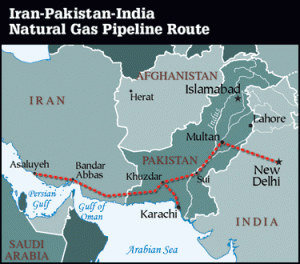
The anticipated Iran-Pakistan-India (IPI/”Peace Pipeline”) pipeline may end up running only through Iran/Pakistan as India backed out from the project last week says Muhammad Abbasi, Pakistani Ambassador to Iran. Delhi’s withdrawal comes simultaneously as the US pressures Islamabad to disengage from the multibillion dollar project set for completion in 2013. This adds to the list of obstacles IPI faced since it was conceptualized in the 1990’s. From international pressures, prolonged funding negotiations, to domestic insecurities and reservations, the pipeline has yet to begin construction. However, Pakistan stresses urgency in moving forward with construction in the face of alarming energy shortages :
Only 60% of households have electricity and 18% access to pipeline gas for heating. Energy demand is expected to increase 250% over the next 20 years. To meet expected demand, electrical generating capacity must grow by 50% from 20.4 gigawatts to 30.6 gigawatts by 2010
Pakistan’s domestic gas production is falling and import dependence growing tremendously. By connecting itself with the world’s 2nd largest gas reserve, Pakistan guarantees a reliable supply for decades. If the pipeline were to be extended to India it could also be an instrument for stability in often tense Pakistan-India relations. Under any scenario of pipeline expansion which makes Pakistan a transit state, Islamabad stands to gain from transit fees hundreds of millions of dollars every year.
Given such potential, it’s not surprising Pakistan is intent on moving forward with IPI regardless of pressure from D.C. Despite Special Envoy Holbrooke’s diplomatic suggestions that the United States might “link funds committed by the Democratic Friends of Pakistan” to their cooperation with Iran on IPI, foreign minister Shah Mahmood Qureshi maintained Pakistan’s urgency:
“The gas pipeline construction agreement with Iran and Pakistan will by no means go under the U.S. pressures,”
But some experts insist that without American support to release funding and loan guarantees, financing of IPI will make the 2013 deadline unfeasible. This poses problems for Pakistan, and on the American front, there are differing concerns. Hoping to maintain US authority and secure interests in the region, President Obama shifts starkly from the previous administration using more engagement and soft power with Iran. So American moves to work with the international community in economically choking Iran and ultimately eliciting behavior from Tehran are diminished as Iranian influence increases through international projects such as IPI. Hardline Bush Administration and more diplomatic Obama led policies are interesting yielding similar ends as Iran continues to expand trade and relations with the international community. This flouts hard, soft, all stances the United States takes in attempting to contain Tehran.
For instance, a vastly constructed pipeline running over 2,775 kilometers (1,725 miles)from the Persian Gulf in Iran, through Baluchistan to a port in Karachi and then north to New Delhi creates “an unbreakable long term political and economic dependence” of billions of people from Pakistan, to India and potentially extending to China.
The prospect of the entire subcontinent being “dependent” on Iran actually sounds alarming, but if we look at certain realities it’s perhaps far fetched. Firstly, any semblance of an actual dependence is most likely only applied to Pakistan given their current energy crisis, the cost effectiveness and efficiency of natural gas as opposed to developing LNG sources: India on the other hand has “two LNG terminals and will complete a third terminal by this year. Two additional terminals have also been proposed, and several companies are examining viability of constructing additional LNG import sites”. So Delih is far less likely to be entirely reliant on Tehran for natural gas because developments in LNG and civilian nuclear projects. Plus, India’s long, strong alliance with Russia allows for a convenient energy supplier to the north if need be. In fact, for Moscow IPI is an opportunity to quell thoughts that Tehran will compete in supplying natural gas to EU markets. Russia’s deputy energy minister explains:
“It is therefore in Russia’s interest to derail the Nabucco project by diverting Iran’s gas away from Europe and locking it to the Asian market. We are ready to join the project as soon as we receive an offer”
Thus a point of contention for Moscow and Washington. DC’s fears are further exacerbated by a potential of IPI eventually ensuring energy supplies to long standing Pakistani ally, China with shipments along the Karakoram Highway through future pipelines . The argument made is that hopes of modifying Iranian behavior with economic pressures plus our mutual hedging with China suffers if IPI is constructed. Again, this relies on the assumption that billions of Indians and Chinese become “dependent” on Iranian gas supplies, which I find unlikely. Pakistan if anyone, is likely to become heavily reliant on those supplies in the next couple decades should IPI be executed as planned. Thus suggested solutions point to alternative pipelines that bypass Iran:
“A rival gas-pipeline project — the Turkmenistan-Afghanistan-Pakistan-India (TAPI) carrying gas from Daulatabad in Turkmenistan via Herat and Kandahar in Afghanistan to Multan in central Pakistan is one such alternative”
But this concept is contingent to a stable Afghanistan, which most experts indicate is not in the near future. Without stabilizing Afghanistan and given chilly relations with India, TAPI is not likely to move forward without overcoming numerous diplomatic and security obstacles. And Pakistan’s energy crisis doesn’t afford Islamabad time to wait for the international community to stabilize Afghanistan or warming relations with India.
Critics of IPI also insist it is conducive to US interests for Pakistan to develop LNG supplies rather than natural gas. This probably entails cooperation with Europe and the United States as opposed to Iran, which is an unviable suggestion. Firstly, LNG development is more expensive than natural gas supplies through a pipeline. Plus, it’s more probable that Pakistan receive lower cost, soft term loans in dealing with Iran as opposed to the EU or US. IPI also presents a possibility of improved trade opening import markets for Pakistan where Iranians can purchase food items. Pakistan has a strong agricultural base and produces wheat, sugar and rice that can be exported efficiently to its neighbors. So for Pakistan, IPI is a viable solution to the energy crisis in addition to creating future revenue generation.
Should the worst happen and a Taliban style regime take over Pakistan, the economies of the world’s most radical Shiite state and that of what could be the world’s most radical Sunni state would be connected to each other for decades to come like conjoined twins.
This is an outrageous misgiving. Al Qaeda and the Taliban spilled over into Pakistan since our War on Terror began in 2001, meaning the Taliban are nowhere near rampant in number or have many sympathizers amongst the mostly moderate population. The Pakistani army made strides in efficiently securing the Swat valley and continue to make progress in eradicating militants. Assuming the entire Pakistani military and heads of state can not obliterate 20-40K (at maximum) Taliban is unreasonable. Many experts have indicated, it’s not that it can’t be done, it’s working to ensure the job gets done efficiently and to secure the long term which is taking time. I think the suspicion of Taliban influence in Pakistan is used perhaps to sensationalize the consequences of IPI construction.
Still, critics maintain that IPI is against our interests and hope lies in it never being constructed given diminutive chances of getting the needed 7.5 billion in funding and because of the volatile location of construction. IPI would run through the province of Baluchistan where resentment and instability with the federal government is historical, underprivileged masses prevail and prior instances of attacks on water pipelines ensued. These facts might impede construction of IPI but it’s important to note that even the most critical voices against the pipeline maintain we not intervene in aiding any subversion of federal government projects in Baluchistan:
US open support for opposition groups who might be willing to undermine the project is unthinkable as any collaboration – overt or covert – would severely cripple our relations with Islamabad
Pakistan’s deep cooperation and commitment to fighting the War on Terror trump other priorities. Plus, in the long run, economic interdependence at the cost of our diminishing influence is maybe preferred to a possibility that this region become increasingly rife with groups well armed and trained at subverting national governments. The Soviet Afghan War was our best teacher of that lesson.
Finally, critics argue how it’s against US interests for Iranian influence to expand in South Asia through IPI because it would add regional instability should Tehran become nuclear and support terrorism. However, this relies on the assumption that heads of state are engaging in bilateral trade with Pakistan on this project for an ultimate goal of international terrorism and that heads of state are irrationally going to create instability in a region that they are increasingly economically interdependent with.
Certainly, a successful natural gas pipeline that spurs economic growth for Iran and helps solve South Asia’s energy crisis might increase Tehran’s influence to some extent, but overall instability and supporting terrorism runs counter to basic arguments of liberal theories of capitalism. With increased trade and interdependence, might increased peace and less interest and instability ensue?
Thus in accepting the reality of what Fareed Zakaria calls, “The Rise of the Rest” wherein increasingly interdependent and economically stable states using minimum or zero US intervention are growing into regional powers President Obama is beckoned to reassess foreign policy. Iran won’t likely rival American hegemony through IPI, but increasingly such situations require we evolve policies to effectively deal with long standing allies like Pakistan who are inevitably drawn into relations that could diminish our influence.
“I hope we (Americans) learn to be more humble, to listen more. Because what we are in the end, or should be, are actions that speak for themselves, that speak for us”,
Says Chairman of the Joint Chiefs of Staff, Michael Mullen, the highest-ranking officer in the US Armed forces. The statement comes as the United States faces possibly its deadliest few months for the War on Terror in a deteriorating Afghan-Pakistan situation. President Obama says this war is one of “necessity” and searches for ways to amplify US efforts with Admiral Mullen and special envoy Richard Holbrooke weighing in on how best to secure this region.
Holbrooke, the seasoned diplomat and Mullen the military expert agree that more needs to be done to engage the Muslim world but differ significantly on how. At the onset of the War on Terror, Holbrooke advocated the United States enhance communication by
“convincing Muslims that this is not a war against Islam, but a war on terror.
Holbrooke says this is acheivable through a sustained public discussion with key Muslim Intellectuals and must be taken up by the White House because it alone has a capacity to direct activities of State, Defense, Justice, CIA, AID and others toward the Muslim world and can also allocate required resources. President Obama’s troop surge in Operation Enduring Freedom, and Holbrooke’s appointment as special envoy marks a shift to more “strategic communications” as advocated by Holbrooke in Afghanistan and Pakistan and focuses on three goals:
“Redefining our message; connecting to the people of Afghanistan and Pakistan on the ground in new ways through cell phones, radio, and other means; and identifying and supporting key communicators who are able, through local narratives, to counter extremists’ propaganda and present a positive alternative. Additional personnel and structures in the Afghan provinces and in Islamabad/Peshawar will be necessary”
However, despite Holbrooke’s diplomatic prescriptions, the situation in Afghanistan/Pakistan is deteriorating and Admiral Mullen last week shifted significantly with the concept of relying on “strategic communications”. Instead, he suggests the problem is not one of communication, rather:
“Our messages lack credibility because we haven’t invested enough in building trust and relationships and we haven’t always delivered on promises. Each time we fail to live up to our values or don’t follow up on a promise, we look more and more like the arrogant American’s the enemy claims we are”
Admiral Mullen stresses credibility by leading through example and suggests a tangiblity to our efforts in Afghanistan and Pakistan are imperative as opposed to just communications. When Holbrooke visitsed Karachi last week and talked about a “major turn with our relationship with Pakistan” and discussed granting more visas for Pakistani’s, textile trade and preferential access to US markets, he visited underprivilaged schools and met with opposition leaders to give an overall message that “drone attacks and the hunt of Al Qaeda are not he only American foreign policy activities in the country”. But Admiral Mullen might counter that these communicative efforts do little to establish meaningful change in the hearts and minds of Muslims. Because these efforts have in the past remained just that, efforts. Rarely are these discussions translated to tangible results for everyday citizens. Each time a special envoy or diplomat thus engages in progressive talks that do not turn out in actuality, US credibility falters.
But Pakistan and the United States have a long, deep history of cooperation. Much of that cooperation has been macro, diplomatic, and military to military cooperation from as far back as defense agreements like SEATO/CENTCOM or until present day collaboration in the War on Terror. Despite the history though, Pakistani masses have seen their country remain economically underdeveloped and their social and political situation has perpetually deteriorated. That is not to imply Pakistan is reliant on a coperation with the US or any alliance/assistance for that matter, but years of allying at the forefront of the Cold War during the US sponsored Soviet Afghan War and now Operation Enduring Freedom, Pakistani’s do not see or feel any positive results and therefore have an interest in cooperation with us.
Admiral Mullen then is correct: US crediblity must be rooted in leading through examples that enhance US credibility which in turn, wins over hearts and minds. He further suggests that when the US does not deliver tanigble benefits in exchange for cooperation and as promised, militant/extremist groups fill those gaps:
“They deliver. Want to know what happens if somebody violates their view of Sharia law? You don’t have to look very far or very long. Each beheading, each bombing, and each beating sends a powerful message or, rather, is a powerful message”
Leaving Pakistan and Afghanistan to recuperate and redevelop without adequate assistance after deeply cooperating in the Soviet Afghan war are exactly the kinds of mistakes that profoundly thwart our interests in winning over civilian hearts and minds
The Soviet Afghan War, and current War on Terror has left Pakistan with an immense refugee problem which created vast security, social and political problems.I think applying Admiral Mullen’s perscriptions to this issue would be a great place to start in winning over Pakistani hearts and minds. Important to note is that Pakistan is currently home to a the second largest Muslim population in the world and continues to grow rapidly. And a deteriorating situation in neighboring Afghanistan we’ve seen has a dangerous spillover effect into Pakistan. Thus, winning hearts and minds in this heavily Muslim populated regoin is certainly in our interest. Pakistani troops and civlians bear immediate, tangible costs in fighting against terrorism in and around their border in our War on Terror. This shared motive, and 60+ year alliance should prompt Washington should focus on establishing viable policies that in serving civlians who truly pay to secure our interests, also establishes credibility in the Muslim world. I think Admiral Mullen describes this hurdle in our dealings in the Muslim world best:
“it’s a subtle world we don’t fully — and don’t always attempt to — understand. Only through a shared appreciation of the people’s culture, needs and hopes for the future can we hope ourselves to supplant the extremist narrative.”
No explanation can adequately address the horrors carried out in Gojra Pakistan. But these horrors are newsworthy and have potential to serve as a lesson in uprooting such inhumanity. Rather than focusing squarely and vaguely on vast historical causation that might allow factions to commit these horrors, a closer look at multifaceted ways in which to uproot that causation by drawing on recent history is valuable.
Because in some ways recent events are repetitive of the country’s history of cyclical, civilian to military governance. Just over half of 62 years of Pakistani statehood have been spent under martial law (which is bizarre, though not entirely as alarming as it sounds). Civilian regimes have been notoriously corrupt and did little to bring about democracy when scrutinized beyond the cover of a “civlian” title. Given this backdrop and our long engagement with Islamabad, Washington’s lenses should be discerning when dealing with Pakistan. But events like Gojra, the Mumbai atrocities and relentless, daily plight Pakistan’s military and civilians face in uprooting terror from in and around their borders, consistently begs the question: what is still going wrong?
If we draw on recent events for explanation, there is one consistency: Since the War on Terror began, Pakistan was most stable under Musharraf with respect to security and international standing and since his departure, the economy is deteriorating.
Correlating these successes to Msuharraf’s tenure might come across as reductive, but it is tangible. Thus, to better formulate our strategy in Pakistan given the luxury of hindsight, it could be useful to revisit Musharraf’s policies by way of dispelling vociferous censures that follow him until now:
As a military leader Musharraf’s governance deepened the cycle of martial law ultimately not allowing a democracy to take shape in Pakistan:
Not necessarily: South Asian policy expert Anatol Lieven explains “All civilian governments have been guilty of corruption, election rigging and the imprisonment or murder of political opponents, in some cases to a worse degree than the military administrations that followed.” And the pool from which to select leaders post Musharraf offered little hope for anything different. Alternative options were extensions of the very leadership Lieven explains. They offered dynastic governance (Benazir Bhutto as daughter of Zulfiqar Bhutto) or perpetual subversion of democracy through maintaining a feudal system (Asif Zardari). In fact, the feudal system wherein masses of uneducated Pakistani’s are bound to a servile existence is what causes this kind of aristocracy to reign. This rampant subversion of Pakistani citizenry is a far cry from democracy.
Musharraf indirectly addressed this by privatizing news media. This profoundly affected everyday Pakistani’s by spurring, fresh news, views, ideas, occupations and attention independent of state censorship and interest. Something I took for granted until spending time in Karachi before Musharraf’s tenure (especially under Sharif’s government). If anti- Americanism was a problem in Pakistan, Sharif’s rigid and religious driven censorship of television, and print media certainly did not help while Musharraf’s policies, did.
On a side note: although media privatization is eclipsed by other news out of Pakistan in the past few years, I cite this as Musharraf’s crowning achievement. I maintain that its effects will have lasting impact on ultimately allowing a viable democracy to take shape in Pakistan by way of a meaningful dissemination of independent and increasingly globalized information.
Musharraf should not be credited with the economic growth because it was driven by foreign support funds from the War on Terror which would have been collected from cooperation by any Pakistani government in power at the time:
Also while investments were “paternalistic” during martial law, economic growth actually did, “trickle down” as was seen in major cities. A more modernized standard of living through increased consumption and access to products reflected this economic expansion amongst all levels in society. For the first time in Karachi, I saw hired help, including chauffeurs who are part of the working class carrying cell phones and purchasing American DVD’s. Women were increasingly seen occupying positions in the financial sector and politics. So military paternalism, is sadly more productive than the civilian corruption that takes place because it means funds are at least circulated domestically, rather than driven out of the country entirely.
Now I’m not equating these specific instances of consumption and progress necessarily to full-fledged support of Musharraf, nor am I making a case for permanent military rule in Pakistan or condoning military corruption. However, such tangible developments amidst unfounded criticism and the reality of Pakistan’s history should inform Washington. A senior fellow on South Asia at the Council on Foreign Relations perhaps prescribed this best in 2007:
Musharraf offers Washington continuity in the face of uncertain political transition. He is a familiar face, a leader with whom the Bush administration has established a sustained working relationship. Under even the smoothest possible transition scenarios, Musharraf’s departure would interrupt bilateral cooperation on military, counterterrorism, and intelligence matters for days or weeks—with uncertain consequences for U.S. security
In hindsight, this assessment is quite apt. Musharraf was an ally who provided results and continued to successfully expand our efforts in the War on Terror. Not just for U.S. interests, but for Pakistani interests in security and development. Had Musharraf not fired the Supreme Court judges and declared the state of emergency that wound up dismissing further justices, he might have maintained his leadership that is needed in Pakistan at this time. And I hope the Obama Administration takes this recent history into close consideration when formulating our ongoing cooperation with leaders in Islamabad.




 Zainab B. Jeewanjee
 Zainab Jeewanjee