It’s my first week in Denver where I’ll be attending graduate school for the next two years and I’m soaking in how kind this city is. It is the most laid back, genuine U.S. City I’ve experienced. The sincerity with which people prod “No, where are you really from?” when I initially respond “California”, is priceless. I feel like a novelty here. At an Eid Celebration last night, even a local of Pakistani descent pointed out “Wow, the guys are going to flip over you. There are no ethnic girls in Denver”.
“Ethnic”? I’ll take it; I realize I’m getting a pass for being a Californian female. Because in light of increasingly disheartening news from Pakistan, be it about floods, match fixing in cricket, and mostly terrorism plaguing the country since 9/11, Pakistani’s have captured the American state of mind in a less than appealing way. Once indecipherable on a world map for most Americans, Pakistan emerged as our stalwart ally in victory after 40+ years of Cold War. Yet as we turn to Islamabad again to fight a War on Terror, we possess a deep skepticism of Pakistani intentions.
Since September 11, every time I come to the States or western countries I feel people have the wrong impression about Pakistan as a terrorist nation. I just wanted to declare that we are very friendly, loving and caring people, and we want peace in this world as much as Americans and the rest of the world wants.
There are extremists in every religion, but just because of them you cannot judge the whole country as a terrorist nation. I just wanted to get this message across as a Pakistani
In plain terms Qureshi clarified that his country is a mostly moderate nation where people expect the same peace and security desired by all people. He reminded us of Pakistan’s humanity, directly countering the “transactional” ties that progressively complicate our understanding of Pakistan. Fareed Zakaria might agree. In a recent piece, he eloquently concurred:
Across the Muslim world, militant Islam’s appeal has plunged. In the half of the Muslim world that holds elections, parties that are in any way associated with Islamic jihad tend to fare miserably, even in Pakistan.
In his article “We’re Safer Than We Think” Zakaria points out that Muslims in Pakistan and beyond are if anything, less safe from terrorism than we are as they suffer the brunt of radical Islam’s consequences.
Over the last few years, imams and Muslim leaders across the world have been denouncing suicide bombings, terrorism, and Al Qaeda with regularity….The fatal problem with these kinds of attacks is that they kill ordinary civilians—not U.S. soldiers or diplomats—and turn the local population against Islamic radicals.
With more thorough detail, Zakaria’s is saying exactly what Qureshi did; Pakistan is not a country of terrorists. So next time I get asked where I am “really” from, I might just say “I’m from Asiam Qureshi.’s country”.
“30 years of this whole business that started with the jihad against the Soviet Union is what we are trying to deal with the aftermath of. Its 30 years of these groups, supporting them, funding them, the opening of radical madrassahs in various parts of the country. Now I think we’ve done a decent job in the last two years of beginning the cleanup”
Pakistan is serious about cleaning up terrorism, but the mess runs deep. And If you want to share in an insightful discussion on the Wikileaks reports, I recommend watching Charlie Rose from last night. Because Pakistan pulled out the big guns in responding to the reports that suggested their Interservices Intelligence Agency is “aiding” the enemies in Afghanistan. Ambassador Hussain Haqqani was Rose’s guest and spoke directly to American anxieties that Pakistan is not entirely interested in ousting terrorists from the region. Specifically responding to the question of ISI links to the Taliban, Haqqani said:
“It goes back to the soviet invasion of Afghanistan. The CIA and ISI both worked with the Mujahedeen who morphed into Taliban. But now the Pakistani military and ISI are conducting successful military operations in SWAT and South Waziristan.
He elaborated:
“We’ve Taken out extremists and 74 ISI personnel have been killed in the past two years. With as many as 233 injured. That alone should be sufficient to convince people that was then and now is now and Pakistan is standing firmly on the side of those who want to eliminate the Taliban and extremists”
The statistics were particularly hard hitting. They brought a human element to our somewhat sterilized discussion about Pakistan here in the states. Being geographically removed, and with a vastly distinct culture, we are mostly informed of how the government in Islamabad deals with our administration in D.C., resorting to diplomatic sound bites and news for our information. But Haqqanis statistics provoke us to realize that just as we have struggled in Afghanistan, Pakistan too has sacrificed greatly as an ally in our war and continues to be deeply invested in combating terror.
Haqqani reminds us that the Wikileaks story is just that; a whistleblower. Without subtracting from the value of revealing what governments might otherwise keep classified, the Ambassador offered facts that quell sensationalized reception of the reports.
Rose asked weighty questions in trademark straightforwardness allowing us a chance to get answers to that the Wikileaks story leaves us lingering with. For instance, “what keeps Pakistan from doing more”; a question even those with ample knowledge and understanding of history and ground realities who can put the Wikileaks story into context sometimes wonder. Rose speculated it was a concern with India, and a fear of U.S. withdrawal. The Ambassador responded:
“There is a concern that India is not yet reconciled to our nationhood and statehood. Those are concerns reflected in public opinion and government has to deal with view that the US has not been a consistent friend of Pakistan and if we do too much at the behest of US they could leave us in the lurch and walk away again. The Biggest concern is the US can actually leave projects incomplete it has happened in the past US assistance and economic aid suspended arbitrarily and at short notice. Things have been left incomplete. They have had a very difficult relationship in the past 6 decades. We are trying tot address the totality of these issues”
It is no secret that India Pakistan relations are a primary driver of action in South Asian politics so the real nugget in the Ambassador’s above response is the talk of Pakistani Public opinion.
One of the first rules we learn in politics is that perceptions matter and what our pundits and political speechwriters have left out of the conversation is how Pakistani opinions factor into Islamabad’s policymaking.
Ambassador Haqqani did an eloquent job of explaining this tremendous sensitivity with which Islamabad must balance its interest in continuing bilateral cooperation with D.C. while alleviating a rampant fear amongst Pakistani citizens that the United States might not be trustworthy, or as the Ambassador put it “ungrateful” for all their country does.
And although Ambassador Haqqani concluded on a positive note , citing increased military cooperation in fighting terrorism and tripartite agreements on trade, he gave viewers a clear view of the “totality” and complexity of issues from the Pakistan side.
To tally Islamabad’s task list thus far: in addition to 30 years of deep cleaning, speedy recovery from loss of life, toil, treasure and time, one must add mending 60 years of mistrust with the worlds superpower to Pakistan’s list of things everyone wants done yesterday.
So let’s think twice, maybe even thrice before sponging the Wikileaks reports without an understanding of context and implicating Pakistan for not doing enough. Prime Minister Cameron, that’ means you.
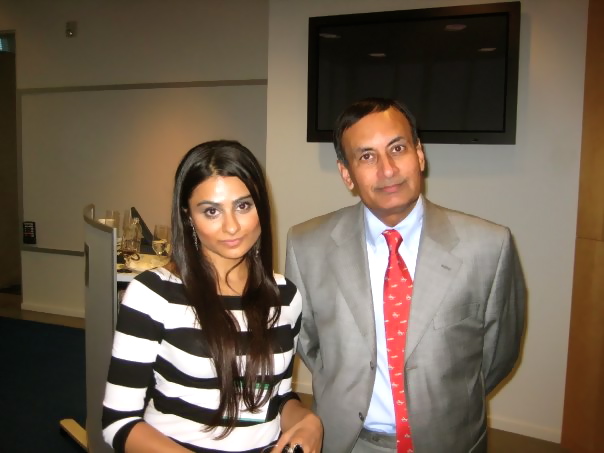
Zainab Interviews the Honorary Sharifuddin Pirzada
Q & A BREAKDOWN
PAST LEADERS: Jinnah
2:39 – 3:17 – Former BJP Parliamentarian Jaswant Singh authored a book on Jinnah that is receiving a lot of controversy, having actually worked with Jinnah, can you share your thoughts on the book ?
3:20 – 4:42 – In recent interviews, Singh has said Muslims in India are “robbed of their psychological security” and basically downtrodden. He says what Jinnah should have done is left some advice for Indian Muslims who stayed back and didn’t migrate to Pakistan after partition, what do you think Jinnah might have said?
4:44-6:01 – He also refers to Jinnah as a “nationalist” not at all Anti-Indian, please expand
6:01-7:34 – Referring to politics, when Jinnah split from the Congress party eventually formulating a two state idea later in his career, were there any politics referring to Nehru or Gandhi that had an impact on decision making? Jaswant Singh makes a mention to some, what does your experience tell us?
7:35: – 8:15 – You’ve mentioned previously that Jinnah was a self made man, more details?
8:15 – 8:55 : Tell us about your experience with Jinnah, its a rare treat for us to have your insight
8: 55 – 9:22 – Further details, conclusion on Jinnah.
“Jinnah had the Charm of Churchill, Dignity of de Gaulle, Magnetism of Mandela, and Objectivity of Obama”
CURRENT LEADERS : Musharraf
9:23 – 10:47 – Shifting to current leaders now, lets talk about Musharraf. You’ve got great experience, tell us about your work with the former General and Leader of Pakistan.
10:48 – 11:55 – How did your work with Musharraf expand during his tenure?
12:56 – 13:45 – You served on the national security council & as senior advisor to Gen. Musharraf, tell us howthe context of national security in Pakistan changed after 9/11. Specifically what came on the agenda, what were the immediate concerns and interests and what drove the decision to behave the way Pakistan did at the time?
13:45 – 15:48 – Recent polls indicate a majority of pakistanis think Musharraf should be punished for treason as per laws under article 6 of the Constitution, how do you feel about that?
15:48 – 14:55 – Do you think it’s a valid case that Musharraf be tried for treason?
14:54 – 15:38 – Regarding an increasingly free media in Pakistan, please offer further insight
15:38 – 16:16 – There’s a contention that the currently free media be attributed to Benazir Bhutto’s regime wherein sateilite technology allowing expanded media was put in place, while others assign credit to Musharraf. Can you clarify this?
16:16 – 18:39 – Do you think it was the state of emergency and sacking of the judiciary that caused Musharraf to lose elections?
18:42 – 19:35 – Final question on Musharraf, what do you think his legacy would be?
“The Media is very free in Pakistan, and Musharraf is to be given a great deal of credit for that”
CURRENT LEADERS : Zardari
19:48 – 20:55 – Recent military achievements in SWAT and international trade deals penned by Zardari paint a somewhat rosy picture for the future, what are your thoughts on him so far?
US – PAKISTAN RELATIONS:
20:57 – 23:14 – There’s a US special envoy in the region, drone attacks continue, the west is pushing for rapid democratization and are heavily investing in counterterrorism through cooperation with Pakistan while Islamabad hopes to secure itself and expand economically in this engagement. But there’s a long history of cooperation but still a lot of skepticism on both sides, do you think current engagement with a new administration who promises more diplomacy will yield different results than we’ve seen in this alliance?
23:14 – 24:52 – What advice might you offer President Obama or the State department in terms of engaging Pakistan?
“Pakistan was member of SEATO and CENTO but certain conditions were not fulfilled and there is a strong section of Pakistan who has reservations with a cordial relationship with the United States”
PAKISTAN & THE MUSLIM WORLD
24:55 – 25:11 – Your position at the Organization of Islamic Conference?
25:13 – 25:57 – On the Israeli Palestinian issue, how do you assess the current two state solution that Obama has put forward? How viable is it?
25:57 – 26:25 – What is Pakistan’s diplomatic/official stance on the Israeli Palestinian Issue?e Islamic Conference
12:25 – 26:35 – What are the main priorities of the Organization of the Islamic Conference?
“The Palestinian Issue followed by Kashmir are of top priority to the Organization of Islamic Conference”
PAKISTAN BORDER RELATIONS : INDIA & AFGHANISTAN:
26:35 – 27:42 – Manmohan Singh & Prime Minister Gilani at the NAAM summit this summer agreed to bracket issues of Terrorism and move forward on peace talks and trade issues. Such rhetoric is not new, and might not reach fruition, so do you see anything being resolved in Kashmir anytime soon, without the help of the US?
27:44 – 28:44 – Elections in Afghanistan are being contested between Abdullah Abdullah and incumbent Karzai. Pakistan doesn’t seem keen on either because both signal a warming of relations between Kabul & New Delhi which is believed to come at a direct expense to Islamabad. How do you feel about that?
America can facilitate peace talks between India and Pakistan on Kashmir, but on the whole, people of Kashmir are still suffering and struggling. The approach of prime ministers has been positive, but an extremist element in India exists which doesn’t want this. To stop suffering in Kashmir, a solution must be reached.
PAKISTAN’S INTERNATIONAL FUTURE:
28:44 – How do you see geopolitics playing out in the next decade for Pakistan, given amplified US presence, including super embassies being constructed in Pakistan/Afghanistan, perpetually stalled relations with India, a very likely nuclear neighbor in Iran, and increasingly influential China and polarized Russia, what does Pakistan look like ten years from now?
“Pakistan in the next ten years must concentrate on democratic set up, economic development & maintaining cordial relatoins with Islamic countries. There are two great friends of Pakistan: Saudi Arabia, the other is China. That’s a good starting point”
After months of consideration on how to deal with our escalating engagement in the AF-Pak region, Obama’s administration has decided:
“the Taliban cannot be eliminated as a political or military movement”
An article in the Washington Post today cites the administrations re-vamped goal of mitigating a Taliban capacity to interfere in the establishment of a stable Afghan government while assuring us that Al Qaeda is the primary threat, and our strategy will focus squarely on eradicating them.
It seemed news on Pakistan in the past year revolved around Islamabad not doing enough to eradicate the Taliban; equating the group to Al Qaeda in terms of importance in the War on Terror. But today marks a clear departure from such criticism. Distinguishing Al Qaeda from the Taliban is a huge step forward for the United States. Because connecting our goals to eliminate both immediate security threats and major elements of Afghan society that are unpalatable to our values, has proven counter productive. Having lived in Pakistan to experience the ill effects of hyper conservative religious factions, I know we mean well in trying to uproot extremism, but it just hasn’t worked in tandem with our military offensive. And I’ve mentioned the importance of a distinction between these groups previously:
The Taliban is historically distinct from militant groups like Al Qaeda. Unlike the Taliban, Al Qaeda is directly responsible for 9/11. Simply put, the Taliban was an ideologically fundamental group, while Al Qaeda is a militant, terrorist group. Both are dangerous as such, but the Taliban has national interests in controlling Afghanistan under strict ideological rules while Al Qaeda is a militant organization with international ambitions.
It’s not a novel contention, but only just being reflected in policy, and I think it has potential for success. As an ideological force, the Taliban foster an ultra conservative brand of Islam, but are not necessarily a threat to our security interests. Plus, if General McChrystal’s goal is defined as establishing a sustainable, democratic Afghan government, in order for it to be considered legitimate, it must be rooted in Afghan values and according to Afghan preferences. Such preferences might seem backward, or entirely unpleasant to us, but so long as our interests are being protected, impressing our brand of democratic values should take a back seat for the time being. I think the Obama administration has taken a wise step in revamping the Af-Pak strategy and hope it yields lasting success.
Senate unanimously passed a bill authorizing “appropriations to promote an enhanced strategic partnership with Pakistan”. The legislation is likely to receive similar support in the House later this week before being sent to President Obama for final approval. Initial versions of legislation were presented as the Biden-Lugar bill last year led by democrats Joe Biden and Senator Kerry, and supported by Hillary Clinton and Barack Obama. Currently, the bill is coauthored by Republican Senator Dick Lugar making it widely bipartisan which reflects our growing desire to engage Pakistan ensuring stability and ultimately our interests in the region.
The Legislation triples foreign aid to our major non NATO ally” allowing up to $1,500,000,000 for their cooperation in “counterterrorism/counterinsurgencydescribing Pakistan’s ongoing struggles and successes against the Taliban and Al Qaeda. It cites assassination of Benazir Bhutto, the Islamabad and Mumbai hotel attacks last fall among other suicide bombings in Pakistan and Afghanistan, some of which involved deaths of US citizens to underscore an immediate need to assist Pakistan at this critical time. As we face mounting deaths in the War on Terror, send additional troops to Afghanistan and President Obama works closely with generals to revamp our strategy there, the bill is meant to forge a new relationship with Pakistan.
It extends diplomatic rhetoric directly to the people of Pakistan by describing the daily plight of citizens who are “especially hard hit by rising food and commodity prices and severe energy shortages” with 2/3rds of the population living on less than 2.25 and 1/5 of the population living below the poverty line”. It further mentions “Compatible goals of combating terrorism, radicalism and promoting economic development through building of infrastructure and promoting social and material well being for Pakistani citizens through development of public services”. And most interestingly, the bill cites Pew opinion polls finding:
“Pakistan has historically viewed the relationship between the United States and Pakistan as a transactional one characterized by a heavy emphasis on security issues with little attention to other matters of great interest to citizens of Pakistan”.
Then referring to the current civilian government as an “opportunity to place relations on a new and more stable foundation”. The bill’s ‘statement of policy‘ identifies the following objectives:
Support the consolidation of democracy, good governance & rule of law in Pakistan
Support economic growth & development to promote stability/security
To build a sustained, long term, multifaceted relationship with Pakistan
Expanding bilateral engagement with Pakistan
To work with Pakistan and bordering countries to facilitate peace (a possible reference to mediating the Kashmir issue. President Obama mentioned doing so during his campaign run for President)
Expand people to people engagement between US and Pakistan through increased educational, technical and cultural exchanges (possibly in the form of more student/professional visas. Envoy Holbrooke mentioned this in visits to Karachi in July)
Work with government of Pakistan to:
prevent Pakistani territory from being used as a base/conduit for terrorism in Pakistan, Afghanistan, India or elsewhere
Coordinate military, paramilitary & police action against terrorist terrorism
Help bring peace, stability and development
(this might entail counterinsurgency/counterterrorism assistance and cooperation through intelligence sharing, arms development/trade and training of Pakistani forces)
Pakistan is aptly described as a major non-NATO, long-standing ally. But cooperation has been dominated by security issues generally in the form of military dictators supported by the States in exchange for Pakistan’s military assistance throughout the Cold War and current War on Terror resulting in the Pakistani mindset of solely “transactional” relations. This bill is a fair attempt to shift that context to a more positive tone with the aforementioned objectives and diplomatic rhetoric.
However, certain specificities such as timetables and solid oversight must be transparently accessible to the Pakistani and American public to ensure more positive relations are achieved. Already experts are weighing in with concerns. Despite the commitment to development in addressing the plight of daily Pakistani’s, Foreign Policy Magazine mentions that the bill doesn’t say exactly how much of these funds are to be allocated toward military assistances. And although senator Kerry insists “Clear, tough minded accountability standards and metrics” are contained in the bill, Dawn News cites Rand Corporation expert Dr. Christine Fair raising the issue of “greater transparency” and wanting to ensure international accounting standards are applied in allocating these funds. Such concerns are equally felt in Pakistan, where past commitments of economic development have not always found their way to alleviating the plight of daily citizens for whom funding is supposedly intended.
For this reason a concerted conviction to improving the daily lives of Pakistani’s is required by Pakistani politicians who have ultimate control over how these funds are applied. I hope that President Asif Zardari along with Parliament works closely to ensure monies are responsibly allocated to a “sustainable” development the bill calls for.
CNN refreshingly shifts the context of current discourse on Pakistan by reporting on female recruitment to the Pakistani Air Force. A story published this week highlights Ms. Ambreen Gul’s experience with the Pakistani air force as “one of seven women trained to fly Pakistan’s F-7 supersonic fighter jets”. Gul describes her experience as both positive and productive. Air Force cadet Ms. Sharista Beg also explains:
“To tell you the truth I’ve been given equal opportunity or I suppose more than men have been given,”
I refer to the story as refreshing because given that news is largely focused on macro level, security issues dealing with the war in Afghanistan and how it relates and spills over into Pakistan, the image we have of Pakistan is imprecisely bleak.
Of course macro level security issues in which our troops are directly engaged rightfully take priority over other news stories on Pakistan, but the unintended consequences of viewing this country as such and simply in terms of the “War on Terror”, “Taliban”, “fundamentalism” or “militancy” is a reduced understanding of what we are dealing with in our engagement there.
So I applaud CNN for balancing information with their story on Fighter Pilot Gul. Hopefully news outlets will continue to publish reports that allow a more accurate picture of what is a largely moderate Pakistan. Because a more accurate picture can only help us understand our situation there. In fact, the article concludes well, citing specifics of how the Pakistani air force works in line with our objectives:
“They’re training in counterinsurgency, collecting aerial intelligence and targeting militant strongholds in the treacherous mountains of Pakistan’s tribal region along the Afghan border”
The nebulous Afghan-Pakistan border has become the front lines in our War on Terror making it easy to forget that Pakistan, just like us fights diligently against fundamentalism and militancy with their resources, troops and morale. We want to uproot terror to bring our troops home and secure interests in the long run, likewise Pakistan shares this long term goal and in addition, has an immediate interest in obliterating militancy for actual day-to-day security. The CNN article does a fine job of reporting in this instance and prompts us to realize that cooperation is key.
“I hope we (Americans) learn to be more humble, to listen more. Because what we are in the end, or should be, are actions that speak for themselves, that speak for us”,
Says Chairman of the Joint Chiefs of Staff, Michael Mullen, the highest-ranking officer in the US Armed forces. The statement comes as the United States faces possibly its deadliest few months for the War on Terror in a deteriorating Afghan-Pakistan situation. President Obama says this war is one of “necessity” and searches for ways to amplify US efforts with Admiral Mullen and special envoy Richard Holbrooke weighing in on how best to secure this region.
Holbrooke, the seasoned diplomat and Mullen the military expert agree that more needs to be done to engage the Muslim world but differ significantly on how. At the onset of the War on Terror, Holbrooke advocated the United States enhance communication by
“convincing Muslims that this is not a war against Islam, but a war on terror.
Holbrooke says this is acheivable through a sustained public discussion with key Muslim Intellectuals and must be taken up by the White House because it alone has a capacity to direct activities of State, Defense, Justice, CIA, AID and others toward the Muslim world and can also allocate required resources. President Obama’s troop surge in Operation Enduring Freedom, and Holbrooke’s appointment as special envoy marks a shift to more “strategic communications” as advocated by Holbrooke in Afghanistan and Pakistan and focuses on three goals:
“Redefining our message; connecting to the people of Afghanistan and Pakistan on the ground in new ways through cell phones, radio, and other means; and identifying and supporting key communicators who are able, through local narratives, to counter extremists’ propaganda and present a positive alternative. Additional personnel and structures in the Afghan provinces and in Islamabad/Peshawar will be necessary”
However, despite Holbrooke’s diplomatic prescriptions, the situation in Afghanistan/Pakistan is deteriorating and Admiral Mullen last week shifted significantly with the concept of relying on “strategic communications”. Instead, he suggests the problem is not one of communication, rather:
“Our messages lack credibility because we haven’t invested enough in building trust and relationships and we haven’t always delivered on promises. Each time we fail to live up to our values or don’t follow up on a promise, we look more and more like the arrogant American’s the enemy claims we are”
Admiral Mullen stresses credibility by leading through example and suggests a tangiblity to our efforts in Afghanistan and Pakistan are imperative as opposed to just communications. When Holbrooke visitsed Karachi last week and talked about a “major turn with our relationship with Pakistan” and discussed granting more visas for Pakistani’s, textile trade and preferential access to US markets, he visited underprivilaged schools and met with opposition leaders to give an overall message that “drone attacks and the hunt of Al Qaeda are not he only American foreign policy activities in the country”. But Admiral Mullen might counter that these communicative efforts do little to establish meaningful change in the hearts and minds of Muslims. Because these efforts have in the past remained just that, efforts. Rarely are these discussions translated to tangible results for everyday citizens. Each time a special envoy or diplomat thus engages in progressive talks that do not turn out in actuality, US credibility falters.
But Pakistan and the United States have a long, deep history of cooperation. Much of that cooperation has been macro, diplomatic, and military to military cooperation from as far back as defense agreements like SEATO/CENTCOM or until present day collaboration in the War on Terror. Despite the history though, Pakistani masses have seen their country remain economically underdeveloped and their social and political situation has perpetually deteriorated. That is not to imply Pakistan is reliant on a coperation with the US or any alliance/assistance for that matter, but years of allying at the forefront of the Cold War during the US sponsored Soviet Afghan War and now Operation Enduring Freedom, Pakistani’s do not see or feel any positive results and therefore have an interest in cooperation with us.
Admiral Mullen then is correct: US crediblity must be rooted in leading through examples that enhance US credibility which in turn, wins over hearts and minds. He further suggests that when the US does not deliver tanigble benefits in exchange for cooperation and as promised, militant/extremist groups fill those gaps:
“They deliver. Want to know what happens if somebody violates their view of Sharia law? You don’t have to look very far or very long. Each beheading, each bombing, and each beating sends a powerful message or, rather, is a powerful message”
Leaving Pakistan and Afghanistan to recuperate and redevelop without adequate assistance after deeply cooperating in the Soviet Afghan war are exactly the kinds of mistakes that profoundly thwart our interests in winning over civilian hearts and minds
The Soviet Afghan War, and current War on Terror has left Pakistan with an immense refugee problem which created vast security, social and political problems.I think applying Admiral Mullen’s perscriptions to this issue would be a great place to start in winning over Pakistani hearts and minds. Important to note is that Pakistan is currently home to a the second largest Muslim population in the world and continues to grow rapidly. And a deteriorating situation in neighboring Afghanistan we’ve seen has a dangerous spillover effect into Pakistan. Thus, winning hearts and minds in this heavily Muslim populated regoin is certainly in our interest. Pakistani troops and civlians bear immediate, tangible costs in fighting against terrorism in and around their border in our War on Terror. This shared motive, and 60+ year alliance should prompt Washington should focus on establishing viable policies that in serving civlians who truly pay to secure our interests, also establishes credibility in the Muslim world. I think Admiral Mullen describes this hurdle in our dealings in the Muslim world best:
“it’s a subtle world we don’t fully — and don’t always attempt to — understand. Only through a shared appreciation of the people’s culture, needs and hopes for the future can we hope ourselves to supplant the extremist narrative.”
No explanation can adequately address the horrors carried out in Gojra Pakistan. But these horrors are newsworthy and have potential to serve as a lesson in uprooting such inhumanity. Rather than focusing squarely and vaguely on vast historical causation that might allow factions to commit these horrors, a closer look at multifaceted ways in which to uproot that causation by drawing on recent history is valuable.
Because in some ways recent events are repetitive of the country’s history of cyclical, civilian to military governance. Just over half of 62 years of Pakistani statehood have been spent under martial law (which is bizarre, though not entirely as alarming as it sounds). Civilian regimes have been notoriously corrupt and did little to bring about democracy when scrutinized beyond the cover of a “civlian” title. Given this backdrop and our long engagement with Islamabad, Washington’s lenses should be discerning when dealing with Pakistan. But events like Gojra, the Mumbai atrocities and relentless, daily plight Pakistan’s military and civilians face in uprooting terror from in and around their borders, consistently begs the question: what is still going wrong?
If we draw on recent events for explanation, there is one consistency: Since the War on Terror began, Pakistan was most stable under Musharraf with respect to security and international standing and since his departure, the economy is deteriorating.
Correlating these successes to Msuharraf’s tenure might come across as reductive, but it is tangible. Thus, to better formulate our strategy in Pakistan given the luxury of hindsight, it could be useful to revisit Musharraf’s policies by way of dispelling vociferous censures that follow him until now:
As a military leader Musharraf’s governance deepened the cycle of martial law ultimately not allowing a democracy to take shape in Pakistan:
Not necessarily: South Asian policy expert Anatol Lieven explains “All civilian governments have been guilty of corruption, election rigging and the imprisonment or murder of political opponents, in some cases to a worse degree than the military administrations that followed.” And the pool from which to select leaders post Musharraf offered little hope for anything different. Alternative options were extensions of the very leadership Lieven explains. They offered dynastic governance (Benazir Bhutto as daughter of Zulfiqar Bhutto) or perpetual subversion of democracy through maintaining a feudal system (Asif Zardari). In fact, the feudal system wherein masses of uneducated Pakistani’s are bound to a servile existence is what causes this kind of aristocracy to reign. This rampant subversion of Pakistani citizenry is a far cry from democracy.
Musharraf indirectly addressed this by privatizing news media. This profoundly affected everyday Pakistani’s by spurring, fresh news, views, ideas, occupations and attention independent of state censorship and interest. Something I took for granted until spending time in Karachi before Musharraf’s tenure (especially under Sharif’s government). If anti- Americanism was a problem in Pakistan, Sharif’s rigid and religious driven censorship of television, and print media certainly did not help while Musharraf’s policies, did.
On a side note: although media privatization is eclipsed by other news out of Pakistan in the past few years, I cite this as Musharraf’s crowning achievement. I maintain that its effects will have lasting impact on ultimately allowing a viable democracy to take shape in Pakistan by way of a meaningful dissemination of independent and increasingly globalized information.
Musharraf should not be credited with the economic growth because it was driven by foreign support funds from the War on Terror which would have been collected from cooperation by any Pakistani government in power at the time:
Also while investments were “paternalistic” during martial law, economic growth actually did, “trickle down” as was seen in major cities. A more modernized standard of living through increased consumption and access to products reflected this economic expansion amongst all levels in society. For the first time in Karachi, I saw hired help, including chauffeurs who are part of the working class carrying cell phones and purchasing American DVD’s. Women were increasingly seen occupying positions in the financial sector and politics. So military paternalism, is sadly more productive than the civilian corruption that takes place because it means funds are at least circulated domestically, rather than driven out of the country entirely.
Now I’m not equating these specific instances of consumption and progress necessarily to full-fledged support of Musharraf, nor am I making a case for permanent military rule in Pakistan or condoning military corruption. However, such tangible developments amidst unfounded criticism and the reality of Pakistan’s history should inform Washington. A senior fellow on South Asia at the Council on Foreign Relations perhaps prescribed this best in 2007:
Musharraf offers Washington continuity in the face of uncertain political transition. He is a familiar face, a leader with whom the Bush administration has established a sustained working relationship. Under even the smoothest possible transition scenarios, Musharraf’s departure would interrupt bilateral cooperation on military, counterterrorism, and intelligence matters for days or weeks—with uncertain consequences for U.S. security
In hindsight, this assessment is quite apt. Musharraf was an ally who provided results and continued to successfully expand our efforts in the War on Terror. Not just for U.S. interests, but for Pakistani interests in security and development. Had Musharraf not fired the Supreme Court judges and declared the state of emergency that wound up dismissing further justices, he might have maintained his leadership that is needed in Pakistan at this time. And I hope the Obama Administration takes this recent history into close consideration when formulating our ongoing cooperation with leaders in Islamabad.
Polls opened today in Afghanistan with Washington watching closely in hopes that elections are peaceful and leave a lasting mark of democracy for future state building. Pakistan has the same interest on perhaps an even more immediate level. Successful elections in Afghanistan are an integral ingredient to Pakistan’s domestic offensive in uprooting dangerous factions, expanding the economy, nurturing their democracy and stabilizing relations with neighbors. But if a candidate does not receive at least 50% of votes in this first round, “elections are pushed into a second, more unpredictable round of voting“. And second round elections might agitate an already rickety political climate amidst apprehensions of violence, which is entirely detrimental for Pakistan given domestic and regional circumstances right now.
On the domestic front, Pakistan’s military continues to make progress against dangerous groups. Weakened by the death (and or disappearance) of leader Baitullah Mehsud, the Taliban in Pakistan “seems to be in disarray”. Meaning Islamabad’s offensive against factions this year are bearing fruits for the War on Terror and shifting toward more stability, hopefully for the long term. But if elections in Afghanistan are pushed to a second round, weeks of political irresolution can allow terrorist groups a climate of uncertainty within which to recuperate from losses and cause turmoil. Which since 2001 has shown that a dangerous spillover effect exists wherein Afghani militant groups shift in to Pakistan harboring themselves into the nebulous, virtually imperturbable border.
Broader regional considerations also factor into Pakistan’s hopes for stable elections. The spillover of militant groups since 9/11 intensifies Pakistan’s long desired interest in seeing a democratic, stable Afghanistan where refugees may repatriate. In fact,Pakistan hosts one of the largest refugee populations in the world, an underreported story that actually helps explain why dangerous factions were able to develop in Pakistan. Millions of devastated Afghans, some armed and many destitute from fighting Soviets in the 1980’s found refuge from their war ravaged country in Pakistan. A mostly destitute population seeking refuge in a developing country with highly volatile political circumstances allowed violent sectarian and religiously extremist factions to exploit and recruit refugees to their cause. In addition, there are heavy economic costs for Pakistan in maintaining such a large number of refugees. Since last years military escalation in Afghanistan, the UN High Commissioner for Refugees explains that there is around 2 to 2.1 million Afghani Refugees now living in Pakistan. He said the United Nations planned to launch an emergency appeal for hundreds of millions of dollars needed to sustain refugees that have come in just this past year. So peaceful elections in a first round that move Afghanistan in a direction of democratic stability is integral to Pakistan’s security: they relieve Islamabad of a very costly responsibility to a long-standing refugee challenge.
Although some minority, yet raucous opinions say elections ushering democratic authority are not in Islamabad’s interest because they “diminish Pakistan’s influence in Afghanistan”. Thus suggesting policymakers are strategically motivated to prevent losing an allegedly malleable buffer zone that Afghanistan serves against India. It’s an unlikely, poorly reasoned notion. It attempts to be qualified by citing Islamabad’s insistence on uprooting domestic militant/fundamentalist groups, so as to avoid confrontation with a supposed malleable buffer forces. But expecting policy makers to divert efforts from turmoil at home to external threats is a laughable assertion. Before taking care of neighboring militant groups whose primary focus is not on fighting Pakistanis, Islamabad legitimately devotes resources to uprooting domestic factions who pose an immediate threat. Suicide bombings have become an almost weekly recurrence in Pakistan and with that level of instability, faulting Pakistan for not doing enough to uproot neighboring terror is outrageous. Plus, NATO forces and amplified American presence in Afghanistan furthers the absurdity of such calls for Pakistan to ignore turmoil at home and focus on Afghanistan. And neither of these allegations logically indicate a Pakistani motivation for instability so as to use Afghanistan as a buffer zone.
But perhaps the most unreasonable way of supporting a notion that Pakistan lacks interest in successful elections refers to relations with India. Specifically, that Islamabad’s refusal to remove forces from the Indian border despite current spillover from Afghanistan indicates an excessive concern with an Indian threat. A few reasons why this is incorrect: firstly, referring again to amplified U.S. and current NATO presence and given an abundance of domestic threats that require Islamabad’s attention, removing troops from the Indian border to the Afghan border does little to help Pakistan now, (especially weighted against the risks of doing so). Secondly, even if troops from were redeployed, those forces are squarely trained/equipped to face a potential Indian threat, not in counterterrorism. Which became well known much to Washington’s dismay with the military’s many unsuccessful attempts at uprooting militants from the northern regions along the Afghan border.
Finally, a refusal to redeploy forces is not because of an excessive concern given the reality of current Indian-Pakistani relations. The Mumbai atrocities occurred less than a year ago and the aftermath saw a speedy, vehement escalation of tensions. Some Indian mediaand politicians fanned the flames, and when tensions rise between India and Pakistan, the world gets nervous. By way of a counterfactual, we can tie how these tensions relate to justifying Islamabad’s decision to maintain troops on the border: If, God Forbid, another atrocity took place on Indian soil since 11/26/08 and Pakistan had redeployed troops away from the border. The result could be an even further escalation of tensions. A terrifying potential for confrontation ensues and Pakistan’s capacity to defend against an already far more immense Indian force is drastically diminished. Which itself has a potential to cause hasty, over offensive beahvior from either side. Basic lessons in Realism thus teach us that redeployment away from the Indian border is out of the question. Given history, and sensitive circumstances since 11/26 I think military strategy might advise the same. Thus from a Pakistani policymakers point of view, troops on the Indian border is a legitimate priority. If anything, one might even argue they deter confrontation.
So, allegations that Islamabad is not sufficiently committed to stable election processes in Afghanistan are just not reasonable. If anything, successful elections relieve Pakistan of deep social and economic costs through refugee repatriation. And from the Mumbai atrocities to countless civilians who suffer daily from terror and a climate of instability that allows violent factions to operate, a peaceful, prosperous Afghanistan beginning with successful elections is very much in Pakistan’s interest.
“Pakistan Objects to U.S. Plan for Afghanistan War” reads a New York Times article last month updating us on our foreign policy. The article forewarns of “fissures” in the U.S. Pakistan alliance at this critical moment when President Obama sends additional troops to the region. The article specifically outlines Pakistan’s insistence on maintaining forces along the Indian border when the United States expresses concern that the Afghan border is of greater priority. Pakistani officials, to some international dismay, contend that it is more constructive to maintain dialogue with some parts of the Taliban rather than going at the group in an all out military offensive. The piece continues to explain that, sources from the Inter Services Intelligence Agency (ISI: Pakistan’s intelligence agency, their equivalent to our CIA) briefed Special Envoy Holbrooke this morning in their strong concerns of an U.S. “surge” which would “result in more civilian casualties, further alienate local populations. Thus more local resistance to foreign troops”. And while the article continues with how these concerns contrast starkly with U.S. fears that Pakistan is not focusing enough on the Taliban in the north, it is important to revisit the consequences of, and reassess our long-term strategy in Operation Enduring Freedom. Because more of the same may not be an apt solution given that the war is escalating in terms of U.S. costs (on various levels), the region is deteriorating, and prominent experts now claim the effort is doomed to be “unwinnable”.
The fact is, this is the deadliest month for U.S. troops in Afghanistan and where there once was no Al Qaeda or Taliban in the sovereign state of Pakistan, now exists a terribly frightening border through which terrorists are fleeing and situating themselves in the north. Furthermore, it is important to remember that until recently, the Taliban was not considered a terrorist organization, although alarming they were not a military threat before 9/11. Al Qaeda was the main target in Afghanistan, and their presence in Pakistan was minimal, if at all. Since our invasion, the Taliban and Al Qaeda are increasingly difficult to differentiate, and rather than being obliterated, are moving in to Pakistan. And a once ideologically problematic group of Islamic extremists, the Taliban, are now dangerously aligning with far more treacherous terrorist outfits like Al Qaeda.
In a similar way, other regional militant groups are gaining ground as extremist groups evade NATO forces and subsequently weaken our anti-terrorist efforts. The Mumbai atrocities and embassy attacks in Afghanistan last year are testimony to the danger of militant groups advancing their efforts in an increasing climate of instability. This only legitimizes Pakistan’s skepticism of continuing an predominantly military means to combating terrorism. If limited surgical strikes, close intelligence sharing, and consistent provision of anti-terror training and supplies is agreed as effective amongst officials, the U.S. and Pakistan should focus on a “surge” on these fronts.
So when the news paints a clashing picture of interests between Pakistan and the United States, it is a simplistic one. Both states actually have an intense interest in securing the region against terrorists and while they might disagree on tactics, it is important that the Obama administration at least reassess the previous administration’s policies of simply implementing a military “surge”. Even if a surge in troops is potentially successful, working closely to expand on what has proven to be effective is a safer option. So a discerning look at this weeks supposed “fissure” between U.S. and Pakistani officials in discussing cooperation should prompt us to better understand Islamabad’s concerns and perhaps reassess our strategy .



 Zainab B. Jeewanjee
 Zainab Jeewanjee