What happens when a majority of one country’s citizens opt for martial law but the democratically elected government in power including judicial, executive and legislative branches are against a military takeover? It’s quite the political conundrum because either side offers legitimate democratic authority, but they’re diametrically opposed. A rational answer is to let the democratically elected government fulfill it’s term and allow citizens to elect politicians to office who will support martial law in the next term. That might work in a fully functional democracy backed by institutions that can uphold legitimacy and granted the state is sufficiently secure. However, in light of decreasing security, severe economic downturns and age old skepticism of U.S. actions in Pakistan, ever so gradually the country shifts it’s gaze toward the military.
Decreasing Security :: To offer partial explanation in a nutshell: Since 2001, terrorists fleeing Operation Enduring Freedom in Afghanistan, spilled over into Pakistan at the nebulous northern border areas which are historically autonomous from federal regulation. The fact that Pakistan already housed one of the worlds largest refugee populations allowed this spillover a massive and destitute demographic from which to exploit support. As a result, we now see unprecedented terrorism in Pakistan where Al Qaeda and the Taliban had no significant presence prior to 9/11.
Skepticism of U.S.’s Role in Pakistan:: Since the inception of Pakistan in 1947, bilateral realations with the United States have been defined by cooperation wherein Pakistan served as a proxy for U.S. Containment throughout the Cold War (i.e. security pacts like SEATO, CENTCOM, then aiding our Afghan led defense against Soviet incursions in the 1980’s). In exchange, Pakistan’s military with U.S. support, bolstered itself as the strongest, most efficient and stable institution in Pakistan. Some argue civilian governments and democratic institutions were thus never given an opportunity to compete with such a well funded, strongly backed military. And therein we find multifaceted dimensions that help explain the controversy over current U.S. support of Pakistan. Former Pakistan to U.S. ambassador Maleeha Lodhi describes the Kerry Lugar bill:
“the offending part of the legislation sets up the country as hired help and puts the military in the dock, presumed guilty on many counts and having to prove its innocence to Washington”
Pakistan is “hired help”, that’s the crux of skepticism on the Kerry-Lugar bill. Concern is rooted in a long history of cooperation with the United States that some argue created a behemoth military institution costing them a fair chance at democracy. In attempt to address that very concern, the Kerry Lugar bill mentions no military aid in exchange for cooperation on the War on Terror, unlike previous assistance packages from the Cold War. Ironically, bleak affairs in Pakistan now which are partially a result of pervious cooperation, particularly during the Soviet Afhgan war, prompt arguments that the military is exactly what needs support right now. Thus, the Lugar Bill receives not only skepticism from Pakistan’s strongest institution, but increasingly the public.
Although Secretary Clinton and Senators Kerry and Lugar have made no indication of altering the bill, to avoid future skepticism and potential resentment of U.S. involvement in Pakistan it could be wise to make changes so as to not sideline the military at this critical period in our War on Terror. Unlike previous Republican presidencies, the Obama administration is committed to dealing with civilian governments in Pakistan. It’s a noble idea and even though i don’t suspect that as the military gains legitimacy the civilian government will collapse soon, we should think twice before riling such concern over a bill that has just a 5 year life span. Central and South Asia are critical regions for our interests and we may need to engage strategically positioned Pakistan in more years to come. So a backlash by the most powerful institution in that country is something we should anticipate, and work actively against.
Pakistani forces are in full offensive mode today, bombing northern areas of South Waziristan. Although planned months in advance, this comes immediately following a siege at military headquarters, and a number of suicide attacks for which Taliban have claimed responsibility. Simultaneously, the Kerry-Lugar Bill elicits concern that contingencies on funding potentially violate sovereignty, US controlled drone attacks continue and the economy has yet to pick up. Needless to say, the War on Terror have been tough times for Pakistan, and I hope the military succeeds in securing northern areas swiftly.
But an interesting perspective that is perhaps overshadowed by statistics, strategies, and tangible costs/benefits of our engagement in Operation Enduring Freedom, are the multifaceted issues of Pakistan’s agenda, which should describe handling security breaches at the forefront of their interests.
The Christian Science Monitor has a piece entitled “Pakistan Taliban Bombing Spree Could spur Backlash” reporting on today’s military offensive, but the thrust is that the Taliban siege at military headquarters “spurs” Pakistani forces to fight harder, and stronger against the Taliban. By attributing an increased fight to the “backlash” of this weekends attacks, the article rests on an implied assumption that Pakistan would otherwise have made suboptimal efforts at obliterating terrorists. At the end of the article an alternative view is offered by a security analyst at the INternational Institute for Strategic Studies in London explaining:
“I don’t think any serious military is baited in that way. It will certainly annoy the military intensely and strengthen resolve, but the South Waziristan operation – which will inevitably occur at some point – isn’t going to be accelerated just because of this.”
“By launching these attacks on the very citadel and symbol of the Pakistani Army they have just crossed a red line, and there is no turning back as far as the Pakistani Army is concerned. I think they will be made to pay for it.”
Certainly, a brazen attack on military headquarters will rile a staunch response. But the articles title still suggests that the siege fuels the military offensive rather than an inherent interest in combatting terrorism.
This idea is an extension of what is now a widespread misperception that Pakistan is not entirely interested in combating terrorism, when on the contrary, this weeks offensive reaffirms Pakistan’s struggle for security. And I wonder if the skeptical lens with which reports question Pakistan’s effort stem from a stage set for discourse back in 2001 when former President George Bush decided countries were simply “either with us, or against us”.
The effectiveness of that strategy is debatable, but 8 years later it doesn’t offer sufficient explanations for allies like Pakistan who work “with us”, yet face persistent accusations of not doing enough. Because this weekend’s siege on military headquarters indicates Pakistan’s inherent interest in uprooting terrorism, but without a comprehensive reading into the situation it’s easy to have only a “with or against us” understanding. The northern areas where Afghani militants have spilled over is an autonomous region, historically beyond the realm of federal authority. Yet its inhabitants share with greater Pakistan a similar culture, ascribe to the same religion (although interpretations vary), and even share a physical resemblance making it a very sensitive area where any state would use force only as a final resort. Militarily obliterating such an area is unpalatable to the general Pakistani public and therefore a difficult issue to deal with for policymakers. In addition, Pakistan’s forces are only 60+ years old and trained predominantly in conventional warfare to face a potential Indian threat.
Thus, there are extremely sensitive considerations and multiple dimensions in the Pakistani approach to dealing with terrorism that since 2001, is an increasingly domestic battle. Just militarily obliterating this kind of demographic is not only potentially destabilizing for Pakistan, but is impractical without additional funding, training, and intelligence sharing with our forces. So Pakistan’s cooperation with the United States is not a black or white, “with us or against us” situation. The Obama administration understands this as if applies General McChrystal’s recommendations to differentiate Taliban from Al Qaeda as targets in the War on Terror. Such practicality takes into considerations long term realities and sensitivities of the region as cooperation in our War on Terror looks increasingly domestic for Pakistan.
At the heels of Pakistan’s offensive against militants in South Waziristan, terrorists brazenly staged an attack on military headquarters this weekend. Commandos responded swiftly, taking out 9 of the militants, capturing their ring leader and freeing 39 hostages. Despite success in ending the siege, the incident demonstrates a worsening Af-Pak situation and beseeches a new strategy.
Our administrations new strategy is defined by an increase in troops to Afghanistan, focusing military efforts squarely on Al Qaeda (less focus on Taliban) and expanded funding to Pakistan by way of the Kerry Lugar bill. And while the troop surge and emphasis on Al Qaeda are debated at length in D.C., the Pakistani media is abuzz on the Kerry Lugar bill. There are calls by The Awami League Party (representing the NWFP regions & a predominantly Pashtun population) that the bill allow for an “uninterrupted flow of non military assistance” while other politicians vouch against the legislation altogether. Tehrik-e-Insaaf chairman Imran Khan said the bill “enslaves” Pakistan and can only benefit the top echelons of government referring to past corruption allegations on senior government officials. Similarly, pundits were all over Pakistani television in the past week, echoing concerns about corruption, lack of support to the military, too many strings attached to funding, and how the bill threatens sovereignty. This morning Foreign Minister Shah Mahmood Qureshi flew to D.C. to discuss theseconcerns just as rumours that Pakistan’s Ambassador to the United States is losing his post becayse of not entirely positive comments regarding the Kerry-Lugar legislation. Suffice to say, the Enhanced Partnership with Pakistan Actmeant to extend a new strategic hand of cooperation to Islamabad is not off to the positive start intend
In fact, Senator Kerry’s office directly responded to popular skepticism in a recent report.
Addressing concerns that the bill would invade state soveriegnty: Senator Kerry explains the bill funds “schools, roads, energy infrastructure and medical clinics” and that “those seeking to undermine” a US/Pakistan in that endeavor are doing so to “advance narrow partisan or institutional agendas“.
Regarding the idea that the legislation comes with too many strings attached, Kerry emphasizes that the $7.5 billion annual pledge is for “unconditioned non military aid” and comes with “strict measures of financial accountability” referring specifically to Executive Branch oversight on the use of these funds.
This is contentious to Pakistan because it’s maybe the first time external oversight is imposed on assistance from the United States. And while the bill does a great job of outlining funds for social infrastructure intended to find it’s way to everyday citizens, on the issue of sovereigty, the real sticking point is regarding a potential subversion of the Pakistani military. Senator Kerry insists that the bill’s:
“focus is on nonmilitary assistance to the people of Pakistan” and military aid is contingent to “cooperation on nonproliferation“. However, the bills funding is rooted in “significant efforts towards combating terrorist groups” and the “Pakistani military not subverting the political or judicial process” to ensure “common goals” of “security and democracy“.
This irks Pakistani’s for a number of reasons. Firstly, there’s ambiguous wording. “Cooperation on nonproliferation” is vague enough to translate as potentially linking funds to Pakistan giving up their right to maintain armaments comparable to neighboring India. Similarly, “significant efforts toward combating terrorism” gives no reference for how this will be measured.
On the Pakistan side, the worry is that “significant efforts”, according to their definition might not match a U.S. definition of success. Plus there might continue to be a disagreement on the idea of “combating terrorism”. It’s a contention we’ve seen play out as D.C. repeatedly called for heightened efforts on combating the Taliban, quitely but surely opposing Pakistan’s attempts at negotiating with those groups rather than employing just a military offensive, (a policy we’re now reverting).
Also, delinking assistance from the military is unprecedented and freightening to some because while it is necessary to develop schools, and social, democratic infrastructure for long term development, in the immediate term there are widespread security breaches with weekly suicide attacks, an ever growing incursion from Afghan militants on the northern border and drone attacks that result in collateral damage.
So Pakistans concerns echo a need for both immediate security and long term development, but not at the expense of one another.
Keep in mind, the widely held, and all but true notion that Pakistan is perhaps the only place where the military controls a country, and not vice versa. That idea is rooted in that their military is historically the strongest, most stable and legitimately accepted institution. Let me emphasize that last part: it’s historically the most legitimately accepted institution in Pakistan in an absence of stable democratic institutions never having developed. Meaning, in times of economic, social and political uncertainty, the military has historically responded most efficiently in alleviating situations since 1947. Whether one accepts the idea that the military creates a perpetual cycle of uncertainty within which to assume power periodically, or the military responds to the shortcomings of civilian governments in the absence of democratic instiuttions (chicken & egg argument), either way, the military’s been relatively effective in handling crises in Pakistan in comparison to civlian regimes. So given the current enviornment of insecurity, people are weary of a hopeful promise for “long term” moves toward “democracy” that might comes at the expense of insufficient assistance to their military who has a capacity to alleviate immediate security concerns.
I think democracy is the ultimate route to security for Pakistan, but despite Executive branch oversight and our “long term” commitment defined by only 5 years of funding, Pakistan’s concerns are understandable. Given a long history of cooperation, Pakistan is more used to US assistance through bilateral relations with a Republican government in DC (think General Zia/Raegan, General Musharraf/Bush, Ayub Khan/Eisenhower, Yahya/Nixon) and the Kerry Lugar bill is a staunch reverasal of our foreign policy with Islamabad. Perhaps finding value in previously crafted policies to Pakistan in combination with our current legislative proposals is an optimal solution to quelling the enahanced concern of our enhanced cooperation.
After months of consideration on how to deal with our escalating engagement in the AF-Pak region, Obama’s administration has decided:
“the Taliban cannot be eliminated as a political or military movement”
An article in the Washington Post today cites the administrations re-vamped goal of mitigating a Taliban capacity to interfere in the establishment of a stable Afghan government while assuring us that Al Qaeda is the primary threat, and our strategy will focus squarely on eradicating them.
It seemed news on Pakistan in the past year revolved around Islamabad not doing enough to eradicate the Taliban; equating the group to Al Qaeda in terms of importance in the War on Terror. But today marks a clear departure from such criticism. Distinguishing Al Qaeda from the Taliban is a huge step forward for the United States. Because connecting our goals to eliminate both immediate security threats and major elements of Afghan society that are unpalatable to our values, has proven counter productive. Having lived in Pakistan to experience the ill effects of hyper conservative religious factions, I know we mean well in trying to uproot extremism, but it just hasn’t worked in tandem with our military offensive. And I’ve mentioned the importance of a distinction between these groups previously:
The Taliban is historically distinct from militant groups like Al Qaeda. Unlike the Taliban, Al Qaeda is directly responsible for 9/11. Simply put, the Taliban was an ideologically fundamental group, while Al Qaeda is a militant, terrorist group. Both are dangerous as such, but the Taliban has national interests in controlling Afghanistan under strict ideological rules while Al Qaeda is a militant organization with international ambitions.
It’s not a novel contention, but only just being reflected in policy, and I think it has potential for success. As an ideological force, the Taliban foster an ultra conservative brand of Islam, but are not necessarily a threat to our security interests. Plus, if General McChrystal’s goal is defined as establishing a sustainable, democratic Afghan government, in order for it to be considered legitimate, it must be rooted in Afghan values and according to Afghan preferences. Such preferences might seem backward, or entirely unpleasant to us, but so long as our interests are being protected, impressing our brand of democratic values should take a back seat for the time being. I think the Obama administration has taken a wise step in revamping the Af-Pak strategy and hope it yields lasting success.
During yesterday’s Australia Pakistan match, my brothers and I got into a discussion on ODI bowling. I said:
what Pakistan could use now aside from openers are solid strike bowlers. The kind who authoritatively combine sheer pace with deadly accuracy to leave batting lineups trembling in defensive mode. Wasim Akram, Waqar Younus, Imran Khan and Shoaib Akhtar come to mind, who within just a few overs, could command a reversal of the course of entire matches allowing their team to defend even modest totals. These were the guys who made Hat Tricks look easy. As a kid I recall my wide eyed expectation that Akram or Younus would simply take multiple wickets to salvage any match where Pakistan was slipping. And they rarely let me down.
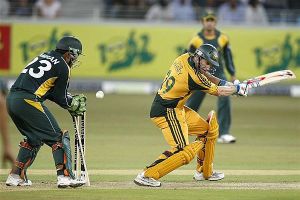
While the current lineup isn’t quite at that caliber yet, yesterday was still a nice taste of some electrifying Pakistani bowling. But first came batting. Though I initially recommended Akmal play it safe allowing more experienced batsmen to assume leadership, he did well to take big shots during opening innings. I didn’t anticipate Younis Khan and Shoaib Malik’s subdued batting or Afridi opening, so Akmal’s 44 off of 63 deliveries proved supportive. Still, conjuring just a 206 total shouldn’t have been difficult to chase, but the Pakistani squad made it a tough earned victory for the Aussies. Skipper Ponting described it best,
“I was chewing my finger nails up there for the last little bit. That ended up being closer than I thought was possible. We snuck across the line.”
I was nervous at the onset of the second innings when the Aussie run rate averaged around 6 after 10 overs compared to the Pakistani average that was just under 4. Watson opened well managing a strike rate of 109 with his partner Paine at around 72. But, just as the Aussies were:
“coasting at 140” a loss of “six wickets for 47 in a dizzying 12-over sequence that temporarily opened the door for India to leap-frog them into the next round of the tournament.”
Pakistani hopes skyrocketed as the Aussies scrambled to maintain wickets. Hussey and Ponting supported their openers with fair enough runs so that despite the fall of wickets, the run rate was maintained to sufficiency almost throughout. Almost throughout. Shoaib Malik took out the Aussie pillar Rikcy Ponting and at the 36th over Saeed Ajmal bowled Ferguson. Promptly thereafter, Naved-ul-Hassan took out Hussey who was looking more and more threatening leaving the Aussies 157 for 4.
Then came my second most missed Pakistani player, Mohammad Asif (second only to Abdur Razzaq), who made a very cool comeback bowling full outside off to Hopes. Hopes drove it upward straight to Younis and then Asif clean bowled batsman number 6 in the same over. That’s likely when skipper Ponting started chewing his finger nails. With just a couple tail enders left to chase roughly a half century and an electrified bowling to face, the last 9 overs were gripping. It wound up going to the very last ball where the Aussies managed to win it. And any game that winds up decisive based on the last ball is fine by me.
So it looks like Australia is in through the Semi’s with Dhoni and company’s tremendous thrashing of the West Indies not enough to take them forward. In any case, bring on New Zealand!
Even if peace talks are stalled between India and Pakistan, warming relations are on the cards for South Asian’s this week. With India’s chances of surviving the ICC Champions Trophy contingent to a Pakistan win on Wednesday against Australia, Dhoni and company will be watching closely in hopes for a victory for the men in green. So what’s it going to take:
Strong Opening:
Imran Nazir can’t be hasty. He has a tendency to get carried away after an early four, or six. Overconfidence can be a hinderance. And he can’t rely on hopes of weak fielding as he might have done in previous matches. He should play his natural game, hit a few boundaries overt time, but keep on guard.
Kamran Akmal has fair potential, even if he’s not my top choice for opener because of a lacking consistency. Key for him is simply: “don’t get out”. Allow Nazir to handle hiking up a solid run rate and understand that if his partner does get out, skilled batsman such as Malik and Afridi are behind him. Plus it’s well known that Pakistan can generate 100+ runs with middle/tail end batsman if need be. So Akmal should refrain from taking leadership, hold his wicket and play big shots if given safe opportunities to do so.
Discipline:
Umar Gul must be more careful. With a 9.16 economy in the India match, and zero wickets, he needs to step it up. Gul has to take charge as Pakistan’s most experienced opening bowler with this squad. There’s no such thing as negligible extras when playing against the Aussies, it’s just too costly.
Wicket Taking:
When Australia loses a wicket, they face opposition with equal or even greater confidence than before. Their batting doesn’t falter, it goes up a notch. So what Pakistan needs to do is ensure a constant aggressiveness in bowling. Keeping an Aussie run rate down in the first five overs is critical. If you give the Aussies a chance to consistently gain confidence from the onset, they’ll run with it and it’ll be hard to chase/contain from there.
Fielding:
Shahid Afirdi & Shoaib Malik are the top fieldsmen. But it’s going to take aconcerted effort on the entire Pakistan side to avoid weak fielding that can wind up expensive in the end. The Australian concept seems to be that when a fielder drops a catch off their hit, they punish bowlers by hitting one out of the park, as if to consider the misfielding an opportunity for a bonus hit, or a free wicket of sorts. It’s an aggressive strategy underscoring the importance of fielding against this team.
The game plan for Pakistan ultimately is: Cautious Intensity. No extras, keep the Aussie run rate down, maintain wickets and the runs will come. Besides, Pakistan’s already secured their seat in the Semi Finals. A safe victory is really all we ask for. Well, in the case of the Indian squad, given that their survival is reliant on both a Pakistan win and an astronomical run rate against the West Indies in their next match, they might be hoping Pakistan get a little more than just a “safe” victory 😉
Excited about Pakistan’s victory in todays ODI vs. India at the ICC Champions Trophy, i looked for YouTube highlights of previous India Pakistan matches hoping to relive thrilling performances of batsmen trembling at Akram/Younis yorkers or some record breaking Tendulkar/Sehwag innings. But I was unable to find a consolidated reel of South Asian highlights as such. It seems all content pertaining to Indian and Pakistani Cricket are elaborately produced showcases of either country triumphing over the other, or amusing clips revealing serious sledging between both teams over the years. And that’s understandable, it’s a competitive sport and fans create videos for the teams they support.
But something is changing. I don’t think fans are looking at these videos the same way as years past. Sambit Bal wrote a nice precursor to today’s match describing the epic India Pakistan rivalry as something far more profound than just another sporting competition. He says cricket in South Asia “has always been close to the national identity”. Quite astutely, he describes how it’s then used: “sometimes as a salve, sometimes a weapon; it has enabled bonding and it has divide; at times it has been a bridge, at others a vehicle for ugly chauvinism; and governments have used it as both a handshake as well as a show of fists”. And therein lies the dilemma.
India Pakistan matches are tremendously exciting, wrought with raw enthusiasm and incredible anticipation, but wind up raising stakes far higher than are normal or necessary. Bal says cricket is close to South Asian “national identity”, and in conversations I’ve heard matches described as akin to “war” or “religion”. That’s just going too far.
To inextricably tie these matches to one’s identity or religious affiliation let alone actual combat is absurd, but fortunately, a phenomenon that’s shrinking. Less and less are India Pakistan matches carrying the same weight for masses and even players. Bal explains that because matches between the countries have increased since 2004, an
“overkill took away the anticipation and intensity. But from a larger perspective, it also took away the heat and emotional charge, and that was not a bad thing at all. Since they were always playing, wins and losses no longer felt like life and death. It felt somewhat dull, but it also felt sane.”
Ahhhh, it felt sane. Now that’s a great way to put it. Cricket shouldn’t be a tool or driving force of nationality, politics let alone international relations. That’s a recipe for perpetual division, which is the last thing South Asia, or the world for that matter needs right now. So even if India Pakistan matches are seeing diminished anticipation, at least it shifts our focus toward the game itself rather than political, social and religious issues which ought to be unrelated. Because a heightened concentration on the game of cricket can finally allow us to debate what’s truly interesting. Like how Pakistan is the only team capable of winning a match in the last ten over’s by scoring 100+ runs while India is the only team who can do that in the first ten 😉
Riaz Mohammad Khan is being considered for the position of Pakistan’s Special Envoy to India says Foreign Minister Shah Mahmood Qureshi. Attempting to resume talks that are stalled since the Mumbai atrocities, Minister Qureshi suggests using “backchannel diplomacy” through informal talks and in parallel with a formal peace process to achieve a warming of relations and overall progress in relations. In a recent statement to Indian TV networks, Qureshi clearly states he is “instructed by the President to move on. We want to normalize with India”. Such top level recommendations reflect Islamabad’s growing desire for more progressive relations with their neighbor, as consistently pursued by the Zardari administration.
Attributing initial moves toward back channel diplomacy to Musharraf era policies in resolving the Kashmir issue with India, Qureshi stresses that progress can only be made if both “front and back channel (diplomacy) move in tandem”. It’s a reasonable assessment given relations have been held up despite three high level meetings between leaders at the sidelines of international summits since June. Back Channel diplomacy, being secret and inherently less formal can eliminate domestic political concerns policymakers face that might stifle open, progressive discussion.
With a climate of mistrust exacerbated by the Mumbai atrocities and on the Pakistan side, claims that India is constantly funding militant separatists in Baluchistan, back channel diplomacy can mitigate both states political need to formally construct ever toughening stances against one another.
The Baluchistan and Mumbai issues are highly sensitive to citizens in both countries and assuaging those concerns is rightfully a priority for politicians on all ends. As a result, official talks between India and Pakistan wind up inherently staunch as they are subject to international media portrayals and reactionary sensitivities of masses in either country. This has done little to advance peace talks in any tangible way. And because the United States has a stake in ensuring stability in Pakistan given increased investment in the form of the Kerry Lugar bill and additional troops to Afghanistan, perhaps special envoy Holbrooke, or another appointed official on behalf of Washington might serve to mediate initial attempts at back channel diplomacy.
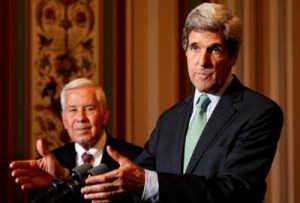
Senate unanimously passed a bill authorizing “appropriations to promote an enhanced strategic partnership with Pakistan”. The legislation is likely to receive similar support in the House later this week before being sent to President Obama for final approval. Initial versions of legislation were presented as the Biden-Lugar bill last year led by democrats Joe Biden and Senator Kerry, and supported by Hillary Clinton and Barack Obama. Currently, the bill is coauthored by Republican Senator Dick Lugar making it widely bipartisan which reflects our growing desire to engage Pakistan ensuring stability and ultimately our interests in the region.
The Legislation triples foreign aid to our major non NATO ally” allowing up to $1,500,000,000 for their cooperation in “counterterrorism/counterinsurgencydescribing Pakistan’s ongoing struggles and successes against the Taliban and Al Qaeda. It cites assassination of Benazir Bhutto, the Islamabad and Mumbai hotel attacks last fall among other suicide bombings in Pakistan and Afghanistan, some of which involved deaths of US citizens to underscore an immediate need to assist Pakistan at this critical time. As we face mounting deaths in the War on Terror, send additional troops to Afghanistan and President Obama works closely with generals to revamp our strategy there, the bill is meant to forge a new relationship with Pakistan.
It extends diplomatic rhetoric directly to the people of Pakistan by describing the daily plight of citizens who are “especially hard hit by rising food and commodity prices and severe energy shortages” with 2/3rds of the population living on less than 2.25 and 1/5 of the population living below the poverty line”. It further mentions “Compatible goals of combating terrorism, radicalism and promoting economic development through building of infrastructure and promoting social and material well being for Pakistani citizens through development of public services”. And most interestingly, the bill cites Pew opinion polls finding:
“Pakistan has historically viewed the relationship between the United States and Pakistan as a transactional one characterized by a heavy emphasis on security issues with little attention to other matters of great interest to citizens of Pakistan”.
Then referring to the current civilian government as an “opportunity to place relations on a new and more stable foundation”. The bill’s ‘statement of policy‘ identifies the following objectives:
Support the consolidation of democracy, good governance & rule of law in Pakistan
Support economic growth & development to promote stability/security
To build a sustained, long term, multifaceted relationship with Pakistan
Expanding bilateral engagement with Pakistan
To work with Pakistan and bordering countries to facilitate peace (a possible reference to mediating the Kashmir issue. President Obama mentioned doing so during his campaign run for President)
Expand people to people engagement between US and Pakistan through increased educational, technical and cultural exchanges (possibly in the form of more student/professional visas. Envoy Holbrooke mentioned this in visits to Karachi in July)
Work with government of Pakistan to:
prevent Pakistani territory from being used as a base/conduit for terrorism in Pakistan, Afghanistan, India or elsewhere
Coordinate military, paramilitary & police action against terrorist terrorism
Help bring peace, stability and development
(this might entail counterinsurgency/counterterrorism assistance and cooperation through intelligence sharing, arms development/trade and training of Pakistani forces)
Pakistan is aptly described as a major non-NATO, long-standing ally. But cooperation has been dominated by security issues generally in the form of military dictators supported by the States in exchange for Pakistan’s military assistance throughout the Cold War and current War on Terror resulting in the Pakistani mindset of solely “transactional” relations. This bill is a fair attempt to shift that context to a more positive tone with the aforementioned objectives and diplomatic rhetoric.
However, certain specificities such as timetables and solid oversight must be transparently accessible to the Pakistani and American public to ensure more positive relations are achieved. Already experts are weighing in with concerns. Despite the commitment to development in addressing the plight of daily Pakistani’s, Foreign Policy Magazine mentions that the bill doesn’t say exactly how much of these funds are to be allocated toward military assistances. And although senator Kerry insists “Clear, tough minded accountability standards and metrics” are contained in the bill, Dawn News cites Rand Corporation expert Dr. Christine Fair raising the issue of “greater transparency” and wanting to ensure international accounting standards are applied in allocating these funds. Such concerns are equally felt in Pakistan, where past commitments of economic development have not always found their way to alleviating the plight of daily citizens for whom funding is supposedly intended.
For this reason a concerted conviction to improving the daily lives of Pakistani’s is required by Pakistani politicians who have ultimate control over how these funds are applied. I hope that President Asif Zardari along with Parliament works closely to ensure monies are responsibly allocated to a “sustainable” development the bill calls for.
CNN refreshingly shifts the context of current discourse on Pakistan by reporting on female recruitment to the Pakistani Air Force. A story published this week highlights Ms. Ambreen Gul’s experience with the Pakistani air force as “one of seven women trained to fly Pakistan’s F-7 supersonic fighter jets”. Gul describes her experience as both positive and productive. Air Force cadet Ms. Sharista Beg also explains:
“To tell you the truth I’ve been given equal opportunity or I suppose more than men have been given,”
I refer to the story as refreshing because given that news is largely focused on macro level, security issues dealing with the war in Afghanistan and how it relates and spills over into Pakistan, the image we have of Pakistan is imprecisely bleak.
Of course macro level security issues in which our troops are directly engaged rightfully take priority over other news stories on Pakistan, but the unintended consequences of viewing this country as such and simply in terms of the “War on Terror”, “Taliban”, “fundamentalism” or “militancy” is a reduced understanding of what we are dealing with in our engagement there.
So I applaud CNN for balancing information with their story on Fighter Pilot Gul. Hopefully news outlets will continue to publish reports that allow a more accurate picture of what is a largely moderate Pakistan. Because a more accurate picture can only help us understand our situation there. In fact, the article concludes well, citing specifics of how the Pakistani air force works in line with our objectives:
“They’re training in counterinsurgency, collecting aerial intelligence and targeting militant strongholds in the treacherous mountains of Pakistan’s tribal region along the Afghan border”
The nebulous Afghan-Pakistan border has become the front lines in our War on Terror making it easy to forget that Pakistan, just like us fights diligently against fundamentalism and militancy with their resources, troops and morale. We want to uproot terror to bring our troops home and secure interests in the long run, likewise Pakistan shares this long term goal and in addition, has an immediate interest in obliterating militancy for actual day-to-day security. The CNN article does a fine job of reporting in this instance and prompts us to realize that cooperation is key.




 Zainab B. Jeewanjee
 Zainab Jeewanjee