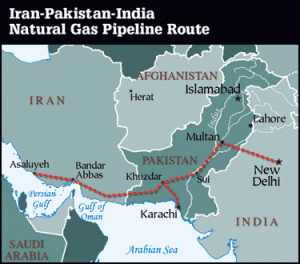
The anticipated Iran-Pakistan-India (IPI/”Peace Pipeline”) pipeline may end up running only through Iran/Pakistan as India backed out from the project last week says Muhammad Abbasi, Pakistani Ambassador to Iran. Delhi’s withdrawal comes simultaneously as the US pressures Islamabad to disengage from the multibillion dollar project set for completion in 2013. This adds to the list of obstacles IPI faced since it was conceptualized in the 1990’s. From international pressures, prolonged funding negotiations, to domestic insecurities and reservations, the pipeline has yet to begin construction. However, Pakistan stresses urgency in moving forward with construction in the face of alarming energy shortages :
Only 60% of households have electricity and 18% access to pipeline gas for heating. Energy demand is expected to increase 250% over the next 20 years. To meet expected demand, electrical generating capacity must grow by 50% from 20.4 gigawatts to 30.6 gigawatts by 2010
Pakistan’s domestic gas production is falling and import dependence growing tremendously. By connecting itself with the world’s 2nd largest gas reserve, Pakistan guarantees a reliable supply for decades. If the pipeline were to be extended to India it could also be an instrument for stability in often tense Pakistan-India relations. Under any scenario of pipeline expansion which makes Pakistan a transit state, Islamabad stands to gain from transit fees hundreds of millions of dollars every year.
Given such potential, it’s not surprising Pakistan is intent on moving forward with IPI regardless of pressure from D.C. Despite Special Envoy Holbrooke’s diplomatic suggestions that the United States might “link funds committed by the Democratic Friends of Pakistan” to their cooperation with Iran on IPI, foreign minister Shah Mahmood Qureshi maintained Pakistan’s urgency:
“The gas pipeline construction agreement with Iran and Pakistan will by no means go under the U.S. pressures,”
But some experts insist that without American support to release funding and loan guarantees, financing of IPI will make the 2013 deadline unfeasible. This poses problems for Pakistan, and on the American front, there are differing concerns. Hoping to maintain US authority and secure interests in the region, President Obama shifts starkly from the previous administration using more engagement and soft power with Iran. So American moves to work with the international community in economically choking Iran and ultimately eliciting behavior from Tehran are diminished as Iranian influence increases through international projects such as IPI. Hardline Bush Administration and more diplomatic Obama led policies are interesting yielding similar ends as Iran continues to expand trade and relations with the international community. This flouts hard, soft, all stances the United States takes in attempting to contain Tehran.
For instance, a vastly constructed pipeline running over 2,775 kilometers (1,725 miles)from the Persian Gulf in Iran, through Baluchistan to a port in Karachi and then north to New Delhi creates “an unbreakable long term political and economic dependence” of billions of people from Pakistan, to India and potentially extending to China.
The prospect of the entire subcontinent being “dependent” on Iran actually sounds alarming, but if we look at certain realities it’s perhaps far fetched. Firstly, any semblance of an actual dependence is most likely only applied to Pakistan given their current energy crisis, the cost effectiveness and efficiency of natural gas as opposed to developing LNG sources: India on the other hand has “two LNG terminals and will complete a third terminal by this year. Two additional terminals have also been proposed, and several companies are examining viability of constructing additional LNG import sites”. So Delih is far less likely to be entirely reliant on Tehran for natural gas because developments in LNG and civilian nuclear projects. Plus, India’s long, strong alliance with Russia allows for a convenient energy supplier to the north if need be. In fact, for Moscow IPI is an opportunity to quell thoughts that Tehran will compete in supplying natural gas to EU markets. Russia’s deputy energy minister explains:
“It is therefore in Russia’s interest to derail the Nabucco project by diverting Iran’s gas away from Europe and locking it to the Asian market. We are ready to join the project as soon as we receive an offer”
Thus a point of contention for Moscow and Washington. DC’s fears are further exacerbated by a potential of IPI eventually ensuring energy supplies to long standing Pakistani ally, China with shipments along the Karakoram Highway through future pipelines . The argument made is that hopes of modifying Iranian behavior with economic pressures plus our mutual hedging with China suffers if IPI is constructed. Again, this relies on the assumption that billions of Indians and Chinese become “dependent” on Iranian gas supplies, which I find unlikely. Pakistan if anyone, is likely to become heavily reliant on those supplies in the next couple decades should IPI be executed as planned. Thus suggested solutions point to alternative pipelines that bypass Iran:
“A rival gas-pipeline project — the Turkmenistan-Afghanistan-Pakistan-India (TAPI) carrying gas from Daulatabad in Turkmenistan via Herat and Kandahar in Afghanistan to Multan in central Pakistan is one such alternative”
But this concept is contingent to a stable Afghanistan, which most experts indicate is not in the near future. Without stabilizing Afghanistan and given chilly relations with India, TAPI is not likely to move forward without overcoming numerous diplomatic and security obstacles. And Pakistan’s energy crisis doesn’t afford Islamabad time to wait for the international community to stabilize Afghanistan or warming relations with India.
Critics of IPI also insist it is conducive to US interests for Pakistan to develop LNG supplies rather than natural gas. This probably entails cooperation with Europe and the United States as opposed to Iran, which is an unviable suggestion. Firstly, LNG development is more expensive than natural gas supplies through a pipeline. Plus, it’s more probable that Pakistan receive lower cost, soft term loans in dealing with Iran as opposed to the EU or US. IPI also presents a possibility of improved trade opening import markets for Pakistan where Iranians can purchase food items. Pakistan has a strong agricultural base and produces wheat, sugar and rice that can be exported efficiently to its neighbors. So for Pakistan, IPI is a viable solution to the energy crisis in addition to creating future revenue generation.
Should the worst happen and a Taliban style regime take over Pakistan, the economies of the world’s most radical Shiite state and that of what could be the world’s most radical Sunni state would be connected to each other for decades to come like conjoined twins.
This is an outrageous misgiving. Al Qaeda and the Taliban spilled over into Pakistan since our War on Terror began in 2001, meaning the Taliban are nowhere near rampant in number or have many sympathizers amongst the mostly moderate population. The Pakistani army made strides in efficiently securing the Swat valley and continue to make progress in eradicating militants. Assuming the entire Pakistani military and heads of state can not obliterate 20-40K (at maximum) Taliban is unreasonable. Many experts have indicated, it’s not that it can’t be done, it’s working to ensure the job gets done efficiently and to secure the long term which is taking time. I think the suspicion of Taliban influence in Pakistan is used perhaps to sensationalize the consequences of IPI construction.
Still, critics maintain that IPI is against our interests and hope lies in it never being constructed given diminutive chances of getting the needed 7.5 billion in funding and because of the volatile location of construction. IPI would run through the province of Baluchistan where resentment and instability with the federal government is historical, underprivileged masses prevail and prior instances of attacks on water pipelines ensued. These facts might impede construction of IPI but it’s important to note that even the most critical voices against the pipeline maintain we not intervene in aiding any subversion of federal government projects in Baluchistan:
US open support for opposition groups who might be willing to undermine the project is unthinkable as any collaboration – overt or covert – would severely cripple our relations with Islamabad
Pakistan’s deep cooperation and commitment to fighting the War on Terror trump other priorities. Plus, in the long run, economic interdependence at the cost of our diminishing influence is maybe preferred to a possibility that this region become increasingly rife with groups well armed and trained at subverting national governments. The Soviet Afghan War was our best teacher of that lesson.
Finally, critics argue how it’s against US interests for Iranian influence to expand in South Asia through IPI because it would add regional instability should Tehran become nuclear and support terrorism. However, this relies on the assumption that heads of state are engaging in bilateral trade with Pakistan on this project for an ultimate goal of international terrorism and that heads of state are irrationally going to create instability in a region that they are increasingly economically interdependent with.
Certainly, a successful natural gas pipeline that spurs economic growth for Iran and helps solve South Asia’s energy crisis might increase Tehran’s influence to some extent, but overall instability and supporting terrorism runs counter to basic arguments of liberal theories of capitalism. With increased trade and interdependence, might increased peace and less interest and instability ensue?
Thus in accepting the reality of what Fareed Zakaria calls, “The Rise of the Rest” wherein increasingly interdependent and economically stable states using minimum or zero US intervention are growing into regional powers President Obama is beckoned to reassess foreign policy. Iran won’t likely rival American hegemony through IPI, but increasingly such situations require we evolve policies to effectively deal with long standing allies like Pakistan who are inevitably drawn into relations that could diminish our influence.
“Tonight we celebrate a great religion and its commitment to justice and progress. We honor the contributions of Americas Muslims and the positive example they set for so many”
No matter how one feels about Washington’s foreign policy, U.S. hegemony, or Americans in general, it’s hard to deny the appeal of our President’s sharp diplomacy. From making his first call in office to Palestinian Authority President Mahmoud Abbas, to his landmark speech in Cairo marking “A New Beginning” in U.S. relations with the Muslim world to hosting the annual White House Iftar, Barack Obama’s message to Muslims is drastically different than previous administrations. This administration extends a mature attempt to engage Muslims at home and abroad.
I use the word mature because previous presidencies naively boxed themselves in an almost solely hostile rhetoric of The War on Terror or simply lacked foresight to effectively convey that America is not adverse to Islam. Lacking foresight is critical because Islam’s global reach puts Muslims atop the list of the worlds fastest growing religions . So when President Obama shifts diplomatic rhetoric to a more mature tone with the Muslim world it’s to ensure progressive relations with this large and increasingly strategic demographic. And that’s why I think President Obama’s overtures are genuine. They fulfill our long term interests in garnering positive relations with a rapidly growing and influential Muslim world.
Regardless of whether his diplomatic overtures vastly alter policies, they are highly symbolic, and perceptions matter. American political discourse in the past referring to religion most often talked about “Judeo-Christian” values and beliefs without a mention of Muslims, even though Islam is the second largest religion in the world. Couple this with a political mis-focus on only extremist factions rather than on the moderate, majority of Muslims, just makes President Obama’s more astute diplomacy that much more valuable. Rather thanalienate Muslims across the globe, he shifts the context of US engagement to one of inclusiveness.
In his Ramadan greeting President Obama repeatedly emphasizes that U.S. relations with the Muslim world draw on commonalities citing rituals such as fasting, values of tolerance, advancing justice and respect as mutual goals that can be reached through cooperation. He specifies expanding education, fostering entrepreneurship, collaboration on science and eradicating global illnesses as instances where the US and Muslim world can engage toward more progressive relations. Not a bad idea. Let’s hope that liberal theories of humanity prove true and these ideas come to fruition.
Major news outlets are doing a fair job of covering Pakistan – U.S. relations this summer with daily reports on terrorist crackdowns and multiple visits by Special Envoy Holbrooke and Secretary Clinton’s July visit. But a relatively under reported story involves Islamabad’s interactions with Europe and their Asian allies this year. Understandably, those relations are secondary to our direct dealings with Pakistan, however certain communications are worthy of note to help better understand Islamabad’s current circumstances and interests:
Subsequently, interior minister Rehman Malik made progress with the French government this summer. The French are reported to provide Pakistan with specifically, “electronic security equipments” in addition to “sending experts to help training at police academies”. Those security equipments consist of “scanners which would be installed at all the entry and exists points of the capital” for enhanced security in addition to “bullet proof jackets”. Additionally, Daniel Touanneau, the French Ambassador to Pakistan commented positively on Pakistan’s efforts to fight terrorism.
Despite progress on anti-terror supply issues, the French made clear that no new nuclear plant would be constructed for Pakistan. The French Secretary of State for Foreign Trade, Anne Marie Idrac explained that without approval from the international community, they would not commission in any foreign country. She reiterated French support of Pakistan’s commitment to democracy and pledged 300 million Euros in aid at the Friends of Pakistan meeting in Tokyo recently. She also cited trade between the two countries increased by six percent. But Pakistan is economically in dire conditions overall and Prime Minister Gilani is more seeking to convince the EU to “support Pakistani negotiations for a free trade agreement” which would allow their exports to gain increased market share in Europe. Specifically, he proposed that the “EU create a new category in GSP arrangements designed to help countries suffering from terrorism”. This would include Pakistan into a well established system allowing them preferential trading arrangements in Europe. The proposal received diplomatic acknowledgement and overall it seems, France is working with Pakistan in their efforts to uproot terrorism.
Similarly, Italy is set to finance ten “development projects worth $100 from the debts that Pakistan” owed them. In addition, 10 million is allocated for the “rehabilitation of displaced persons”. I think this sort of project is worthy of note. Without delving into details, the concept of using past debt to finance large scale development projects that employ everyday Pakistani’s and have a strong potential to create lasting infrastructure and spur trickle down prosperity on some level is valuable. Especially in addition to the EU grants of 150 million Euros in humanitarian assistance most of which I anticipate will go to the recent refugee issue that has caused international concern. In tandem with such assistance, large scale development projects in financial cooperation with international governments could be an effective way spur lasting, progressive change. Because providing needed supplies for counter terrorism in the north, coupled with funding to make sure refugees from that area are not permanently displaced in addition to development and opportunities for future trade are solid starting grounds for building a more socially and politically stable Pakistan.
“I hope we (Americans) learn to be more humble, to listen more. Because what we are in the end, or should be, are actions that speak for themselves, that speak for us”,
Says Chairman of the Joint Chiefs of Staff, Michael Mullen, the highest-ranking officer in the US Armed forces. The statement comes as the United States faces possibly its deadliest few months for the War on Terror in a deteriorating Afghan-Pakistan situation. President Obama says this war is one of “necessity” and searches for ways to amplify US efforts with Admiral Mullen and special envoy Richard Holbrooke weighing in on how best to secure this region.
Holbrooke, the seasoned diplomat and Mullen the military expert agree that more needs to be done to engage the Muslim world but differ significantly on how. At the onset of the War on Terror, Holbrooke advocated the United States enhance communication by
“convincing Muslims that this is not a war against Islam, but a war on terror.
Holbrooke says this is acheivable through a sustained public discussion with key Muslim Intellectuals and must be taken up by the White House because it alone has a capacity to direct activities of State, Defense, Justice, CIA, AID and others toward the Muslim world and can also allocate required resources. President Obama’s troop surge in Operation Enduring Freedom, and Holbrooke’s appointment as special envoy marks a shift to more “strategic communications” as advocated by Holbrooke in Afghanistan and Pakistan and focuses on three goals:
“Redefining our message; connecting to the people of Afghanistan and Pakistan on the ground in new ways through cell phones, radio, and other means; and identifying and supporting key communicators who are able, through local narratives, to counter extremists’ propaganda and present a positive alternative. Additional personnel and structures in the Afghan provinces and in Islamabad/Peshawar will be necessary”
However, despite Holbrooke’s diplomatic prescriptions, the situation in Afghanistan/Pakistan is deteriorating and Admiral Mullen last week shifted significantly with the concept of relying on “strategic communications”. Instead, he suggests the problem is not one of communication, rather:
“Our messages lack credibility because we haven’t invested enough in building trust and relationships and we haven’t always delivered on promises. Each time we fail to live up to our values or don’t follow up on a promise, we look more and more like the arrogant American’s the enemy claims we are”
Admiral Mullen stresses credibility by leading through example and suggests a tangiblity to our efforts in Afghanistan and Pakistan are imperative as opposed to just communications. When Holbrooke visitsed Karachi last week and talked about a “major turn with our relationship with Pakistan” and discussed granting more visas for Pakistani’s, textile trade and preferential access to US markets, he visited underprivilaged schools and met with opposition leaders to give an overall message that “drone attacks and the hunt of Al Qaeda are not he only American foreign policy activities in the country”. But Admiral Mullen might counter that these communicative efforts do little to establish meaningful change in the hearts and minds of Muslims. Because these efforts have in the past remained just that, efforts. Rarely are these discussions translated to tangible results for everyday citizens. Each time a special envoy or diplomat thus engages in progressive talks that do not turn out in actuality, US credibility falters.
But Pakistan and the United States have a long, deep history of cooperation. Much of that cooperation has been macro, diplomatic, and military to military cooperation from as far back as defense agreements like SEATO/CENTCOM or until present day collaboration in the War on Terror. Despite the history though, Pakistani masses have seen their country remain economically underdeveloped and their social and political situation has perpetually deteriorated. That is not to imply Pakistan is reliant on a coperation with the US or any alliance/assistance for that matter, but years of allying at the forefront of the Cold War during the US sponsored Soviet Afghan War and now Operation Enduring Freedom, Pakistani’s do not see or feel any positive results and therefore have an interest in cooperation with us.
Admiral Mullen then is correct: US crediblity must be rooted in leading through examples that enhance US credibility which in turn, wins over hearts and minds. He further suggests that when the US does not deliver tanigble benefits in exchange for cooperation and as promised, militant/extremist groups fill those gaps:
“They deliver. Want to know what happens if somebody violates their view of Sharia law? You don’t have to look very far or very long. Each beheading, each bombing, and each beating sends a powerful message or, rather, is a powerful message”
Leaving Pakistan and Afghanistan to recuperate and redevelop without adequate assistance after deeply cooperating in the Soviet Afghan war are exactly the kinds of mistakes that profoundly thwart our interests in winning over civilian hearts and minds
The Soviet Afghan War, and current War on Terror has left Pakistan with an immense refugee problem which created vast security, social and political problems.I think applying Admiral Mullen’s perscriptions to this issue would be a great place to start in winning over Pakistani hearts and minds. Important to note is that Pakistan is currently home to a the second largest Muslim population in the world and continues to grow rapidly. And a deteriorating situation in neighboring Afghanistan we’ve seen has a dangerous spillover effect into Pakistan. Thus, winning hearts and minds in this heavily Muslim populated regoin is certainly in our interest. Pakistani troops and civlians bear immediate, tangible costs in fighting against terrorism in and around their border in our War on Terror. This shared motive, and 60+ year alliance should prompt Washington should focus on establishing viable policies that in serving civlians who truly pay to secure our interests, also establishes credibility in the Muslim world. I think Admiral Mullen describes this hurdle in our dealings in the Muslim world best:
“it’s a subtle world we don’t fully — and don’t always attempt to — understand. Only through a shared appreciation of the people’s culture, needs and hopes for the future can we hope ourselves to supplant the extremist narrative.”
This summers meeting between Pakistani Prime Minister Gilani and Indian counterpart Manmohan Singh at the Non-Aligned Summit (NAM) resumed cooperative talks since they had stalled after the Mumbai atrocities. The summit marked a breakthrough in Indian-Pakistani relations when both sides decided to bracket issues of terrorism from future peace talks, by signing an agreement that identifies terrorism as the tantamount, mutual interest at this time. But the meeting has proven costly for Prime Minister Singh who some speculate, in attempt to leave behind a legacy of progressive cooperation with Pakistan, might have gone too far. Members of the opposition BJP party, and even some in his own Congress party say the NAM declaration does little else but soften India’s position in foreign policy to Pakistan.
Singh addressed criticism in Parliament during debate with a BJP member who accused him of “surrendering” and “walking into the Pakistani camp”. The prime minister countered that unless tensions and possible war are desired, such engagement is necessary and by in large, did not retract his statements. Although, he did try and recover some political base by later clarifying: “ talks between the two countries on broader issues like trade and travel cannot continue unless Pakistan pursues strong action against terror”. The clarification however, maintains his stance that peace talks can take place bracketing concerns on terrorism but would still allow leeway for trade and travel issues to be used as leverage later. Delinking peace talks thus leaves open the possibility of including Kashmir in future discussions with Pakistan, (although there is no specific mention of Kashmir in the agreement), and could mark a beginning of more progressive dialogue. Singh specifically cited Prime Minister Gilani’s providing an additional dossier on the Mumbai atrocities at the NAM summit had convinced him of Pakistan’s commitment to uprooting terrorist groups given that:
“this is the first time that Pakistan has ever formally briefed us on the results of an investigation into a terrorist attack in India. It is also the first time that they have admitted that their nationals and a terrorist organization based in Pakistan carried out a ghastly terrorist act in India.”
Under current leadership it seems relations are moving with some positive direction, with emphasis on the word “some”. Because such instances for optimism are not entirely rare in South Asian history. A recent article in Dawn reminds us that while positive dialogue takes place,
“India-Pakistan relations do not move in a straight line. They zigzag from crisis to crisis. In the interregnum the two countries either engage in negotiations or struggle to revive an interrupted dialogue”
That’s a very perceptive notion. The agreement at NAM is hopefully indicative of future cooperation, but history has shown us a reality that the arms race in South Asia tends to impede diplomatic progress. Ultimately, the message conveyed with development of arms, is immediate, tangible, and potentially hostile. On the other hand, diplomacy is gradual, inherently more subtle and less concrete.
So earlier this week on the anniversary celebrating India’s retaking of military posts in Kargil when Delhi symbolically launched its nuclear submarine, the INS Arihant (Destroyer of the Enemies) realpolitik dictates a clear message to Pakistan that is explained by their Foreign Office spokesman Abdul Basit:
‘continued induction of new lethal weapon systems by India’ is ‘detrimental to regional peace and stability’. The obvious concern in Pakistan then is whether this capability is a potential “platform to launch nuclear missiles”
Thus when either neighbor develops such armaments, basics of power politics teaches that the risk of not responding with deterrent armaments could be akin to state suicide. Whether or not one assumes conflict to be inevitable , an arms race is almost certain in situations like this. So, even though Pakistan is unlikely to announce nuclear submarine capability soon, in some capacity armaments of defense will be sought to counter India’s recent development. This will be considered necessary even though the Indian launch is directed at China’s rapid military modernization and not limited to a focus on Pakistan. Realpolitik will still drive Islamabad to invest in counter armaments despite the fact that Pakistan is heavily invested in the costly War on Terror, and more than ever in need of funding for social developments and aid for the largest refugee problem in the world.
International summits such as the Non Aligned Movement or even SAARC meetings which yield progressive diplomacy then work secondary to an expensive, and expansive arms race which in turn, perpetuates a now notorious and mutual mistrust that plagues South Asia. So, Prime Minister Singh’s alleged “softening” with Pakistan might be conciliatory in a diplomatic way, but continued development of armaments eclipses that rhetoric. Progressive relations will ultimately require more tangible approaches that enhance a meaningful trust rather than perpetuate an arms race.
Muhammad Ali Jinnah, better known as the founder of Pakistan when India was divided in 1947 is making headlines today with controversy surrounding ex-Indian Parliamentarian Jaswant Singh’s recent book: India – Partition – Independence. Immediately following the books release, Singh was expelled from his position in the Bhartiya Janata (BJP) party, protests wherein the book was burned and a prompt ban on the work in Gujarat ensued. But why the uproar?
In a recent interview, Singh reveals the following views on Jinnah that are now apparently too controversial in India, but receiving mostly praise across Pakistan:
Jinnah was an Indian nationalist
He joined the Indian Congress party before the Muslim League implying an original loyalty to a United India and eventual shift to non secularism as a result of Congress party politics later
Jinnah fought the British for an Independent India, in tandem with fighting “resolutely and relentlessly” for Muslim rights in India
Jinnah is admirable for being a self made man, having created a position in politics for himself without the luxury of prior wealth or status
Jinnah was not anti-Hindu
Jinnah failed insofar as he received a “moth eaten” piece of divided India in the form of Pakistan and left Muslims who stayed back in India without sufficient guidance
Gandhi himself referred to Jinnah as a great Indian, so there should be no controversy in recognizing him as such today
Muslims in India today are downtrodden, live in pain and are “robbed of the essence of psychological security”
Both Indian Muslims and Pakistani’s have paid a price for Partition since both would have been stronger under a united India
To those who have not grown up or spent much time in South Asia, it may be difficult to understand why such ideas can be controversial and strike such polar chords in the hearts and minds of people divided by a man made border only 60 years ago. But the division of India, into two states resulting in an independent Pakistan saw extreme violence, mass refugee migration and that carnage left a lasting scar on South Asian mindsets. Put in a most blunt form: India suffered the bitter taste of a fractured state that is rooted among the great civilizations in history. And Pakistan suffered the bitter reality of as Singh put it, “a moth eaten”, post colonial state with perhaps an inevitably fractured and frail territory from inception. From the bizarre geopolitical landscape of Bangladesh not contingent to, yet officially part of Pakistan to the conflict over Kashmir at the very onset of partition, Singh makes a fair point in explaining partition caused profound suffering on both ends. The subsequent bitterness is manifest in perpetual hostility between both states in the form of conflicts, and in India, even on a communal level where according to Singh, Muslims are still downtrodden.
So praising Jinnah as a “great man” in India may be akin to condoning the very fracturing of India. In Pakistan, it’s lauded as an admission that their founder heroically created a homeland where Muslims would no longer be downtrodden. Singh’s work also might acknowledge that partition dealt an unfair hand to Pakistani’s, an idea that can come across as unpalatable on the Indian side. But relying on interviews from Jaswant Singh on the book so far, I think the controversy is a tired insinuation of hostility from the state. Banning the book on the grounds that:
only fuels a hostile polarization of India and Pakistan. Mind you, India and Pakistan as states are increasingly polarized, which in turn results in a division of peoples. Because my guess is that had government kept its hands out of censoring Singh’s book it might have spoken to the hearts and minds of South Asian’s disseminating novel ideas that are not divisive. Noam Chomsky once said that “states are violent institutions”, in South Asia, at the very least they are bitter, but people inherently are not. Singh’s work might have tapped into that sentiment and in the banning of it, states tighten their grip on citizens by perpetuating division and hostility in South Asia. Against a backdrop of a desire for economic growth, stability and globalization, that kind of bitterness is stale 60 odd years later. So I’m looking forward to reading the book and am lucky that my copy was reserved before the ban, in safe hands far from from protests and government intervention.
Former leaders from Ayub Khan, Benazir Bhutto, and General Musharraf tried to address the issue of growing energy consumption and diminishing supplies which is now legitimately deemed a “crisis” in Pakistan. President Zardari had his hand in addressing the crisis last week during the quarterly visit to Beijing where he discussed China’s assistance on energy projects. The result is a signed Memorandum of Understanding between both states for the construction of the Bunji dam in the Astore district of Pakistan. Pakistani Ambassador to China, Masood Khan confirmed this dam is one of 8 slotted for priority construction and will have a capacity of generating 7,000 megawatts of electricity. Additionally, Presdient Zardari visited the ambitious Three Gorges Dam and met with Solar Power companies in China this year and enthusiastically invited them to carry out feasibility studies and expertise:
“We need solar power for individual housing units and I want the Chinese to carry out a study in Pakistan,”
Applying such construction to the northern areas of Pakistan as per recent deals with China have the potential to spur similar growth. Localized hydel projects with Chinese expertise can bypass a need for more macro transmission and distribution costs involved with creating larger infrastructure. Time and money are saved if large scale distribution channels to transmit power are not needed. And because the energy produced would be confined to the area of consumption more expensive centralized power generation and large scale load issues may be avoided.
“personally monitoring all ongoing projects being carried out by Chinese engineers and experts in Pakistan, adding that he was holding regular meetings with Chinese ambassador in Islamabad”
So colorful history aside, President Zardari is one of the few, if not first true businessmen turned leaders of Pakistan and it will be great to see the success of his recent bilateral negotiations with China translate to a lasting alleviation of the energy crisis.
Shahrukh Khan, one of the most famous men in the world was detained in New Jersey last week and thinks it was because of his Muslim surname. I don’t condone unreasonably preferential treatment for megastars, but something is amiss when terms like “Islamaphobia” and “Racial Profiling” are internationally understood within an American context.
Travelling from Vegas last year, as I handed my pass to board a flight back to DC I was stopped and asked to wait aside for reasons not disclosed. Four French nationals were told the same. As all the other passengers boarded, we waited for at least 15 minutes and were given no explanation for being pulled aside. Eventually a burly looking woman and imperturbable looking man in black security garb arrived and said we were to be frisked. One of the French nationals and I asked why this was necessary after having already cleared regular security to which they responded, it’s just “routine”. The response doesn’t qualify as a logical answer to the question, but neither guard seemed interested in engaging in sound argumentation: futility kept me from trying to get an accurate response. The burly one frisked me and a French female who had a duffle bag much larger and fuller than my over the shoulder bag. She didn’t search the French female’s duffle, but mine was searched at length despite having been through X-ray and manual security beforehand. I watched her tinker with my book, pens, makeup pouch, stuffed toy, and laptop and mentioned to her: “You forgot to check the other girl’s bag”. She said “what?” I repeated my comment as she re-fastened my bag and handed it back to me. I walked away as she started to answer figuring a response was likely to include the word “routine” and leave any reasonable person dissatisfied.
Homeland Securities explanation to Shahrukh Khan was identical: his treatment was “routine”. But Khan said he felt “humiliated” and in saying “we should not be treated on the basis of our color or nationality” made clear that he felt racially profiled. In my experience, I didn’t feel humiliated although I was dissatisfied, because as an American national, the only variable for which I received a more in depth check than the French female, was aapparently my race. It was discriminatory, and it didn’t feel nice.
I’m not vouching for less security necessarily, but it’s time a solution is explored if these “routine” searches/detentions are increasingly discriminatory extending to variables such as race, religious affiliation and nationality. We live in too rapidly a globalizing world for the United States to come across as unwelcoming.
No explanation can adequately address the horrors carried out in Gojra Pakistan. But these horrors are newsworthy and have potential to serve as a lesson in uprooting such inhumanity. Rather than focusing squarely and vaguely on vast historical causation that might allow factions to commit these horrors, a closer look at multifaceted ways in which to uproot that causation by drawing on recent history is valuable.
Because in some ways recent events are repetitive of the country’s history of cyclical, civilian to military governance. Just over half of 62 years of Pakistani statehood have been spent under martial law (which is bizarre, though not entirely as alarming as it sounds). Civilian regimes have been notoriously corrupt and did little to bring about democracy when scrutinized beyond the cover of a “civlian” title. Given this backdrop and our long engagement with Islamabad, Washington’s lenses should be discerning when dealing with Pakistan. But events like Gojra, the Mumbai atrocities and relentless, daily plight Pakistan’s military and civilians face in uprooting terror from in and around their borders, consistently begs the question: what is still going wrong?
If we draw on recent events for explanation, there is one consistency: Since the War on Terror began, Pakistan was most stable under Musharraf with respect to security and international standing and since his departure, the economy is deteriorating.
Correlating these successes to Msuharraf’s tenure might come across as reductive, but it is tangible. Thus, to better formulate our strategy in Pakistan given the luxury of hindsight, it could be useful to revisit Musharraf’s policies by way of dispelling vociferous censures that follow him until now:
As a military leader Musharraf’s governance deepened the cycle of martial law ultimately not allowing a democracy to take shape in Pakistan:
Not necessarily: South Asian policy expert Anatol Lieven explains “All civilian governments have been guilty of corruption, election rigging and the imprisonment or murder of political opponents, in some cases to a worse degree than the military administrations that followed.” And the pool from which to select leaders post Musharraf offered little hope for anything different. Alternative options were extensions of the very leadership Lieven explains. They offered dynastic governance (Benazir Bhutto as daughter of Zulfiqar Bhutto) or perpetual subversion of democracy through maintaining a feudal system (Asif Zardari). In fact, the feudal system wherein masses of uneducated Pakistani’s are bound to a servile existence is what causes this kind of aristocracy to reign. This rampant subversion of Pakistani citizenry is a far cry from democracy.
Musharraf indirectly addressed this by privatizing news media. This profoundly affected everyday Pakistani’s by spurring, fresh news, views, ideas, occupations and attention independent of state censorship and interest. Something I took for granted until spending time in Karachi before Musharraf’s tenure (especially under Sharif’s government). If anti- Americanism was a problem in Pakistan, Sharif’s rigid and religious driven censorship of television, and print media certainly did not help while Musharraf’s policies, did.
On a side note: although media privatization is eclipsed by other news out of Pakistan in the past few years, I cite this as Musharraf’s crowning achievement. I maintain that its effects will have lasting impact on ultimately allowing a viable democracy to take shape in Pakistan by way of a meaningful dissemination of independent and increasingly globalized information.
Musharraf should not be credited with the economic growth because it was driven by foreign support funds from the War on Terror which would have been collected from cooperation by any Pakistani government in power at the time:
Also while investments were “paternalistic” during martial law, economic growth actually did, “trickle down” as was seen in major cities. A more modernized standard of living through increased consumption and access to products reflected this economic expansion amongst all levels in society. For the first time in Karachi, I saw hired help, including chauffeurs who are part of the working class carrying cell phones and purchasing American DVD’s. Women were increasingly seen occupying positions in the financial sector and politics. So military paternalism, is sadly more productive than the civilian corruption that takes place because it means funds are at least circulated domestically, rather than driven out of the country entirely.
Now I’m not equating these specific instances of consumption and progress necessarily to full-fledged support of Musharraf, nor am I making a case for permanent military rule in Pakistan or condoning military corruption. However, such tangible developments amidst unfounded criticism and the reality of Pakistan’s history should inform Washington. A senior fellow on South Asia at the Council on Foreign Relations perhaps prescribed this best in 2007:
Musharraf offers Washington continuity in the face of uncertain political transition. He is a familiar face, a leader with whom the Bush administration has established a sustained working relationship. Under even the smoothest possible transition scenarios, Musharraf’s departure would interrupt bilateral cooperation on military, counterterrorism, and intelligence matters for days or weeks—with uncertain consequences for U.S. security
In hindsight, this assessment is quite apt. Musharraf was an ally who provided results and continued to successfully expand our efforts in the War on Terror. Not just for U.S. interests, but for Pakistani interests in security and development. Had Musharraf not fired the Supreme Court judges and declared the state of emergency that wound up dismissing further justices, he might have maintained his leadership that is needed in Pakistan at this time. And I hope the Obama Administration takes this recent history into close consideration when formulating our ongoing cooperation with leaders in Islamabad.
Polls opened today in Afghanistan with Washington watching closely in hopes that elections are peaceful and leave a lasting mark of democracy for future state building. Pakistan has the same interest on perhaps an even more immediate level. Successful elections in Afghanistan are an integral ingredient to Pakistan’s domestic offensive in uprooting dangerous factions, expanding the economy, nurturing their democracy and stabilizing relations with neighbors. But if a candidate does not receive at least 50% of votes in this first round, “elections are pushed into a second, more unpredictable round of voting“. And second round elections might agitate an already rickety political climate amidst apprehensions of violence, which is entirely detrimental for Pakistan given domestic and regional circumstances right now.
On the domestic front, Pakistan’s military continues to make progress against dangerous groups. Weakened by the death (and or disappearance) of leader Baitullah Mehsud, the Taliban in Pakistan “seems to be in disarray”. Meaning Islamabad’s offensive against factions this year are bearing fruits for the War on Terror and shifting toward more stability, hopefully for the long term. But if elections in Afghanistan are pushed to a second round, weeks of political irresolution can allow terrorist groups a climate of uncertainty within which to recuperate from losses and cause turmoil. Which since 2001 has shown that a dangerous spillover effect exists wherein Afghani militant groups shift in to Pakistan harboring themselves into the nebulous, virtually imperturbable border.
Broader regional considerations also factor into Pakistan’s hopes for stable elections. The spillover of militant groups since 9/11 intensifies Pakistan’s long desired interest in seeing a democratic, stable Afghanistan where refugees may repatriate. In fact,Pakistan hosts one of the largest refugee populations in the world, an underreported story that actually helps explain why dangerous factions were able to develop in Pakistan. Millions of devastated Afghans, some armed and many destitute from fighting Soviets in the 1980’s found refuge from their war ravaged country in Pakistan. A mostly destitute population seeking refuge in a developing country with highly volatile political circumstances allowed violent sectarian and religiously extremist factions to exploit and recruit refugees to their cause. In addition, there are heavy economic costs for Pakistan in maintaining such a large number of refugees. Since last years military escalation in Afghanistan, the UN High Commissioner for Refugees explains that there is around 2 to 2.1 million Afghani Refugees now living in Pakistan. He said the United Nations planned to launch an emergency appeal for hundreds of millions of dollars needed to sustain refugees that have come in just this past year. So peaceful elections in a first round that move Afghanistan in a direction of democratic stability is integral to Pakistan’s security: they relieve Islamabad of a very costly responsibility to a long-standing refugee challenge.
Although some minority, yet raucous opinions say elections ushering democratic authority are not in Islamabad’s interest because they “diminish Pakistan’s influence in Afghanistan”. Thus suggesting policymakers are strategically motivated to prevent losing an allegedly malleable buffer zone that Afghanistan serves against India. It’s an unlikely, poorly reasoned notion. It attempts to be qualified by citing Islamabad’s insistence on uprooting domestic militant/fundamentalist groups, so as to avoid confrontation with a supposed malleable buffer forces. But expecting policy makers to divert efforts from turmoil at home to external threats is a laughable assertion. Before taking care of neighboring militant groups whose primary focus is not on fighting Pakistanis, Islamabad legitimately devotes resources to uprooting domestic factions who pose an immediate threat. Suicide bombings have become an almost weekly recurrence in Pakistan and with that level of instability, faulting Pakistan for not doing enough to uproot neighboring terror is outrageous. Plus, NATO forces and amplified American presence in Afghanistan furthers the absurdity of such calls for Pakistan to ignore turmoil at home and focus on Afghanistan. And neither of these allegations logically indicate a Pakistani motivation for instability so as to use Afghanistan as a buffer zone.
But perhaps the most unreasonable way of supporting a notion that Pakistan lacks interest in successful elections refers to relations with India. Specifically, that Islamabad’s refusal to remove forces from the Indian border despite current spillover from Afghanistan indicates an excessive concern with an Indian threat. A few reasons why this is incorrect: firstly, referring again to amplified U.S. and current NATO presence and given an abundance of domestic threats that require Islamabad’s attention, removing troops from the Indian border to the Afghan border does little to help Pakistan now, (especially weighted against the risks of doing so). Secondly, even if troops from were redeployed, those forces are squarely trained/equipped to face a potential Indian threat, not in counterterrorism. Which became well known much to Washington’s dismay with the military’s many unsuccessful attempts at uprooting militants from the northern regions along the Afghan border.
Finally, a refusal to redeploy forces is not because of an excessive concern given the reality of current Indian-Pakistani relations. The Mumbai atrocities occurred less than a year ago and the aftermath saw a speedy, vehement escalation of tensions. Some Indian mediaand politicians fanned the flames, and when tensions rise between India and Pakistan, the world gets nervous. By way of a counterfactual, we can tie how these tensions relate to justifying Islamabad’s decision to maintain troops on the border: If, God Forbid, another atrocity took place on Indian soil since 11/26/08 and Pakistan had redeployed troops away from the border. The result could be an even further escalation of tensions. A terrifying potential for confrontation ensues and Pakistan’s capacity to defend against an already far more immense Indian force is drastically diminished. Which itself has a potential to cause hasty, over offensive beahvior from either side. Basic lessons in Realism thus teach us that redeployment away from the Indian border is out of the question. Given history, and sensitive circumstances since 11/26 I think military strategy might advise the same. Thus from a Pakistani policymakers point of view, troops on the Indian border is a legitimate priority. If anything, one might even argue they deter confrontation.
So, allegations that Islamabad is not sufficiently committed to stable election processes in Afghanistan are just not reasonable. If anything, successful elections relieve Pakistan of deep social and economic costs through refugee repatriation. And from the Mumbai atrocities to countless civilians who suffer daily from terror and a climate of instability that allows violent factions to operate, a peaceful, prosperous Afghanistan beginning with successful elections is very much in Pakistan’s interest.



 Zainab B. Jeewanjee
 Zainab Jeewanjee