President Obama stayed true to his word. During the presidential campaign last year, he vowed to hunt down Al Qaeda in Pakistan and after months of deliberation with Congress, his focus on deepening military involvement in the region has come to fruition. 30,000 more troops are promised to the Af-Pak war and in his speech yesterday, Obama focused squarely on the “inextricable” link Afghanistan and Pakistani security share. He insisted the “NWFP” is where terrorist leadership including 9/11 masterminds Osama bin Laden and Ayman al Zwahiri find “safe haven” and reiterated an urgency to pass the Kerry Lugar bill. But overall,
No new strategy was laid out. We’re sending more troops without any information that an improved plan is in place. With an increased focus on Pakistan knowing it has deteriorated since the War on Terror began, it is critical to see details of a more effective Af-Pak strategy.
Politicians, pundits, scholars, journalists and even bloggers like myself have called for increased intelligence sharing and military training from our end to Pakistani forces to uproot terrorists. And President Obama briefly, but finally acknowledged this would take place. However, it was said almost in passing relative to 9/11 rhetoric reminding us that we must stand in solidarity with our allies and expand our efforts in the war on terror. Which is important, however, after 8 long years of conflict and heavy taxpayer dollars allocated to this war in a downward economy, I expected at least some details of a revamped approach. Otherwise there’s a fear that more of the same will lead to more of the same: an escalation of our engagement and simultaneous worsening in the region.
There’s a very good piece in the Los Angeles Times explaining this troop surge is a replay of our approach in Iraq. The idea is that a temporary troop surge with predetermined date of withdrawal allows domestic security forces time to develop so that when our troops leave, they manage security to a large extent on their own. However, experts in the article point out that Afghanistan is vastly different from Iraq and a troop surge might not yield similar success in this case. Also, there’s little mention of Pakistan because a
troop surge would not apply to Pakistan where established military and paramilitary security forces already exist. Thus Obama’s square focus on Pakistan in tandem with a troop surge is incomplete without additional details on a revamped strategy.
And the Kerry Lugar bill is not sufficient. The fact that President Obama at the beginning of his speech still urges us to support the legislation despite widespread skepticism at home and in Pakistan, is testimony to how much a new plan is needed. Let’s hope we hear one soon.
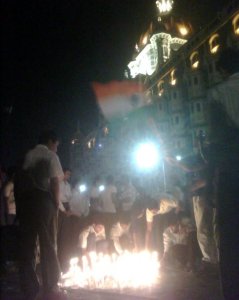
At the heels of 26/11, Pakistan charged seven people involved in the Mumbai atrocities today. The Virginia Quarterly Review has a four part article revealing the ordeal in harrowing detail and after reading it, I’m still stunned. On 26/11 last year I got a call from a friend born and raised in Mumbai who was flying out there that afternoon, he said his parents were fine but his voice was wrought by a despair I hadn’t heard from him before. He didn’t specifically say he was distraught or describe how he felt in detail, but i recognized the frustration instantly because I’d heard that voice before: from friends in Karachi who witness countless threats and acts of terrorism since 9/11. I identified immediately with my friends frustration and despair on a humanitarian level, and even further because although the perpetrators in Mumbai were allegedly trained in Pakistan, I knew they’d ultimately hurt Pakistani’s the most.
As India forges ahead economically and internationally, Pakistan is deteriorating. Terrorism has brought vanishing security that has perpetually halted foreign investment, stagnating the economy leaving no trickle down for the lower and middle class majority population who simultaneously realize a widening gap in their position vis a vis the wealthy. Terrorism has rendered governance in survival mode since 9/11 making leeway for decreased oversight and increased corruption, which was rampant to begin with.
A year after the Mumbai atrocities, we see Manmohan Singh hosted at the White House in elaborate fanfare with progressive talks on bilateral trade rooted in liberalism that is fitting for a country with roughly 8% growth in GDP and a middle class that’s now larger than our entire population in the United States.
Conversely, relations with Pakistani South Asia in light of that progress are a valid point of comparison because we have a strategic interest in both countries. More than ever, it’s apparent we have economically strategic interests with India, and security based interests in Pakistan. And like previous presidencies the Obama administration quickly realized the delicate art of balancing both interests given that either country feels progressive relations with the United States inherently comes as a direct expense of one another. Engaging India as it expands economically and Pakistan geopolitically for security’s sake (i.e. in the War on Terror and in the face of an ascending China) pose an opportunity for us to strike a creative balance in South Asia.
It’s not about who wears the crown, (“Taj”) in South Asian U.S. relations, it’s about engaging both sides for the long haul.
In Pakistan that means cooperating today for security’s sake and uprooting terrorism and fundamentalism for tomorrow. Key from there is not abandoning ship, but remaining engaged so that Pakistan too has a route to economic expansion in the future. Without security, viable development won’t take place. And so long as we are engaged in an Af-Pak war, our policymakers have a responsibility to establish a roadmap that is rooted in long term success. This is our chance to get it right in South Asia, and that begins with an intention for a permanent solution. Assisting Pakistan to navigate the rising tide of development in our globalized world could be the key to ensuring they remain a strategic, long standing ally.
Pervez Musharraf was on Fareed Zakaria GPS this morning discussing the Af-Pak situation in two segments. The second segment focused on Pakistan where Zakaria prefaced Q&A by reminding viewers that General Musharraf is an “authentic representation of Pakistan’s military” and that his comments will reveal that the situation in Afghanistan is rooted in a“60 year geopolitical rivalry that we just walked in to, and its between between India and Pakistan“. Sounded like grand stuff.
And Zakaria jumped right in. He began with questions on whether the Pakistan military is as committed to eliminating terrorists in the north who launch cross border attacks as they are to obliterating terrorists in the South who are responsible for domestic assaults. He said the military “never seems to get around to attacking North Waziristan who attacks India or Afghanistan because they were supported in the past”. Musharraff made clear that during his tenure, he insisted on drone technology needed to obliterate terrorists from both regions, especially given Baitullah Mehsud who assassinated Bhutto and that terrorists were never supported by the military or any government policy. He mentioned that ISI “ingress” in terrorist groups is standard procedure practiced by all Intelligence operations, clarifying that “ingress” is not be equated to “support”, rather it’s standard maintenance of contacts with such groups for the states advantage.
When questioned about the widespread notion that Al Qaeda leader Mullah Umar is in Pakistan, Musharraf said it’s “200% wrong” explaining Umar would have no interest in leaving a safe haven in the northern areas where Taliban has de-facto control for Quetta where US and Pakistani intelligence/ military roam rampant. It was a reasonable response and Zakaria’s questions sounded increasingly implicative.
Zakaria probed the notion saying that the “Afghanistan government and intelligence say he’s in Pakistan” to which Musharraff firmly explained “don’t talk about the Afghan government and intelligence. By design, they mislead the world, they talk against Pakistan because they are entirely under the influence of Indian intelligence”.
Wow, he just said it. It’s often documented in Pakistani media that Indian intelligence is widely responsible for insurgencies in northern areas of Pakistan and the province of Balochistan by way of material support, but rarely is that view expressed in mainstream U.S. media. Former Foreign Minister Sharifuddin Pirzada recently explained to me that warming of relations between Delhi and Kabul come at a direct expense of Pakistan because of such subversive, Indian led dealings with Afghanistan. Similarly, Musharraf explained he has provided “documented evidence” of this activity in the past.
From the first question on Pakistan’s commitment to uprooting cross border terrorism, to the question on Mullah Umar, Zakaria elicited Musharraf into discussion of a supposed “geopolitical rivalry” between India and Pakistan wherein Afghanistan is used as a “client state” by either nation as a buffer against, if not to subvert one another. And although I can’t say that is entirely untrue, Zakaria approached today’s interview with this preconceived notion, and overstepped neutrality by implicating Pakistan in the process.
Amidst drastic worsening of the Af-Pak situation with US forces suffering our deadliest months and Pakistani civilians and military bearing the brunt of terrorist assaults, Secretary Clinton arrived in full diplomatic force last week. She made media rounds sitting down for Q&A sessions with everyone from major news outlets to universities. But even the Clinton charm and expertise was met with vociferous skepticism. Before concerns on the Kerry Lugar bill could be adequately addressed, Clinton’s statements seem to have only riled increased trepidation in Pakistan:
Hamid Mir of GEO News peppered her with questions regarding illegally armed US diplomats roaming the streets of the capital and continued drone attacks. His questions reflect macro concerns that sovereignty is inherently undermined in cooperating with the United States. And at the Government college in Lahore, Secretary Clinton faced what I thought were even tougher questions:
Students identified a worsening War on Terror is akin to the Vietnam quagmire and suggested it’s time we focused on winning hearts and minds.
Another student echoed widespread skepticism of US/Pakistan cooperation citing failures of previous engagement during the Soviet Afghan War and how again “forcing Pakistan to take action that we might not want to take” is a legitimate concern among masses. Another said bilateral relations are marred by a subsequent “trust deficit” with Secretary Clinton responding that American’s have a similar lacking faith in Pakistan.
“Al Qaeda has had safe haven in Pakistan since 2002….I find it hard to believe that nobody in your government knows where they are and couldn’t get them if they really wanted to”
And that was just on security. On society and development she criticized “At the risk of sounding undiplomatic, Pakistan has to have internal investment in your public services and your business opportunities”
Ouch, thinks Pakistan. If Hillary’s mission was to rally support of cooperation with the United States amidst rapidly increasing skepticism of D.C.’s policies, the rhetoric has fallen short. In fact both Pakistani and American media are growing weary of the alliance:
Chris Matthews, in trademark rambunctiousness goes to town on Pakistan’s efforts in the War on Terror. But simplistic, irrelevant comments from his guests subtract from any substantive debate on the issue.
No offense Mr. Matthews, but just a brief look at a history book, closer reading of ground realities, or even quoting Hillary in context of the entire situation would have made for a more substantial segment. The panelists actually likened U.S engagement of Pakistan to a Sigfreid and Roy Act. It’s laughable and renders the aforementioned student questions more articulate and informative than this discussion.
Nonetheless, it seems former Pakistani President Ayub Khan’s book suggesting cooperation based on the idea of each being “Friends not Masters” is now a shared sentiment in this alliance . So the dilemma remains: increasing skepticism polarizes Islamabad and D.C. I just hope it will spur realization that winning hearts and minds on both ends is imperative.
Zainab Interviews the Honorary Sharifuddin Pirzada
Q & A BREAKDOWN
PAST LEADERS: Jinnah
2:39 – 3:17 – Former BJP Parliamentarian Jaswant Singh authored a book on Jinnah that is receiving a lot of controversy, having actually worked with Jinnah, can you share your thoughts on the book ?
3:20 – 4:42 – In recent interviews, Singh has said Muslims in India are “robbed of their psychological security” and basically downtrodden. He says what Jinnah should have done is left some advice for Indian Muslims who stayed back and didn’t migrate to Pakistan after partition, what do you think Jinnah might have said?
4:44-6:01 – He also refers to Jinnah as a “nationalist” not at all Anti-Indian, please expand
6:01-7:34 – Referring to politics, when Jinnah split from the Congress party eventually formulating a two state idea later in his career, were there any politics referring to Nehru or Gandhi that had an impact on decision making? Jaswant Singh makes a mention to some, what does your experience tell us?
7:35: – 8:15 – You’ve mentioned previously that Jinnah was a self made man, more details?
8:15 – 8:55 : Tell us about your experience with Jinnah, its a rare treat for us to have your insight
8: 55 – 9:22 – Further details, conclusion on Jinnah.
“Jinnah had the Charm of Churchill, Dignity of de Gaulle, Magnetism of Mandela, and Objectivity of Obama”
CURRENT LEADERS : Musharraf
9:23 – 10:47 – Shifting to current leaders now, lets talk about Musharraf. You’ve got great experience, tell us about your work with the former General and Leader of Pakistan.
10:48 – 11:55 – How did your work with Musharraf expand during his tenure?
12:56 – 13:45 – You served on the national security council & as senior advisor to Gen. Musharraf, tell us howthe context of national security in Pakistan changed after 9/11. Specifically what came on the agenda, what were the immediate concerns and interests and what drove the decision to behave the way Pakistan did at the time?
13:45 – 15:48 – Recent polls indicate a majority of pakistanis think Musharraf should be punished for treason as per laws under article 6 of the Constitution, how do you feel about that?
15:48 – 14:55 – Do you think it’s a valid case that Musharraf be tried for treason?
14:54 – 15:38 – Regarding an increasingly free media in Pakistan, please offer further insight
15:38 – 16:16 – There’s a contention that the currently free media be attributed to Benazir Bhutto’s regime wherein sateilite technology allowing expanded media was put in place, while others assign credit to Musharraf. Can you clarify this?
16:16 – 18:39 – Do you think it was the state of emergency and sacking of the judiciary that caused Musharraf to lose elections?
18:42 – 19:35 – Final question on Musharraf, what do you think his legacy would be?
“The Media is very free in Pakistan, and Musharraf is to be given a great deal of credit for that”
CURRENT LEADERS : Zardari
19:48 – 20:55 – Recent military achievements in SWAT and international trade deals penned by Zardari paint a somewhat rosy picture for the future, what are your thoughts on him so far?
US – PAKISTAN RELATIONS:
20:57 – 23:14 – There’s a US special envoy in the region, drone attacks continue, the west is pushing for rapid democratization and are heavily investing in counterterrorism through cooperation with Pakistan while Islamabad hopes to secure itself and expand economically in this engagement. But there’s a long history of cooperation but still a lot of skepticism on both sides, do you think current engagement with a new administration who promises more diplomacy will yield different results than we’ve seen in this alliance?
23:14 – 24:52 – What advice might you offer President Obama or the State department in terms of engaging Pakistan?
“Pakistan was member of SEATO and CENTO but certain conditions were not fulfilled and there is a strong section of Pakistan who has reservations with a cordial relationship with the United States”
PAKISTAN & THE MUSLIM WORLD
24:55 – 25:11 – Your position at the Organization of Islamic Conference?
25:13 – 25:57 – On the Israeli Palestinian issue, how do you assess the current two state solution that Obama has put forward? How viable is it?
25:57 – 26:25 – What is Pakistan’s diplomatic/official stance on the Israeli Palestinian Issue?e Islamic Conference
12:25 – 26:35 – What are the main priorities of the Organization of the Islamic Conference?
“The Palestinian Issue followed by Kashmir are of top priority to the Organization of Islamic Conference”
PAKISTAN BORDER RELATIONS : INDIA & AFGHANISTAN:
26:35 – 27:42 – Manmohan Singh & Prime Minister Gilani at the NAAM summit this summer agreed to bracket issues of Terrorism and move forward on peace talks and trade issues. Such rhetoric is not new, and might not reach fruition, so do you see anything being resolved in Kashmir anytime soon, without the help of the US?
27:44 – 28:44 – Elections in Afghanistan are being contested between Abdullah Abdullah and incumbent Karzai. Pakistan doesn’t seem keen on either because both signal a warming of relations between Kabul & New Delhi which is believed to come at a direct expense to Islamabad. How do you feel about that?
America can facilitate peace talks between India and Pakistan on Kashmir, but on the whole, people of Kashmir are still suffering and struggling. The approach of prime ministers has been positive, but an extremist element in India exists which doesn’t want this. To stop suffering in Kashmir, a solution must be reached.
PAKISTAN’S INTERNATIONAL FUTURE:
28:44 – How do you see geopolitics playing out in the next decade for Pakistan, given amplified US presence, including super embassies being constructed in Pakistan/Afghanistan, perpetually stalled relations with India, a very likely nuclear neighbor in Iran, and increasingly influential China and polarized Russia, what does Pakistan look like ten years from now?
“Pakistan in the next ten years must concentrate on democratic set up, economic development & maintaining cordial relatoins with Islamic countries. There are two great friends of Pakistan: Saudi Arabia, the other is China. That’s a good starting point”
Speaking to my grandmother whose in Karachi yesterday morning, she explained my cousins stayed home from elementary school as most schools had shut down this week. Karachi is the the largest, most bustling city in Pakistan, and despite being situated in the south, far removed from the hotbed of militants in northern Waziristan, terrorism has gradually spilled over from Afghanistan, crept into Pakistan and paralyzed the country. My grandmother described a city laden with tension where people live in a constant climate of uncertainty and increasing fear.
It was pressing to hear her tired voice describe the situation with a kind of detachment. Her tone was passive: an indication of hopelessness. And that hopelessness is not in reference to obliterating terrorists, because there’s little speculation on a military capacity to wipe out at most, 10 thousand terrorists. Rather, her passive tone is a worn out sound echoing 62 years of statehood rooted in insecurity. She’s seen Pakistan through three wars fought with India, including a civil war in the 70’s resulting in a cession of East Pakistan, one of the worlds largest refugee problems in the 1980’s and now the War on Terror fought on home soil. Her passivity is an exhausted acceptance of perpetual political insecurity.
The aforementioned video shows a younger generation, not yet exhausted. They’re shocked, frustrated by what’s happening in their country as they passionately raise their voices in protest against extremist Islamic groups who oppress the country.
Most ironic is that extremist groups bombed the Islamic University in Islamabad where these young men study. Testimony to how grossly extremists propagate an inaccurate view of Islam that terrorizes Muslims everyday.
Which brings me back to how imperative it is that Pakistani and US forces focus on uprooting and not just obliterating terrorists. Pakistan is home to the worlds 6th largest population, and the second largest Muslim country. That’s a strategic demographic in the War on Terror and for future international security. Ensuring terrorism is uprooted in the long term will require a sustained, multifaceted, military and non military approach. Few will argue against the necessity of economic development, the question really is how to pay for it. I’ve mentioned before that the Kerry Lugar bill is a fair, but insufficient attempt at doing this, and ultimately, Pakistan itself must uproot terrorism.
This critical time is an opportunity for Pakistani politicians to take responsibility and bring forth a detailed agenda that rallies current masses. A specific, well publicized plan of action, accepting but not relying on outside assistance is Pakistan’s best hope at engaging its citizens to wipe out terrorism for the long haul. Hopelessness, frustration and desire for Pakistani’s to develop economically and free themselves from terror poses a widespread opportunity to supplement the military offensive with civil support. That support is the capital with which to begin an agenda to uproot terrorism.
Grassroots organizations, women’s and educational groups whose ideologies run counter to extremist groups should be actively highlighted by the media and politicians.
A more proactive approach that is clearly visible works on two levels. One, it aggregates support in the country against extremism setting a future stage for more moderate masses. Secondly, it alleviates international fears of Pakistan becoming a failed state. Because not only do citizens like my grandma need hope, but the international community also watches in concern for Pakistan to define itself in unity and diametrically against extremism.
What happens when a majority of one country’s citizens opt for martial law but the democratically elected government in power including judicial, executive and legislative branches are against a military takeover? It’s quite the political conundrum because either side offers legitimate democratic authority, but they’re diametrically opposed. A rational answer is to let the democratically elected government fulfill it’s term and allow citizens to elect politicians to office who will support martial law in the next term. That might work in a fully functional democracy backed by institutions that can uphold legitimacy and granted the state is sufficiently secure. However, in light of decreasing security, severe economic downturns and age old skepticism of U.S. actions in Pakistan, ever so gradually the country shifts it’s gaze toward the military.
Decreasing Security :: To offer partial explanation in a nutshell: Since 2001, terrorists fleeing Operation Enduring Freedom in Afghanistan, spilled over into Pakistan at the nebulous northern border areas which are historically autonomous from federal regulation. The fact that Pakistan already housed one of the worlds largest refugee populations allowed this spillover a massive and destitute demographic from which to exploit support. As a result, we now see unprecedented terrorism in Pakistan where Al Qaeda and the Taliban had no significant presence prior to 9/11.
Skepticism of U.S.’s Role in Pakistan:: Since the inception of Pakistan in 1947, bilateral realations with the United States have been defined by cooperation wherein Pakistan served as a proxy for U.S. Containment throughout the Cold War (i.e. security pacts like SEATO, CENTCOM, then aiding our Afghan led defense against Soviet incursions in the 1980’s). In exchange, Pakistan’s military with U.S. support, bolstered itself as the strongest, most efficient and stable institution in Pakistan. Some argue civilian governments and democratic institutions were thus never given an opportunity to compete with such a well funded, strongly backed military. And therein we find multifaceted dimensions that help explain the controversy over current U.S. support of Pakistan. Former Pakistan to U.S. ambassador Maleeha Lodhi describes the Kerry Lugar bill:
“the offending part of the legislation sets up the country as hired help and puts the military in the dock, presumed guilty on many counts and having to prove its innocence to Washington”
Pakistan is “hired help”, that’s the crux of skepticism on the Kerry-Lugar bill. Concern is rooted in a long history of cooperation with the United States that some argue created a behemoth military institution costing them a fair chance at democracy. In attempt to address that very concern, the Kerry Lugar bill mentions no military aid in exchange for cooperation on the War on Terror, unlike previous assistance packages from the Cold War. Ironically, bleak affairs in Pakistan now which are partially a result of pervious cooperation, particularly during the Soviet Afhgan war, prompt arguments that the military is exactly what needs support right now. Thus, the Lugar Bill receives not only skepticism from Pakistan’s strongest institution, but increasingly the public.
Although Secretary Clinton and Senators Kerry and Lugar have made no indication of altering the bill, to avoid future skepticism and potential resentment of U.S. involvement in Pakistan it could be wise to make changes so as to not sideline the military at this critical period in our War on Terror. Unlike previous Republican presidencies, the Obama administration is committed to dealing with civilian governments in Pakistan. It’s a noble idea and even though i don’t suspect that as the military gains legitimacy the civilian government will collapse soon, we should think twice before riling such concern over a bill that has just a 5 year life span. Central and South Asia are critical regions for our interests and we may need to engage strategically positioned Pakistan in more years to come. So a backlash by the most powerful institution in that country is something we should anticipate, and work actively against.
“Tonight we celebrate a great religion and its commitment to justice and progress. We honor the contributions of Americas Muslims and the positive example they set for so many”
No matter how one feels about Washington’s foreign policy, U.S. hegemony, or Americans in general, it’s hard to deny the appeal of our President’s sharp diplomacy. From making his first call in office to Palestinian Authority President Mahmoud Abbas, to his landmark speech in Cairo marking “A New Beginning” in U.S. relations with the Muslim world to hosting the annual White House Iftar, Barack Obama’s message to Muslims is drastically different than previous administrations. This administration extends a mature attempt to engage Muslims at home and abroad.
I use the word mature because previous presidencies naively boxed themselves in an almost solely hostile rhetoric of The War on Terror or simply lacked foresight to effectively convey that America is not adverse to Islam. Lacking foresight is critical because Islam’s global reach puts Muslims atop the list of the worlds fastest growing religions . So when President Obama shifts diplomatic rhetoric to a more mature tone with the Muslim world it’s to ensure progressive relations with this large and increasingly strategic demographic. And that’s why I think President Obama’s overtures are genuine. They fulfill our long term interests in garnering positive relations with a rapidly growing and influential Muslim world.
Regardless of whether his diplomatic overtures vastly alter policies, they are highly symbolic, and perceptions matter. American political discourse in the past referring to religion most often talked about “Judeo-Christian” values and beliefs without a mention of Muslims, even though Islam is the second largest religion in the world. Couple this with a political mis-focus on only extremist factions rather than on the moderate, majority of Muslims, just makes President Obama’s more astute diplomacy that much more valuable. Rather thanalienate Muslims across the globe, he shifts the context of US engagement to one of inclusiveness.
In his Ramadan greeting President Obama repeatedly emphasizes that U.S. relations with the Muslim world draw on commonalities citing rituals such as fasting, values of tolerance, advancing justice and respect as mutual goals that can be reached through cooperation. He specifies expanding education, fostering entrepreneurship, collaboration on science and eradicating global illnesses as instances where the US and Muslim world can engage toward more progressive relations. Not a bad idea. Let’s hope that liberal theories of humanity prove true and these ideas come to fruition.



 Zainab B. Jeewanjee
 Zainab Jeewanjee